Editorial Board
MusicWeb International
Founding Editor Rob Barnett Editor in Chief
John Quinn Contributing Editor Ralph Moore Webmaster
David Barker Postmaster
Jonathan Woolf MusicWeb Founder Len Mullenger
Buy
through MusicWeb for £18 postage
paid (sale or return).
Johann Sebastian
BACH(1685-1750)
Six Sonatas and Partitas for solo violin, BWV 1001-1006 (c. 1720)
CD 1
Sonata No.1 in G minor, BWV 1001 [14:43]
Partita No.1 in B minor, BWV 1002 [28:58]
Sonata No.2 in A minor, BWV 1003 [20:55]
CD 2
Partita No.2 in D minor, BWV 1004 [28:23]
Sonata No.3 in C major, BWV 1005 [20:46]
Partita No.3 in E major, BWV 1006 [18:14] Viktoria Mullova (baroque
violin)
rec. 18-19 March 2007, 20-22 October 2008, Bolzano, Italy. DDD ONYX CLASSICS 4040
[64:50 + 67:32]
I have been brought up on two principal recordings of the Sonatas
and Partitas: Arthur Grumiaux from 1960 on Philips Classics
Duo 438 736-2 and the 1973 version from Nathan Milstein on Deutsche
Grammophon 'The Originals' 457 701-2. I played these
recordings over and over again during my university studies
having a slight preference for the account by Milstein for its
additional refinement. In the early 1990s Mullova recorded the
3 Partitas on Philips 434 075-2 on a modern strung violin
but not the 3 Sonatas.In the light of
her discovery and subsequent embracing of period instrument
performance Mullova would rather people now forget about the
Grammy-nominated Philips recording. Having heard this quite
remarkable new Onyx set I can quite understand her position.
I am still basking in an afterglow of satisfaction.
This is not the first recording to use using period instruments;
not by any means. Probably the finest account has been from
the impressively sensitive Rachel Podger on Channel Classics
CCS SEL 2498. There are also two fine Naxos sets to consider
from baroque violinists Jaap Schröder on 8.557563/64 and
Lucy Van Dael on 8.554422/23.
From her formative years in Russia as a student at the Moscow
Conservatoire and for many years as a performer Mullova followed
the tradition of playing the modern stringed violin and bow.
Her Moscow teachers had laid down strictures for performing
Bach. Mullova explains, “they were based on a widely-held
approach of the time that combined a standardized, beautiful
sound, broad, uniform articulation, long phrasing, if possible,
and continuous vibrato on every note, in imitation, they used
to say, of an imaginary organ.”
From not even being aware that a period bow existed Mullova
has gradually developed her passion for Baroque and Classical
music performed on period instruments. Her epiphany occurred
following an inspirational meeting in Paris with Baroque specialist
the bassoonist and continuo player Marc Postinghel. Since then
she has immersed herself in early music, working with several
outstanding period instrument specialists: Ottavio Dantone,
Giovanni Antonini, Andrea Marcon and Giuliano Carmignola.
I recall Mullova's splendid 2001 recording from St. Jude's
Church, London of Mozart's Violin Concertos 1, 3
and 4 both as soloist and director of the period
instrument Orchestra of the Age of Enlightenment on Philips
470 292-2. There she used a 'Jules Falk' Stradivarius
from 1723 with gut strings and a period bow. For Onyx
she recorded in 2004 at Cremona, a superb disc of Vivaldi's
5 Violin Concertos again using her cherished 'Jules
Falk'. This was with the period instrument ensemble Il Giardino
Armonico under Giovanni Antonini.
I have fond memories of her 2007 Vivaldi collaboration at Toblach
in the Italian Dolomites with Baroque violinist Giuliano Carmignola
and the Venice Baroque Orchestra under Andrea Marcon (Archiv
Production).
On this new Onyx recording Mullova now favours her 1750 Giovanni
Battista Guadagnini violin with gut strings, tuned down to A415
Hz. She uses a contemporary copy of a Baroque bow by Italian
maker Walter Barbiero. Mullova does not take the authenticity
obsessively far having her Guadagnini in a modern set-up that
she feels does not adversely affect her interpretations.
For those interested in a few historical details Johann Sebastian
Bach probably commenced writing this collection of 6 Sonatas
and Partitas for solo violin during his tenure with the
Duke Wilhelm-Ernst of Sachsen-Weimar. In 1717 Bach was forced
to leave the Ducal Court at Weimar. It was in 1720 whilst employed
as Kapellmeister by Prince Leopold of Anhalt-Köthen at
Köthen that Bach completed the set.
The first disc here commences with the Sonata No.1 in G minor
cast in the traditional four movement church sonata form.
In the G minor score I was struck by the aching tenderness
of the opening Adagio. The following Fuga: Allegro
feels like a depiction of an unrelenting struggle against humanity.
The short Siciliana is coquettish and nervy at times
and I could easily picture a wooing ritual at the Ducal Court.
Boisterous and extrovert, Mullova's playing of the concluding
Presto is breathtaking with a real sense of risk-taking.
The Partita No.1 in B minor is designed in chamber sonata
form as an eight movement dance suite.To open the score
the effervescent and elegantly performed Allemanda convincingly
depicts a dancing scene at a Court Ball. Infused with incense,
an air of sacred mystery hangs densely over the first Double.
In the youthful exuberance of the Corrente one can easily
imagine a scene of children of the nobility playing in the Court
grounds. Breathtakingly fast, almost wilful playing from Mullova
in the second Double marked Presto takes the listener
to the brink of frenzy. By contrast the languid relaxation of
the Sarabande is evocative of a lazy summer's day
slumber. Strict and forthright Mullova demonstrates the finest
manners in the third Double and with unrestrained vigour
the joyful clamour of freedom is paramount in the Tempo di
Borea. In the fourth and final Double Mullova provides
whirling music of dizzying abandon.
The Sonata No.2 in A minor opens with movement marked
Grave significant for its mournful nature with aspects
of reflective affirmation. Mullova's bright and uplifting
playing shakes off the cobwebs in the Fuga resisting
the temptation for even quicker speeds. I loved the exhilarating
flourish for a few moments at 6:54. Mullova dedicates the tender
and poetic Andante to her daughter Katia. Here I felt
the music evocative of a narrative of hope and justice for mankind.
There is brisk playing from Mullova in the final movement Allegro
who twists, kneads and shapes this music of virile athleticism
into an endless reverie.
The second disc opens with the five movement Partita No.2
in D minor. The final movement of the D minor Partita
isthe monumental Ciaconna (Chaconne)
designed as a theme and series of variations. Considered by
many to be the summit of solo violin repertoire the Ciaconna
is often played as an independent score. Of a disproportionate
length to the other movements it has been suggested that the
Ciaconna was written in remembrance of Bach's wife
Maria Barbara. According to musicologist David Ewen the Ciaconna
gives, “testimony to Bach's capacity to bring to
his polyphonic writing whether for violin or cello, a wealth
of emotion as well as thought.” ('The Complete
Book of Classical Music', Pub: R. Hale, London, 1965).
An Allemande opens the D minor Partita with an
assured Mullova conjuring up a haunting atmosphere. In the following
Corrente the soloist imparts a safe and comforting world
of carefree ecstasy that contrasts with the somewhat starchy,
serious and introspective central movement Sarabanda.
Blistering playing of white-hot intensity from Mullova in the
Giga demonstrates awesome technical mastery. In the darkly
brooding character of the mighty Ciaconna I was struck
by the astonishing playing, rapt with intense concentration
and generating terrific emotional impact. Of the many highlights
I especially enjoyed the fiendishly difficult fiery run at 12:49
- effortlessly played and completely glorious too.
The Sonata No.3 in C major opens with an Adagio
of a spare almost saturnine quality. In the extended Fuga
Mullova communicates this profound and humane music as a
powerful quasi-devotional utterance. I love the way Mullova's
Guadagnini sings with aching tenderness amid the leafy light
and shades of the Largo. In the final movement Allegro
assai Mullova surges the music forward fervently with the
radiant energy of a flaming beacon.
The final disc of the set is the Partita No.3 in E major
a seven movement score and the shortest Partita of
the trio by some ten minutes. The well loved Preludio
is often played as a separate recital piece. Technical distinction
is a striking feature of Mullova's magnificent playing especially
when woven with this elevated level of exhilaration and colourful
drama. A distinct melancholy pervades the Loure without
ever becoming cloaked in unwelcome sentimentality. Mullova sensuously
phrases the extremely popular Gavotte en Rondeau a gravely
beautiful outpouring. This is followed by the first Menuet,serene and mysterious in colour lavished with assiduous
care for blend and balance. The second Menuet is gracefully
performed with a distinctive purity and grace that invites admiration.
I admired the glistening freshness of the short Bourrée
abundant with vitality and rhythmic zest. The E major
Partita and the whole programme concludes with the Gigue
marked by Mullova's uplifting and determined playing of
such striking presence that it reminded me of the boughs of
a mighty oak resisting a determined gusty wind.
I first became aware of this Mullova recording last week, alerted
by the large amount of attention it was receiving at the listening
booths at the renowned 'Ludwig Beck' department store
in Münich. There I had time to hear a few excerpts on their
TEAC player and Pioneer headphones and was immediately struck
by the outstanding sonics. From subsequent hearings on my own
set-up I can report a cool, crystal-clear sound with superb
balance. Lacking in an informative essay about the actual scores
this double set from Onyx is otherwise beautifully presented.
There are a select number of very special discs of masterworks
in my collection. I treasure these above all others; my 'Desert
Island' discs, if you like. In this list I would include
sets of the Chopin Ballades and Scherzos from
Artur Rubinstein on RCA Red Seal Living Stereo; both the Haydn
and Beethoven complete Piano Trios by the Beaux Arts
Trio on Philips; J.S. Bach complete Sonatas for Violin and
Harpsichord with Arthur Grumiaux and Christiane Jaccottet
on Philips; Mendelssohn's complete String Quartets from
the Henschel Quartet on Arte Nova;Mozart Piano Sonatas
byMitsuko Uchida on Philips; J.S. Bach The Well-Tempered
Clavier by harpsichordist Kenneth Gilbert on Archiv Produktion;
Beethoven complete String Quartets by the Takács
Quartet on Decca and Schubert Winterreise performed by
Dietrich Fischer-Dieskau and Jörg Demus on Deutsche Grammophon.
I consider this life-enhancing Onyx set to be in the same elevated
league. Beautiful, expressive and often haunting this timeless
music is performed with the flaming power of a blast furnace.
Throughout the set the glorious timbre of the Guadagnini and
Mullova's imperious playing are intoxicating. This is a
very special recording - one to treasure. I wouldn't be
surprised if this became one of the great 'classics'.
























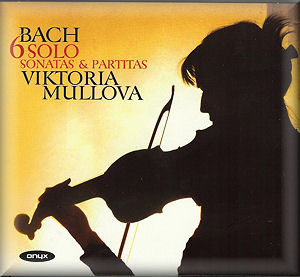
 Viktoria Mullova (baroque
violin)
Viktoria Mullova (baroque
violin) 
