Of Bach’s Cello Suites, there has been
such a plethora of recent recordings lately that greatness
(Queyras) and extroverted excellence
(Lipkind)
relegated the merely superb (Klinger)
and the very good (Gastinel)
(never mind the dishwater variety — Isserlis)
to shadowy spots they didn’t necessarily deserve and wouldn’t
have received had the timing been better. Timing is excellent,
however, for Viktoria Mullova’s Sonatas & Partitas because
there hasn’t been an important recording issued since Julia
Fischer’s (Pentatone) and Gidon Kremer’s
on ECM in 2005, and Christian
Tetzlaff’s on Hänssler in 2007.
Her recording is big news, then, and better
yet: it’s good news. In brief and thoughtful liner-notes
that peel right through to the essence of why she added hers
to the long list of violinists’ names on the Sonata & Partita
roll call, she outlines her musical transformation as it
relates to Bach. She has come from a decidedly old-school
approach - she describes it as a sort of Russian robotic
approach with continuous vibrato,
sans liberties,
and little articulation - to what is for all theoretical
purposes a Historically Informed Performance account. She
even plays with gut strings and a baroque bow, one or the
other or both of which she has been doing for years in all
repertoire where appropriate. Her recordings of the Beethoven
and Mendelssohn Concertos are on gut string and she uses
the baroque setup for her recent Bach and Vivaldi recordings.
As with her
latest
Bach release and the
Vivaldi
concertos on Archiv, she is playing a 1750 Guadagnini
(and a Walter Barbiero baroque bow) tuned to A=415, not her
1723 "Julius Falk" Stradivari.
Listening to it at first, my first response
to it was rather cool. Her playing is not always beautiful.
Short bow strokes in the D minor
Sarabande certainly
don’t aim for prettiness. The sound is close, but with lots
of room around her, direct but spacious, allowing the sound
to bloom, and hiding nothing — for better
and worse.
I found it occasionally too close, leaving me with the feeling
of standing a little too close to a painting that I admire.
Her former rigor in Bach — perhaps even stiffness — is gone,
although that approach I actually find myself appreciating.
It wasn’t until direct comparison that
the scales fell off my
ears, revealing not only relative
excellence but greatness. If upon the first few listens she
didn’t seem to be delivering something truly out of the ordinary,
now she shines. I matched her against Tetzlaff’s
new recording and — difference of pitch apart — the dissimilarities
are vast and instructive. The relative lack of ambience gives
a yet more immediate, more contained impression of Tetzlaff’s
instrument: presumably his modern Guarneri del Gesu copy
by Peter Greiner. When listened to on its own, Tetzlaff’s
Hänssler recording is striking to a degree, but the allure
is lost: the violin sound comes across as squeaky, the playing
constrained and lacking spontaneity.
Mullova works hard to get momentum by
way of her rather aggressive rhythmic dotting and double-stopping,
enjoying the hard edges that Bach offers. Although it doesn’t
quite
sound like it, it
feels more like Nathan
Milstein than
anyone else. The touches of gentleness amid that overt vigor
betray the amount of thought put into making the recording,
making Tetzlaff’s approach seem rather academic and deliberate
(check the
Siciliana) in comparison. Mullova really
does play with guts — not just gut strings — which gives
the Sonatas & Partitas a feel of being lived rather than
just read. When Mullova is faster - throughout most of the
First Sonata - she strikes as more pointed and lively. When
she is slower (most extreme—4:04 to 2:21—in the first
Double),
less trying to master a technical challenge than communicating
the spirit of the music. In the second
Double, taken
fast by both but faster still by Tetzlaff, the latter comes
perilously close to sounding like a sewing machine.
With first impressions manifesting themselves
as hardened opinions, the differences between her and Tetzlaff,
which I originally thought would be small despite Mullova’s
quasi-HIP approach, became ever more obvious. Painfully so,
after a while. After a while, the audio quality of the Hänssler
recording gives you the impression of being thrown back 25
years. And the interpretation becomes more and more uninteresting.
Not skipping ahead whenever it was Tetzlaff‘s turn grew ever
more difficult. When Mullova came back on - say, with the
A minor
Fuga after Tetzlaff’s
Grave - it felt
like relief.
That the differences are — or become — so
striking, is all the more surprising since I cherish Tetzlaff
in general and cherished his Bach in particular. This drop
in appreciation isn’t just a matter of appreciating a particular
interpretive style, either. And that’s despite some terrific
instances on his part—the A minor
Allegro, D minor
Giga,
and his
Ciaconna among them. Spot-light comparisons
with other favorite recordings did not yield the same discrepancies
despite being very different from Mullova. My comparisons
were: Milstein on
DG, my eternal touchstone; Podger, my
HIP-standard bearer; Fischer,
my favorite among modern, honeyed versions. Especially Julia
Fischer offers drastic contrast and yet she delights equally.
Only Shlomo Mintz’s mellifluous account might be further
from Mullova than Fischer.
Mullova, for all her HIP-training and
gear, will not replace Rachel Podger as the favorite of that
particular approach: there is modern spirit to it all that
makes it stand too tall and too proud to be a vehicle for
the authenticists’ ideology. Nor will she end all arguments
on style with this HIP-means/modern spirit approach. That’s
incidentally not what a recording is intended or supposed
to do. What Mullova will achieve, however, is as much a splash
in the world of Sonata & Partita connoisseurs as Fischer
created, and that by wonderfully different means. The time
it took to get to appreciate, like, and finally love this
recording was well invested.
Jens F. Laurson
























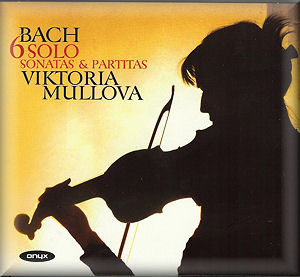
 for details
 Viktoria Mullova (violin)
