For this release Archiv have secured the services of Viktoria
Mullova and Giuliano Carmignola; two of the most renowned violinists
on the period instrument scene today. This is their first collaboration
and I was delighted that they have chosen to record Vivaldi’s
rarely heard Concertos for two Violins. Immediately
noticeable is the appealing timbre of the two solo violins. Mullova
plays her 1750 Guadagnini and Carmignola a 1732 ‘Baillot’ Stradivarius, lent to him for this recording
by the Fondazione Cassa di Risparmio in Bologna.
Mullova studied at the Central Music School of Moscow
and the Moscow Conservatoire in the city of her birth. She was
awarded first prize at the 1980 Sibelius Competition in Helsinki
and also won Gold Medal at the Tchaikovsky Competition in 1982.
In 1983 she audaciously defected from the Soviet Union to claim
political asylum in Sweden before quickly moving to the USA.
She made her name making recordings
of standard repertoire using modern instruments before switching
her allegiance to a baroque violin with a period bow. I admire
her recording on period instruments of five Vivaldi violin concertos
with Il Giardino Armonico under Giovanni Antonini for
Onyx.
Another favourite authentic instrument recording is Mullova’s performance
and direction of the set of Mozart violin concertos 1,
3 and 4 with the Orchestra of the Age of Enlightenment on Philips
470 292-2.
The Treviso-born Carmignola has been a professor of violin
at the Venice Conservatory for over ten years. In 1999 he was
appointed professor of violin at the Lucerne Hochschule and
is currently a professor of music at Siena’s
Accademia Musicale Chigiana. Several of Carmignola’s period
instrument recordings have been released to considerable acclaim.
Of these I have especially enjoyed the set of Mozart violin
concertos with Orchestra Mozart under Claudio Abbado on Archiv
Produktion.
I
admire Carmignola’s two discs of previously unrecorded Vivaldi
late violin concertos with the Venice Baroque Orchestra under
Andrea Marcon for Sony Classical 87733 and 89362. Also for Sony
Classical, Carmignola’s version with the same forces of the
Four Seasons on SK90391 (expanded edition with Op. 3
Nos. 10 and 11). Again for Archiv
Produktion I have a great regard for Carmignola’s
premier recordings of five Vivaldi violin concertos with Andrea
Marcon’s Venice players on 00289 477 6005.
Undoubtedly
the pioneering interpretations of Vivaldi and late-baroque music
in general using period-instruments were dictated to by the
severe limitations of the authentic instruments. This must have
felt so restricting to the players; as if they were all wearing
straitjackets. Consequently, performance style often came across
as technically mechanical, rather lacklustre, frequently insipid
and even sterile. Today the finest period instrument performance
specialists such as Mullova and Carmignola
can explore and exploit the strength of their period
instruments rather than feeling constrained by the weaknesses.
This increase of technically proficiency has permitted a freer
interpretative approach, the successful fruits of which we hear
on this disc.
Compared to his violin concertos - he wrote some 250 in the genre -
Vivaldi’s Concertos for two violins, strings and basso continuo
have been sorely neglected in performance and in the recording
studio. Most of Vivaldi’s Concertos for two violins are from the collection of
450 manuscripts housed in the National University Library in
Turin. The six presented here are good examples of what Lindsay Kemp describes in
the accompanying essay as demonstrating:
“… for the most part Vivaldi’s usual method
of writing for two soloists on similar instruments: rapid interchanges of phrases of melodic fragments which echo,
overlap and swap over with each other, alternating with passages
of parallel motion, almost invariably euphonious …”.
The first Concerto is RV 516. It opens and closes with brisk
and robust outer movements. The central movement is a languid
Andante with continuo accompaniment. The D major RV 511
has a vivacious opening Allegro molto, preceding
a meditative Largo and closing with an Allegro that provides a powerful
burst of energy. In RV 514 I was struck by the wonderfully uplifting
Allegro non troppo. The Adagio has a dark almost
mysterious character and the score concludes with a dance-like
Allegro. RV 524 commences with a rich and robust Allegro.
With basso continuo accompaniment the Andante has a rather
unsettled quality that contrasts markedly with the lively and
buoyant Allegro. The opening movement of RV 509 is marked
Allegro ma poco e cantabile a dark-toned movement with
suggestions of menace. With basso continuo accompaniment the
Andante molto provides a tender conversation between
the two violins. The closing Allegro is rich, strong
and determined. The closing Concerto on the disc RV 523 is in
A minor and opens and closes with light, bright and lively outer
movements that share a similar character. I enjoyed the Largo accompanied by basso continuo, especially the wonderful interweaving
between the two violins.
Founded
in 1998 the Venice Baroque Orchestra under the direction of
Andrea Marcon are one of several outstanding period instrument
ensembles that have come to prominence at the forefront of the
late-baroque scene in the last ten or so years. On this recording
the Venice Baroque Orchestra employs fourteen players, all stringed
instruments, with founder Marcon directing from the harpsichord.
The
South Tyrol of the Dolomites is the
location for this outstanding recording made at the Gustav Mahler
Auditorium of the Grand Hotel at Toblach. The closely recorded sound
is first class, vividly clear and well balanced. The essay in
the booklet is to a good standard.
Mullova
and Carmignola provide one of the most consummate displays of
period instrument playing that I have heard. True masters of their
instruments.
Michael Cookson
























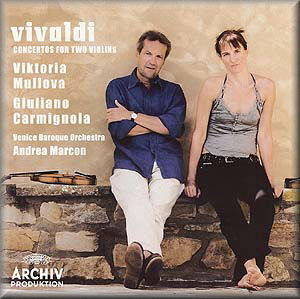

 Viktoria Mullova, Giuliano Carmignola (violins)
