The eminent baroque violinist Giuliano Carmignola, a
player so frequently associated with recordings of his Italian
countryman Vivaldi, is here teamed up with
the gifted young players of Orchestra Mozart, the
Bologna based ensemble. It is not entirely clear from the
information in the booklet if the orchestra is playing
on period instruments. Some commentators in various publications
have been uncertain too. Concertmaster of the Orchestra
Mozart, Raphael Christ has been kind enough to clarify
the situation for me, “
Yes, the entire orchestra is
playing on period instruments including the winds (
oboes,
horns, flutes).”
An enviable contrast is made by the renowned and charismatic Claudio
Abbado, a conductor not generally associated with period
instruments, who provides a wealth of experience and security
of direction to the proceedings. Carmignola’s association
with Maestro Abbado goes back to 1971, when as a then recent
winner of the Vittorio Veneto competition, he was asked
to play as soloist with the Maestro’s Orchestra della Scala.
The Treviso-born Carmignola has been a professor of violin at the
Venice Conservatory for over ten years. In 1999 he was
appointed professor of violin at the Lucerne Hochschule
and is currently a professor of music at Siena's Accademia
Musicale Chigiana. Renowned as a stylish player; as stylish
as the fine Romeo Gigli suits that he is often photographed
wearing. Without any hint of pretentiousness Carmignola’s
playing is classy with an innate serious professionalism,
as I recall from the year 2002 at Carmignola’s BBC Proms
concert when disturbed by noise from a member of the audience
he turned around and glared towards the perpetrator.
Carmignola
has released several outstanding discs of Italian baroque
music in recent years and is best known for his Vivaldi
interpretations: see my reviews of Sony
SK89362 &
SK87733 and
Archiv
4776005.
In addition Carmignola has recorded
The Four Seasons to
significant acclaim with the Venice Baroque Orchestra under
the direction
of Andrea Marcon on Sony SK 51352.
Although a sticker on the cover to this disc states, “
Carmignola’s
first recording of Mozart’s violin concertos”. Carmignola
is, however, no stranger to the these Mozart scores having
previously recorded the complete set in 1997 with
the chamber orchestra Il Quartettone directed by Carlo
de Martini. Carmignola was playing a 1733 Pietro Guarneri
on the recording produced at San Martino, Italy on Brilliant
Classics 92884 (c/w 2
Rondos, K261, K269 and
Adagio, K373) (see
review).
All five of Mozart’s violin concertos were written during his extremely
difficult period of engagement as composer to the court
orchestra of Archbishop Colloredo of Salzburg. It
is not certain if the set was intended for his own use
or for that of Salzburg Court Orchestra leader Antonio
Brunetti. For many years it was generally thought that
Mozart had composed all five violin concertos in 1775,
however, it is generally acknowledged that Mozart wrote
the
Violin Concerto No. 1 in B flat major,
K207 as early as 1773; when he was just seventeen.
From the disc timings one notices that Carmignola and Abbado have
elected to employ very swift tempos across the majority
of the movements. The opening score on the set is the
Violin
Concerto No. 1 in B flat major, K207, a work so infused
with an abundance of melody. Carmignola effortlessly, with
assurance, displays the considerable lyrical invention
of the score. One notices that the
Adagio is taken
less slowly than the majority of the five versions that
I used for comparison purposes and conversely the
Presto is
exceptionally quick.
In some quarters the
Violin Concerto No. 2 in D major, K211
is acknowledged as the least adventurous of the set. The
Allegro
moderato is briskly taken. The beautifully refined
Andante is
gloriously played by Carmignola and the
Rondo,
finale has
an abundance of exuberance.
Generally acknowledged as the favourite concerto of the set the final
work on disc one is the
Violin Concerto No. 3 in G major,
K216. The
G Major score is sometimes known as the ‘
Strassburg’ as
the third movement contains a rustic dance melody from
a popular song of the day associated with the Alsatian
city of Strassburg. Carmignola conveys a degree of intimacy
and charm in the exuberant opening
Allegro. Although
the least slow of all the versions I know, the
Adagio,
which feels like it has evolved from a feeling of gracious
sentiment, contains a dreamy quality with Carmignola providing
a feather-light touch.
The opening work on disc two is the
Violin Concerto No. 4 in D
major, K218. Briskly interpreted by Carmignola and
Abbado, Mozart’s long, flowing melodic lines are bold
and crisply played by Carmignola. The interpretation
of the sturdy
Allegro is not without elegance,
the
Andante cantabile is given a radiant performance
by Carmignola and I loved his sheer boldness in the
Rondeau,
finale.
Throughout the
Violin Concerto No. 5 in A major ‘
Turkish’,
K219 one notices Carmignola’s considerable intensity of
expression. The very swift
Allegro aperto is performed
by Carmignola with freshness and vitality and the briskly
taken final movement
Rondo contains a fleet and
picturesque
alla turca section, which gives the
score its nickname.
There are a large number of recordings of Mozart’s
Violin
Concertos in the catalogues some of them complete
sets. The finest collection of all five concertos, that will especially
appeal to the listener who
prefers modern instrument performances, is unequivocally
that from Arthur Grumiaux and the London Symphony
Orchestra under Sir Colin Davis
on the Duo Series from Philips Classics 438 323-2 (c/w
Adagio,
K261;
Rondo, K373;
Sinfonia concertante,
K364). These perennially fresh performances are wonderfully satisfying, being especially
beautifully played with an abundance of vivacity and
expression, together with an appealing purity of tone.
Grumiaux made the recordings in London between 1961-64
and the near fifty year old sound quality, in their digital
transfers, stands up remarkably well. I would nominate
this Grumiaux set as indispensable to any collection
of serious music.
I have also enjoyed the digital recordings of the complete set of
Mozart
Violin Concertos with
Thomas Zehetmair
as soloist and director of the Philharmonia Orchestra.
Recorded in 1990 and 1991 at the famous Snape Maltings
Concert Hall at Aldeburgh for Teldec Classics, Zehetmair
demonstrates an impressive affinity for these Mozart scores
(Warner Classics, Apex 2564 64329-2). Included
on this Zehetmair set
is the contentious sixth
Violin Concerto in
the key of D major bearing the Köchel catalogue number
K271a. This is a rarely-heard work of doubtful authenticity
and one that remains the topic of much discussion (
see
review).
The majority of recordings of the Mozart
Violin Concertos are
single discs that contain a selection of two or three of
the set of five. Of these the field is dominated by two
straight period-instrument choices;
Viktoria Mullova on Philips and Fabio Biondi on Virgin
Classics, and a period-informed version on modern instruments from Maxim
Vengerov on EMI Classics.
Viktoria Mullova performs and directs her wonderfully
recommendable interpretations of Mozart’s
Violin Concertos
Nos. 1, 3 and
4 with the Orchestra of the Age
of Enlightenment on Philips 470 292-2. Recorded in 2001
at St. Jude’s Church, Hampstead in London, Mullova’s exciting,
stylish and characterful interpretations left a huge impression
on me. Playing a Jules Falk 1723 Stradivarius and using
a period bow as well as gut strings Mullova’s burnished
playing sustains a remarkable intensity of emotion that
at certain points on the release made the hairs stand up
on the back of my neck.
With exhilarating, explosive and thought-provoking performances of
the
Violin Concertos Nos.
1-3 Fabio Biondi performs and directs Europe Galante, recorded in 2005 in San Marcello,
Italy on Virgin Classics 3 44706 2. Biondi and Europa Galante
are one of the very finest and most exciting ensembles
that have come to prominence at the cutting-edge of the
authentic-instrument scene in the last fifteen years or
so. Not a performance for the traditionalist Mozartian,
Biondi provides a most individual interpretation with a
strong sense of expressive freedom. With rapid
tempi Biondi
imaginatively and bravely provides most exciting and incredibly
energetic playing with an often biting attack; a risky
approach that comes off with aplomb. Notwithstanding, Biondi
never loses his innate style and artistry with strongly
dramatic and colourful playing that comes across with the
spontaneity of a live performance, rather than mad-cap
recklessness (
see
review).
Another recommendable single disc of the Mozart
Violin
Concertos No. 2 and
4,
and the
Sinfonia
concertante is from Maxim Vengerov directing, from
the violin, the UBS Verbier Festival Chamber
Orchestra. Returning from his sabbatical Vengerov made
the recordings in 2006 at the Henry Wood Hall, London
and also the Salle Métropole, Lausanne, Switzerland
on EMI Classics 378374-2 (
Sinfonia
Concertante,
K364).
This is the first volume of a projected complete set
of the Mozart violin concertos. Using modern instruments
one senses that Vengerov with these controlled and
unforced readings has approached these violin concertos
conscious of the insights he has gained in historically-informed
performance practice by studying intensively and working
with the eminent early music specialists Trevor Pinnock
and Rachel Podger. Dazzling virtuosity has been put
carefully aside by the thoughtful Vengerov who is heard
at his most mellow and beguiling in the measured speeds
of these rather understated Mozart performances. I
found the sound quality extraordinary, being warm and
exceptionally clear (
see
review).
The set concludes with the
Sinfonia concertante in E flat major
for violin and viola, K364. Mozart composed this
score in Salzburg during the summer of 1779 following
his return from Paris, where he had evidently been inspired
by his visit to Mannheim. The origins of the substantial
three movement score are vague, although, it may have
been intended for performance by Salzburg Court Orchestra
members Antonio Brunetti and Joseph Hafeneder. The
Sinfonia
concertante has the viola
tuned a semitone higher than usual and together with
its remarkably full and rich orchestration it deserves
to be better known.
Described in 1985 by musicologist Dr. Volker Scherliess as
being, “
distinguished by its wealth of melodic invention … the
Sinfonia concertante is one of the richest and most mature
creations of his art.” One might notice that the
score is more technically complex than its outward charm
would suggest.
Immediately in the
Sinfonia concertante one is aware of the
outstanding orchestral contribution from Abbado’s Orchestra
Mozart. The substantial opening movement marked
Allegro
maestoso is symphonic in its ambitions. Carmignola
and the orchestra’s principal violist Danusha Waskiewicz
communicate a wonderful bittersweet quality to the music.
The elegiac writing of the glorious
Andante contains
profound introspection splendidly conveyed by the duo’s
warm and assured playing. The bustling closing movement
Presto,
in
the form of a
Rondo, has a light-hearted quality
interpreted in the manner of a brisk and vivacious dialogue
by the partnership of Carmignola and Waskiewicz. Throughout
the
tempi are very brisk, overall over three minutes
quicker than versions from Vengerov and Power on EMI, and
Perlman and Zukerman on DG.
Of the alternatives it is hard to fault
the sensitive 2006 Lausanne interpretation
from the partnership of Vengerov and violist Lawrence
Power on EMI Classics 378374-2. Their splendidly confident
playing in the
Allegro maestoso seems to emerge
from the orchestra rather than provide virtuosic domination. The
Andante movement
is particularly delectable with the interplay between
the two solo instruments conveying the intimacy of a
private conversation. In the closing movement marked
Presto the
duo shun extrovert tendencies with playing of a controlled
but rather understated quality.
Another leading version of K364 is the expressive and characterful
performance from Rafael Druian and Abraham Skernick with
Members of the Cleveland Orchestra under George Szell.
The evergreen 1963 recording was made at Cleveland, USA
and is available on Sony SBK67177 (c/w
Rondo, K269).
I also greatly admire the stylish and confident interpretation
from Itzhak Perlman and violist Pinchas Zukerman with the
Israel Philharmonic Orchestra under Zubin Mehta. This live
performance was recorded at the 1982 Huberman Festival
for Deutsche Grammophon 415 486-2 (c/w.
Concertone,
KV190).
Recorded in 1964 at London another splendid alternative for their
assured musicianship is from Arthur
Grumiaux and violist Arrigo Pellicia and the London
Symphony Orchestra under Sir Colin Davis on the Philips Classics Duo 438 323-2
(c/w
Adagio, K261;
Rondo K373; five
violin
concertos).
Overall this lovingly performed set of the Mozart violin concertos
on period instruments from Giuliano Carmignola on Archiv
Produktion is one that can readily compete with the very
finest versions in the catalogues. Employing generally
swift tempos Carmignola provides controlled and stylish
interpretations of vitality and freshness supported by
the experience and sensitivity of Abbado and his orchestra.
The inclusion of the
Sinfonia concertante is a most
welcome bonus. Generally I found this version to be closely
recorded, clear and well balanced. I checked the sound
quality on six standard CD players, as for some unknown
reason, on a couple of my players the sound comes across
as over-bright and sharply metallic. The booklet notes
include an interview with Giuliano Carmignola on his working
relationship with Abbado and unfortunately there is only
a small amount of information provided on the scores themselves.
Michael
Cookson
























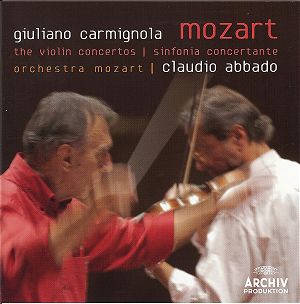

 Giuliano
Carmignola (violin)
Giuliano
Carmignola (violin) 
