Editorial Board
MusicWeb International
Founding Editor Rob Barnett Editor in Chief
John Quinn Contributing Editor Ralph Moore Webmaster
David Barker Postmaster
Jonathan Woolf MusicWeb Founder Len Mullenger
Claude
DEBUSSY (1862-1918) Piano Music - Volume 3
Préludes – Book 2 (1913) [37:57]
Berceuse héroïque (1914) [03:38]
Pièce pur l’oeuvre du “Vêtement du blessé” (1915) [01:11]
Elégie (1915) [01:54]
La Boîte à joujoux (1913) [33:04] Noriko Ogawa
(piano)
rec. 27-28 June 2004 (Boîte), 21-24 July 2005 (others) BIS CD-1355 [79:37]
I first became acquainted with Ogawa’s Debussy when making
comparisons with the second volume in Bavouzet’s ongoing cycle
on Chandos. I was greatly impressed by her natural fluency and
musicality
in the pieces on her Volume 1. I was also sure that a lot
more work had gone into creating this apparent naturalness
than it might seem.
The most recent volume bears this out. Between four and five years
have elapsed since the first and the pianistic control has
now become superfine. I remarked that Bavouzet’s command of
nuance and texture was exceptional, implicitly suggesting
that Ogawa’s was merely very good. In terms of the subtlest
shading, colouring and balance she is now equal to anyone
who has recorded this repertoire. The absolute precision with
which every single one of Debussy’s detailed dynamic markings
is observed is remarkable. At the other end of the scale her
pianistic address in “Feux d’artifice” yields nothing to Bavouzet,
whose first
volume contained both books of “Préludes”.
Has this patient honing of her art resulted in any loss of
spontaneity? I occasionally wondered about this in the earlier
stages of
the “Préludes”, but whenever I found myself entertaining such
a thought, along came something so lovely, and so natural-sounding,
that I felt a little ungrateful. Bavouzet’s insights are considerable – though
his Book 2 was better than his Book 1 – but they sometimes
draw attention to themselves. I could prefer his more mercurial “Les
Fées sont d’esquises danseuses” and “Ondine”. This, though,
could also depend on my mood at the moment – in my original
review I found Bavouzet’s “Fées” excessively demonic. I found
more cheeky humour in Ogawa’s “Mr. Pickwick” and she reveals
better the sad poetry underlying “Les tierces alternées”.
Another artist I compared was Monique Haas, whose Debussy
and Ravel recordings from the LP era have been reissued as
a 6-CD set
by Erato (2564 69967-2). I expect to complete my review of
this shortly. Haas displays all the virtues of classic French
pianism. She can occasionally be straightforward and unfussy
to a fault, though this worried me more in her first book
of Préludes than her second. She can also rise to a challenge.
Two of the Préludes which demand the utmost in concentration
and a rising sense of mystery over a long span are “La terrasse
des audience du clair de lune” – proto-Messiaen – and “Canopes”.
Fine though both Ogawa and Bavouzet are here, Haas surpasses
them in sheer potency of atmosphere.
This brings us back to the problem I find myself raising every
time a recording of these inexhaustible pieces comes up for
review.
There will never be a single set containing the best version
of each Prélude, and the real Debussy lover will need to get
all those that contain at least some supreme performances.
Ogawa is certainly among them.
Of the three pieces written during the First World War, Ogawa
plays the “Berceuse héroïque” with a sense of numbed sorrow. She
keeps the textures dry, almost Prokofief-like. Haas and Thiollier
inject more overt passion into it. To my ears this is a case
where less means more. In support of Ogawa is Debussy’s own
description of the piece as “melancholy, reticent”.
Though the other two pieces were published during the 1930s
they tended to remain outside the official canon of his works.
The earlier
LP surveys, including Haas’s, did not include them. Differences
between Ogawa and Thiollier (Naxos
Vol. 5) in the “Elégie” are small. In the “Pièce pour
l’oeuvre du ‘Vêtement du blessé’”, Ogawa maintains the wartime
mood of numbed sadness, suggesting a wispy memory of a waltz,
or perhaps of a Satie “Gymnopédie”. Thiollier’s performance – rather
confusingly, the piece is called “Page d’Album” on his disc – treats
it as a nostalgic evocation of the Parisian salons of Debussy’s
early years. I find it incredible that such a tiny piece can
support two totally different yet equally convincing interpretations.
The piano score of the children’s ballet “La Boîte à joujoux” was
published in 1913. Debussy immediately began to orchestrate
it, but it was still incomplete at the time of his death.
The first performance took place posthumously in 1919, with
the orchestration completed by André Caplet. In view of the
fact that the work was clearly conceived orchestrally, the
piano version, though Debussy’s own, has never been considered “canonic”.
It was not included by Haas, let alone Gieseking or other
early cycles. The recent Austbø cycle did not include it;
nor will, apparently, the Bavouzet cycle-in-progress. The
only other version I know is that by Thiollier (Naxos
Vol. 2) though I see that Ciccolini, at least, included
it.
Neither the orchestral version – in Ansermet’s well-regarded performance – nor
Thiollier’s excellent piano account have ever done a great
deal for me. Ogawa held me spellbound. She truly “orchestrates” the
music. With Thiollier, well as he plays, it is a single instrument
producing all the sounds. Ogawa creates an almost multi-dimensional
illusion. Each musical idea seems to come from a different
instrument. Her characterization is so vivid, furthermore,
that all the different toys appear to come alive before our
eyes. At the end of the Third Tableau she makes the love music
for the Soldier and the Doll infinitely touching. Both on
the pianistic level and on that of total identification with
the music, this is consummate artistry. I wondered at first
whether I needed to add anything to the glowing review of this disc by John France. When I heard the ballet
score I thought he might have gone overboard a whole lot more!
No Debussy collection can afford to miss this “Boîte à joujoux”. And
however many versions of the “Préludes” you may have, I don’t
think you’ll regret adding this one.
























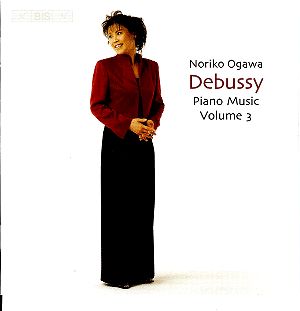

 Noriko Ogawa
(piano)
Noriko Ogawa
(piano)