Volume
2 of François-Joël Thiollier’s Debussy cycle, which I’m belatedly
discovering, contains the popular Children’s Corner and
the charming Little Negro together with two quite large
works which don’t always get into surveys of Debussy’s solo
piano music. La boîte à joujoux was intended as a ballet
for children or marionettes and the piano score was completed
in 1913. This was presumably not intended as an autonomous performing
version but a basis from which to work, for Debussy began orchestration
the following year, leaving it unfinished at his death. His
friend André Caplet, who also made an orchestral version of
Children’s Corner, completed it for performance in 1919
under Inghelbrecht. I have to admit I don’t remember ever hearing
the orchestral score – or the piano one – but as played here
there is nothing to suggest it was not originally intended for
piano if you did not know, though it is sparing of Debussy’s
usual pianistic effects.
This
is late, rarefied Debussy and without any stage action it seems
disconcertingly fragmentary. The Gounod and Bizet quotations
are introduced with Satie-like wit; these and the introduction
of a zany version of The Little Negro to represent the
English soldier may be the most memorable moment. The third
tableau seems the most complete musically. The work might
grow on you with time. Thiollier sounds as if he is improvising
it on the spot, and this seems the most likely approach to bring
it to life. Something a bit more classically strict would be
needed on the orchestra, but there would be greater colour to
counteract it.
The
Epigraphes antiques were completed in 1914 for piano
duet, though they were partly based on music written in 1900.
Debussy published a version for solo piano the same year as
the duet version. It is the latter which is more often heard,
in so far as these six pieces are heard at all. Here again,
I have to confess previous ignorance of this music in either
version. I can only say that, though I suppose Debussy must
have removed quite a lot of notes to make it work with only
two hands, it sounds perfectly complete in this form. The music
is related to the Chansons de Bilitis by Pierre Louÿs,
of which Debussy’s vocal settings are rather better known. This
means that there is not the glorious variety to be found in
the Estampes, Images and Préludes, but
even so it is surprising that pianists who love these latter
sets have not seized upon the Epigraphes. After all,
just as you don’t have to play the others by the bookful, you
could slip one or two of these into a mixed Debussy group. I’d
particularly like to try out nos.4 and 6. Thiollier creates
a convincing world of mournful mystery.
In
The Little Negro, which opens the programme, he is naughty
but nice. He opens at quite a lick, similar to Gieseking but
less relentless. Then at the second theme he slides in almost
as if he’s going to play the big tune from Rhapsody in Blue.
Theoretically it’s wrong but I love it and it gives life to
a piece that usually sounds merely pretty.
In
Children’s Corner we must again close our eyes and let Thiollier
do his own thing. In theory I think the poetry of Doctor
Gradus ad Parnassum should emerge from very even playing
of the semiquavers, as though someone really is playing a Clementi
study. Gieseking and Rogé would seem to think so too. Thiollier
leans on individual notes, stretching the rhythm, yet how bewitching
he can be. Pianist, acoustics and engineers have combined to
create something not far off Gieseking’s inimitably translucent
sound in this music, though Gieseking himself was far more classical
in his approach. Given that Thiollier’s fingers know where to
find the magic in Debussy, and that his liberties seem to arise
from an inborn sympathy with the music, best just take him on
his own terms. The real test of Thiollier as a Debussy test
will come in the remaining three volumes, but so far I’m a fan.
This
could be a very useful volume for listeners who have a satisfactory
Debussy cycle already, but which excludes the two rare works
here. They might be sufficiently captivated by Children’s
Corner to explore further.
Christopher
Howell
























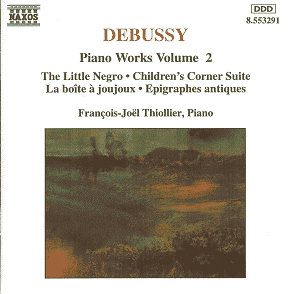

 François-Joël Thiollier
(piano)
François-Joël Thiollier
(piano)