This
actually arrived while I was dealing with the Tateno (misattributed
to Hatto) recording and also reminding myself of the Thiollier.
For a while I included Bavouzet in the comparisons but then
I realized I would have to listen to him separately on his own
terms. I noted that in the matter of actual pianistic control
– I am referring here to refinement of nuance, not mere digital
dexterity – he was superior to either of the others. But I have
more than once expressed my belief that the faster tempi of
Gieseking and Casadesus are closer to what Debussy wanted. Bavouzet
is not the worst offender – he gets all the Préludes onto one
CD with space for a tiny filler – but in a straight comparison
I preferred the naturalness of Tateno and the volatility of
Thiollier.
Perhaps
I was unlucky in the ones I took for a three-way comparison.
It’s true that Bavouzet is awfully slow in the opening “Danseuses
de Delphes”, but here practically every pianist seems to want
to assert his individuality by playing a different tempo from
the written one. Or if, like Thiollier, he plays the written
tempo, he invents dynamics of his own. Bavouzet plays a tempo
of his own and invents dynamics of his own.
However,
this proves not to be a blueprint for how he is going to continue.
Before I really started to enjoy anything, though, I had to
get used to another of his quirks, a frequent separation of
the hands, at times extreme. I know people react differently
to this. My feeling is, if he always separated his hands,
I could eventually write it off mentally, like finding you’ve
put on a pair of shoes that pinch your feet at every step, and
you’ve just got to go through the day with them and try not
to notice them too much. But as he sometimes but not always
does it, I found myself quite distracted from the music
and simply saying to myself as each new chord came up, “will
he, won’t he, will he, won’t he …?” As time went on, though,
he seemed to do it less, and I was very little disturbed by
this quirk in Book 2.
Nevertheless,
I soon found and appreciated that not all his tempi are slow.
“Les sons et les parfums” has real volatility, I enjoyed the
lilt of “Les collines d’Anacapri” and “Des pas sur le neige”
is so wonderfully textured it certainly didn’t seem slow. In
“La Cathédrale engloutie” he follows Debussy – as does Thiollier
– in changing the basic beat from crotchet (fourth note) to
minim (half-note) according to what feels right. His texture
in the last two pages is a miracle of pianissimo control, but
he seems to be holding back at the actual climax, so the piece
as a whole comes out a little understated. In view of what he
can achieve in this direction I was surprised to find the opening
of “Ce qu’a vu” too loud so this piece, for the opposite reason
to “Cathédrale”, also loses its full effect.
A
mixed bag, then. But Book 2 told a different tale. I was pleased
to find that “Brouillards” was not treated as a slow piece –
it’s marked “Modéré” – and I thought it perfectly textured.
“Feuilles mortes” is all the more effective for being really
slow, especially as Bavouzet has such control of over its long,
melancholy lines. Quite honestly, in this book my only real
reservation concerned “Les fées”, who sounded demonic rather
than exquisite dancers. In particular, I have never heard “La
terrasse des audience” played better, a miracle of rapt wonder.
The opening gestures of “Bruyères” and “M. Pickwick” are personalized
in a way that may become tiresome with repeated hearings. But
the inner joy of the later stages of the former and the zany
humour of the latter are beautifully conveyed. “Ondine” is properly
seductive, “Canope” brings another example of Bavouzet’s control
over long pianissimo lines, “Les tierces alternées” has atmosphere
as well as fluency – this was one of Tateno’s less effective
offerings – and there is both colour and virtuosity to “Feux
d’artifice”. As a bonus there’s a tiny piece which remained
unknown until 2001, no mere curiosity but, as played by Bavouzet,
full of poetry and atmosphere. It quotes from two of the “Préludes”
so it is ideally placed here.
In
the old days, when these pieces came on a separate LP for each
book, the situation would have been clear; a very high recommendation
for Book 2 but a suggestion to go elsewhere for Book 1. As it
is, anyone who loves Debussy and collects multiple versions
of his major works will not want to be without a disc which
may contain some of the finest performances he has of several
of the individual pieces, including most of Book 2. For a first
time buyer, given the full price, I’m not sure if it’s worth
paying any more than the Naxos price for Thiollier. But I look
forward to the next volume in this series.
Christopher
Howell
























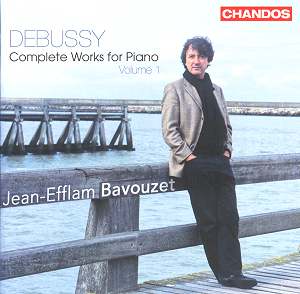

 Jean-Efflam
Bavouzet (piano)
Jean-Efflam
Bavouzet (piano)