Complete
Debussy piano music cycles come with a plethora of couplings,
ensuring that the listener who likes to pick and choose among
pianists will either have to get each cycle complete or have
half the repertoire duplicated and the other half missing.
Never
mind, the programme elected by Bavouzet as a follow-up to the
Préludes which occupied Volume
1 is extremely intelligent in its planning. It is based
entirely on triptychs, whether so designed by the composer or
whether grouped together as such here. He opens with a choice
of three of the early pieces and concludes with three of the
mature essays written between “Estampes” and “Images”, thereby
creating a sort of additional set of “Images oubliées”, this
time ones the composer forgot to collect into a set.
The
centrepiece is “Estampes”, the cycle in which Debussy first
discovered his impressionistic style of piano writing. Framing
it are two other triptychs, showing the two directions in which
he was heading in the years between the sweet salon-style offerings
that open the disc and “Estampes”. The “Images oubliées” were
published only in 1978. Though the central piece was later revised
as the Sarabande in “Pour le piano”, the others show him experimenting
with pianistic impressionism rather earlier than he was credited
for. Ravel claimed to have established pianistic impressionism
with his “Jeux d’eaux” (1901), and as far as Debussy’s published
works are concerned he was perfectly correct, since “Pour le
piano” suggests a neo-classical development to which Debussy
returned only much later.
Bavouzet
has a remarkable tonal control and range of sonority. He delicately
orchestrates the opening “Ballade” and from this point of view
the performance could hardly be bettered. His rubato, however,
emphasizes rather than disguises the fact that the piece consists
almost entirely of four-bar phrases and it emerges rather segmented.
The more classically disciplined Monique Haas may seem relatively
plain on a bar-to-bar basis, but she provides the continuity
which is lacking in Bavouzet. I would add that, when I heard
Haas on her own, I did not note any lack of tonal palette.
Since
my comparisons will frequently include Haas, I should say at
this point that her Debussy and Ravel recordings have been collected
into a 6-CD set (Erato 2564 69967-2). This has been on my reviewing
pile for some time and I expect to complete my report shortly.
The
“Ballade” is the only piece on the disc with this sort of constructional
shortcoming and I did not feel anywhere else that Bavouzet was
overdoing the rubato. Indeed, his gentle lilt and delicate colouring
get the very best out of the “Valse romantique”. Other pianists
have made a nice job of it, particularly Haas, but no one, until
now, has quite persuaded me that it’s really worth bothering
with unless you’ve been booked to do all Debussy.
Debussy’s
marking for the “Danse” is “Allegretto”. Haas’s fundamentally
disciplined approach means that she would not think of marking
up a written tempo for the sake of effect. Her steady yet lively,
good-humoured performance is surely what Debussy intended. The
great Walter Gieseking clearly felt that the music wasn’t interesting
enough at a relaxed tempo and took it a good deal faster. Unfortunately,
the great Walter Gieseking learnt some of the minor pieces in
the cycle specially for the recording, to somewhat rough and
ready effect. If you want the faster tempo Bavouzet is your
man, beautifully controlled and with a coursing energy, but
no sense of haste.
When
Haas set down her cycle, the “Images oubliées” were still languishing
in manuscript so, as with Gieseking and other “canonical” cycles,
she didn’t include them. I made my comparison with another cycle-in-progress,
though one that’s taking an awfully long time, that by Noriko
Ogawa (BIS). Ogawa’s special quality is her gentle fluency,
which allows the music to waft along in a manner that is unfailingly
attractive. There are no great differences between the two in
the first piece, but the second finds Bavouzet taking a considerably
faster tempo. His performance has a fine intensity while Ogawa,
by allowing herself and us time to savour the music fully, possibly
gives it more meaning. In the last piece Bavouzet is brilliant
and humorous while Ogawa has a sense of open-eyed wonder at
the colours of nature. It is good to have two equally convincing
performances of this once-rare cycle.
In
the first piece of “Estampes”, “Pagodes”, Bavouzet is fairly
impulsive, not as much as Gieseking whose volatility few have
risked imitating, but rather on the same lines. His Spain is
full of strong passions and bright colours. Difficult to resist,
yet arguably he has marked up some of the dynamics. His “piano
expressif” in the passage marked “Tempo rubato”, for example,
strikes me as mezzo forte at least. I can’t help feeling
that this is Grenada under the noonday summer sun rather than
in the evening. Likewise in the last piece his gardens seem
to be the subject of a full-scale thunderstorm rather than gentle
rain. It’s stunningly imaginative playing but in the last resort
the softer-edged Ogawa gets my vote.
One
might allow her a certain right to know what Pagodas are like,
and they shimmer in iridescent colours in her unhurried hands.
The sounds of the Grenada evening waft in and out of earshot
while the rain patters and drips without succumbing to tropical
violence. Both pianists know better than to interrupt the even
movement of the raindrops throughout the piece, as did Pascal
Rogé in his recent
recording (Onyx).
Haas
has an interesting approach to “Jardins sous la pluie”. True
to her classical ideals, she doesn’t deliberately evoke pictorial
images. She simply plays the piece as a toccata, the idea being
apparently to concentrate on the music and let it sound like
gardens under the rain if it will. Being Debussy, it does. I
must say that when I listened to Haas’s disc for its own sake,
her “Estampes” seemed to me very close to perfection. Now I
have made these comparisons I realize that both Bavouzet and
Ogawa get a little more out of the music.
Ogawa
has not recorded “Pour le piano” yet. Bavouzet is well-attuned
to the crisp neo-classical style. So, predictably, is Haas.
I find it hard to choose between them and was slightly surprised
to see that Bavouzet has shorter timings in all three movements,
since they sounded remarkably similar.
Bavouzet
is certainly “Très vif et fantasque” in “Masques”. It’s a brilliant
display – by the side of which Haas seems a little plain – and
you may think that’s enough for this piece. Roger Nichols’ notes
comment that “if there are hidden things in this work, they
have yet to be unearthed”. I suggest that Ogawa has unearthed
some of them. Her opening is more distant and she finds shadows
and mystery while not holding back when the revellers are present
before our eyes. This is outstanding.
On
the other hand, the same differences work the other way in “L’isle
joyeuse”. Bavouzet has the irresistible sweep necessary to bind
this relatively long – by Debussy’s standards – piece together.
By remaining jaunty to the end he avoids the suspicion that
Debussy is trying to write a finale à la Rachmaninov. Ogawa
doesn’t entirely avoid this. Elsewhere she has plenty of poetry
but this is one Debussy work that thrives on high octane – as
Horowitz showed. Haas’s concentration on musical values seems
to fall short in the same way.
On
the other hand, Haas plays “Cahier” with exceptional poetry,
revealing a side of herself she sometimes prefers to keep in
abeyance. Bavouzet is at his poetic best too, and I couldn’t
choose between them. Ogawa has recorded this, but it’s in her
Volume 2 which I don’t have.
I
think there will never be a “best” version of this inexhaustible
music. Each new cycle seems to reveal something new. The cycles
in progress by Bavouzet and Ogawa seem to me of outstanding
interest. This latest volume has a couple of supreme performances,
“Valse romantique” and “L’isle joyeuse”, several more that are
equal to the best and none that are not worth hearing. Having
been a little circumspect over his Volume 1, I am delighted
to state that am greatly looking forward to the next instalment.
I discovered Ogawa while making these comparisons and hope to
comment further. I am wondering, though, if I need add to the
praise already given on this site to her Volume
1 and Volume
3 by Terry Barfoot and John France respectively. Slightly
less interesting, to judge from the samples I’ve heard, are
the surveys by Austbø (Simax, recently
completed) and Rogé (Onyx, his second cycle, see link above).
Thiollier’s Naxos cycle has a number of fine performances but
this hardly seems the moment to list them since, of the pieces
on Bavouzet’s Volume 2, only the Ballade shows him at his best.
Christopher
Howell
























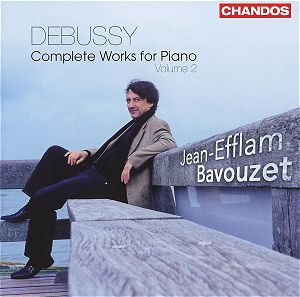

 Jean-Efflam
Bavouzet (piano)
Jean-Efflam
Bavouzet (piano)