Though
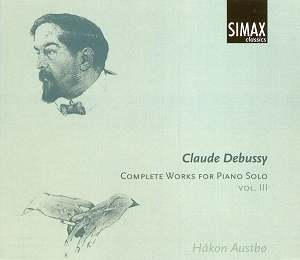
this is the final volume of Austbø’s Debussy cycle it is actually
dedicated to the earlier works and covers exactly the same ground
as the first volume of Thiollier’s Naxos cycle. Complete cycles
don’t always overlap so conveniently. In this case your choice
of one or the other doesn’t oblige you to stick with the same
pianist all the way to avoid duplications or omissions. In truth,
any chronologically arranged cycle would start like this, since
Debussy’s pre-impressionist pieces – up to Pour le piano
– fit neatly onto one CD. However, Pascal Rogé for one, in his
ongoing Onyx cycle, has preferred to slip these early pieces
a few at a time into discs mainly devoted to later works. The
listener-friendly solution as opposed to the musicological one,
you might say. Setting these relative trifles alongside some
of the masterpieces of the piano literature can emphasize their
limits, however. Hearing them all together may bring home to
you how much they nevertheless have to offer. Certainly, both
Thiollier and Austbø inspire this thought.
Thiollier
was recorded in a church, resulting in a resonant, warm sound
which at its best recalls the glistening sonorities that still
shine through Gieseking’s legendary recordings from the 1950s.
He is freer than Gieseking, but his fingers know where to find
the magic in Debussy. In the dreamier pieces, the first Arabesque,
the Rêverie, the Ballade, the Nocturne
and Clair de lune from the Suite bergamasque I
found him utterly captivating. He also makes the remaining movements
of the Suite bergamasque a more convincing setting than
usual for Clair de lune. I felt, however, that his do-it-yourself
approach was less attuned to the dance-based pieces, particularly
the Mazurka and the Valse romantique, which get
pulled out of shape.
Austbø
was also recorded in a church, but until I saw this in the booklet
I took it for a normal studio sound. The piano is a bit less
overpoweringly grand than that of Pascal Rogé in the second
instalment of his new survey. The performances and recordings
both impress by their delicacy. Austbø keeps his textures clean
and clear, avoiding impressionist washes of sound. This doesn’t
mean he doesn’t use the pedal, in fact he uses it a lot at times,
but he has the type of clear touch which avoids things getting
clouded.
More
than Thiollier, he remains conscious of the roots of these pieces
in Grieg and in the type of French salon music we also find
in early Fauré. The music emerges as a sort of parallel to Delius’s
earliest orchestral works. He is clearly preferable in the dance
pieces, excepting the Danse (Tarantelle styrienne).
Theoretically his steady tempo is correct for Debussy’s Allegretto
marking but it signally lacks the verve of Thiollier, let alone
Gieseking who evidently agreed that Debussy’s marking was too
cautious. His stricter, drier approach could be preferred in
the neo-classical suite Pour le piano, though there’s
a lot to be said for Thiollier’s joyous abandon here. He is
better behaved but far less magical in the Prélude to
the Suite bergamasque, though the grace of his Menuet
and Passepied offer a genuine alternative to Thiollier.
Clair de lune casts its usual spell at the beginning
and end, but the central section is plain compared with Thiollier’s
more inspired flights.
I
also thought the Rêverie well managed, with an attention
to the motivic interest in the left hand that compensates to
some extent for his more homely approach to the music. On the
other hand, the Ballade in particular reminded me that I had
recently abandoned an attempt to listen to Austbø’s performance
of Brahms’s shorter works (now on Brilliant) on account of his
frequent separation of the hands and arpeggiation of the chords.
Though to judge from a recent Pianophiles discussion, this could
be a plus point for some.
In
short, I would say Austbø is the more historically aware performer.
He knows these are attractive but minor early pieces and he
doesn’t try to make them sound any more than that. Thiollier
seeks a timeless beauty, even greatness, in them. When he finds
it, he is preferable. When he doesn’t, distortion may result.
Personally I would prefer Thiollier, because the pieces he makes
most beautiful are the ones I most like to listen to anyway.
The fact that Austbø does a better job with the Mazurka and
the Valse romantique must be weighed against the fact
that I could happily live the rest of my life without hearing
any further performances of these admittedly agreeable trifles.
Others may not agree. There is also the further complication
that Austbø is slightly preferable in the one major work here,
Pour le piano. I hope I have described the two discs
sufficiently well for the reader to understand which he might
prefer. You will get excellently informative notes either way.
I have tried to keep the price factor out of it, but it is a
further point in favour of Thiollier.
Christopher
Howell

























 Håkon Austbø
(piano)
Håkon Austbø
(piano)