Pascal Rogé
is now recording Debussy for the second
time. His Decca cycle was much appreciated
in its day. This time he takes an expansive,
deeply considered view. On the whole
I like my Debussy more volatile but
all this is beautifully played and warmly
textured.
In the most important
work here, "Estampes",
the first of Debussy’s works which is
wholly impressionistic in sound, Rogé’s
timings are similar to those of the
elderly Claudio Arrau. Yet, while Arrau
is more interventionist and can seem
mannered, he is ever the great communicator.
There is all the mystery of the Far
East in his "Pagodes"
and his Latin-American birthright no
doubt helps him to give a sinuous lift
to "La Soirée dans Grenade".
Furthermore, it is Rogé not Arrau
who, in the interests of expressiveness,
allows some hiccoughs in the gentle
pattering of the raindrops in "Jardins
sous la pluie", even robbing
the closing page of its quivering excitement.
Arrau mainly avoids this. With Arrau
we also hear plainly that the pieces
are respectively about three different
parts of the world.
Put on Gieseking after
this and his "Pagodes"
may seem manically fast and excitable.
When you have taken time to adjust you
realize it is Gieseking who more than
anyone takes the notes of the page and
creates sheer magic. It may seem perverse
to stick with a recording made over
fifty years ago but what else can I
say?
Some have questioned
the supremacy of Gieseking in this music;
my colleague Jonathan Woolf has had
some interesting things to say on the
subject. Well, some Gieseking performances
are more supreme than others. His "Estampes"
seem to me to show him at his most inspired,
though I can accept Arrau as evidence
that there are other ways. By the side
of either of them Rogé seems
a little pallid. The difference between
excellence and greatness, I suppose.
Elsewhere differences
are smaller. In the first of the Children’s
Corner pieces, "Doctor Gradus
ad Parnassum", I wondered if
any marginal advantages in Gieseking’s
playing warranted the sacrifice of up-to-date
sound. But as you get acclimatized,
what pellucid light still hovers over
those old recordings after so many years.
In "Jimbo’s Lullaby"
Rogé’s slower tempo makes the
music sound melancholy. Gieseking explains
better what Debussy meant by marking
the beginning "doux et un peu gauche".
He sounds like a child picking out the
notes one by one. He finds a droll humour
in the piece which I find more interesting.
For once Gieseking
is slower in the "Serenade of
the Doll" and gives it an incomparable
elegance. Honours are about even in
"The Snow is Dancing"
but Gieseking finds more character in
the last two pieces.
In early Debussy, Rogé
is fluently attractive. I didn’t have
a comparison for the "Suite
bergamasque". I much enjoyed
it though I have an idea I would like
it all a shade faster. Full marks for
not playing "Clair de lune"
as if it’s the soundtrack to "Frankie
& Johnny", but maybe it could
flow a little more without gushing.
In the "Ballade" he
eases into each change of harmony in
a way which rather draws attention to
the fact that the piece is made entirely
of two-bar segments. A more free-flowing
approach might have hidden this. The
Mazurka is nicely done. In the
Arabesques the pianist on a disc
claimed to be by Joyce Hatto is a little
more upfront, finding more capricious
humour in the second. Ironically, there
have been suggestions that the "Hatto"
version of the first Arabesque is Rogé’s
own earlier Decca recording.
"La Plus que
lente" brings the only performance
here I actively dislike, too slow and
pulled-around. Gieseking is here too
fast and unsettled. Which leaves the
"Hatto" as the performance
that succeeds perfectly in maintaining
a gentle waltz movement all through,
in spite of some quite extreme rubato.
I look forward to knowing who the pianist
really is. In "Le Petit Nègre"
Gieseking is too impatient by far while
Rogé is delightful. In general
Gieseking’s versions of the less well-known
pieces, which he rarely if ever played
outside the studio, suggest all too
brief an encounter.
Altogether an excellent
production, with recording and booklet
notes by Roger Nichols worthy of it.
But in the last resort not really memorable.
Christopher Howell
























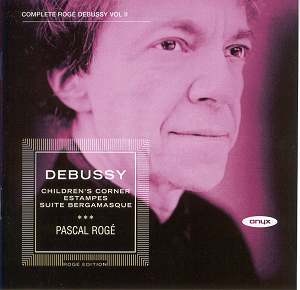
 Pascal Rogé (piano)