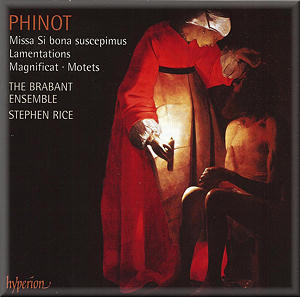
So here we are again: so much to learn, so much to discover. In
Phinot we have a composer, a very prolific one, of two masses,
about one hundred motets (publ. 1547-8) as well as Vesper psalms
and Magnificats. His music was performed and published well after
his execution for committing homosexual acts probably at the height
of his fame. He has never had a CD devoted to his music before
and I have never come across anything of his, ever. Please let
me know if there have been previous recordings. We know little
about his life apart from the occasional reference. He appears
to have been a cathedral singer at coastal Italian city of Pesaro. If you go there today,
as I did three years ago for the opera festival, you will find
no reference to Phinot. On the other hand Rossini was born there
and his name is celebrated far and wide in the city. All that
we are left with is the music; what is it like?
If
you are to make an investment into a new or unknown composer
you need to be able to trust the performers. With the Brabant
Ensemble and the musicianship and prowess of Stephen Rice
you know that you are in safe hands.
It’s
good that Phinot’s Mass takes centre-stage, even if it’s quite
a short one by the standards of his time. It is a parody mass
using Sermisy’s somewhat solemn and melancholy setting from
the Book of Job “The Lord gives and the Lord takes away”.
It is a moving work, but in the hands of Phinot it blossoms
and develops into something of an ecstatic and joyous experience.
There are several similarities between motet and mass. First,
both are in four parts, second each has passages of paired
imitation, upper voices for instance echoed by lower. Imitation
was more a product of the earlier generation, men like Gombert
and Josquin; we do not know who Phinot’s teachers were. Thirdly
there are many homophonic passages to create contrast. ‘Sit
nomen Domini benedictum’ in the motet (Blessed be the name
of the Lord). This is set homophonically to wondrously still
and simple chords. Finally there are shared melodic fragments
as Rice and Roger Jacob point out in their interesting shared
booklet notes. It seems to me that the mass might be an early
work as the cadences have an early Renaissance feel and the
final chord is often minus its third.
The
motets show similar stylistic traits, mixing homophonic passages
to highlight certain aspects of the texts with strict imitation.
Four of them are in eight parts utilizing the then burgeoning
interest in double-choir settings; long before those lauded
ones by Gabrieli. The booklet writers give us the rather obscure
names of Ruffino d’Assisi and Francesco Santacroce. They were
slightly older contemporaries of Phinot who were discovering
double-choir imitative motets at the time. This writing contrasted
high with low registers, as happens most movingly in ‘Tanto
tempore’ a setting of a few lines from St. John.
The
Lamentations setting is unusual in that it does not set the
opening Hebrew letters but runs as a continuous motet. It
is also in eight parts. Here the second verse is set for the
upper voices and the third verse for the lower. This means
that the fourth verse is well contrasted for the two opposing
choirs – a good textural contrast. The final ‘Jerusalem’ section is set homophonically.
The
other double-choir pieces are the joyous ‘Iam non dicam’ another
setting of a passage from St.
John
and the serenely homophonic ‘O sacrum convivium’. For some
reason they feel reminiscent of Victoria a composer yet to
be born.
There
are three motets in four and five parts. The brief and cheerful
‘Magnificat’ is written as an ‘alternatum’ setting with plainsong.
It is in four parts but the Gloria has a canonic five part
texture. Similar in style is the simple and unremarkable vesper
psalm setting (no 110) ‘Confitebor tibi, Domine’ which ends
the CD. I save the most remarkable piece until the end, that
is the setting of ‘Pater peccavi’ which takes the words of
the Prodigal son as he contemplates his penniless plight away
from home. At the moment of his deepest depression, Phinot
allows the music to drift down into dark ‘flat’ keys resulting
in some extraordinarily expressive and dissonant harmonies.
At ‘Surgam et ibo’ –‘I will arise and go to my father’, the
tonality makes its way home via some marvellous sequences.
All of this is explained in the booklet.
The
Brabant ensemble - normally sixteen
singers - has been amazingly prolific for Hyperion in the
last three years. This is their sixth disc. They have introduced
us to some little known figures like Manchicourt (see review)
and Crecquillon (see review)
and more recently, although musically less satisfying they
tackled the Chirk Castle part-books (see review).
Also it is not at all surprising that their recent Morales
disc (see review)
has been nominated for the 2009 Gramophone early music awards.
They have a gloriously fresh, yet intensely expressive sound,
intonation is miraculous and they are aided on each occasion
by a superb acoustic and recording.
As
well as the aforementioned essay the disc comes with full
texts, well translated. The cover is adorned with a beautiful
section of George de la Tour’s ‘Job mocked by his wife’ which
fits neatly the text of the motet on which the mass is based.
Gary Higginson