A little over half a year ago, in September
2008, I reviewed a disc in the Naxos ‘Deutsche Schubert-Lied-Edition’
with Florian Boesch (see review).
I gave it a hearty welcome and designating it Bargain of
the Month. That disc was recorded in November 2006 while
the present one was made half a year later. In the meantime
Boesch had visited Wigmore Hall for a recital with Malcolm
Martineau. My colleague Evan Dickerson found a kinship with
Hans Hotter ‘being manly and solidly founded in the bass-baritone
aspect of his voice, but with some elements of tenderness
also present’. In this Schumann recital the elements of tenderness
are very much to the fore. Many Lieder singers are fully satisfied
with the tender part of the voice and some of them can achieve
excellent results, provided they also have a good way with
the text and can communicate it vividly. But to take a step
further - to become an outstanding interpreter - the singer
also needs to be able to draw down a more robust part of the
voice. The really great ones - Schlusnus, Hüsch, Hotter, Souzay,
Fischer-Dieskau and Prey to mention some names from the past
- all possessed a marrowy deeper aspect to the voice. Florian
Boesch is well equipped in these respects and has a wide range
of dynamic and vocal colour, from the velvety piano and pianissimo
to the bass-baritone’s dark-tinted full voice which at will
can take on a rasping demonic character. Like Fischer-Dieskau
he can shift gear with quicksilver speed from soft to brutal
and when it suits the dramatic situation he is willing to
sacrifice the well-modulated tone for something rawer, more
primitive. Warte, warte, wilder Schiffmann, number
6 of Liederkreis illustrates this clearly. The danger
with a too well behaved approach is that a performance can
be bland, even monotonous, however beautiful the singing is
per se. None of the singers mentioned above ever fell
into that trap and neither does Boesch – at least judging
by what I have heard so far.
Lieder singing is not just a question of singing,
it also needs good piano playing. Being a good accompanist
requires great flexibility and an ability to adjust to different
approaches. Ideally the singer and the pianist should have
a relation on equal terms. Am I too loud? was the title
of legendary accompanist Gerald Moore’s memoirs but an equally
relevant question should be ‘Am I too recessed?’ I have heard
Malcolm Martineau on numerous occasions and he always seem
to find the right balance. In the recording studio the producer
and the balance engineer are also central components for the
end result and in this case everything seems ideal. When one
as listener doesn’t reflect on balance, perspective and acoustics
then all involved have done a good job.
Liederkreis Op. 24 seems to be less
often performed, on disc as well as on the concert platform,
than the other Liederkreis, Op. 39, but every time
I return to Op. 24 I feel that in many ways this is the essence
of the Heine-Schumann combination. The last time I had a new
recording of it by a baritone it was Roman Trekel, also on
an all-Schumann disc (see review)
but not with an identical programme. The greatest difference
was that he also included Dichterliebe. That is a very
good record too. Trekel’s is a different voice-type, lighter,
brighter, closer to the tenor but he is also able to invest
the more dramatic songs with the required power. Comparing
the two singers directly Boesch has a certain advantage through
his darker and more full-throated low register, which pays
dividends in Es treibt mich hin, es treibt mich her, Schöne
Wiege meiner Leiden and Warte, warte, wilder Schiffmann.
Overall his dynamic scope is wider and his softer singing
even more beautiful and heartrending.
Among the other songs the three-part Der
arme Peter is a rarity but it has a lot to offer. Die
beiden Grenadiere is on the other hand among the best
known and requires a dramatic story-teller. Gérard Souzay
and Heinz Rehfuss (accompanied by Frank Martin) were my first
recordings. Boesch and Trekel are both more restrained, though
there is no lack of intensity – it’s just that it is under
the surface. Boesch is impressive indeed when the Marseillaise
melody flows out in the last stanza of the song. Its companion
piece Die feindlichen Brüder with its stormy accompaniment
is also superbly sung. The ballad Belsazar, Schumann’s
first setting of Heine, is narrated with insight.
The three Heine songs from
Myrten are among Schumann’s
finest songs and the reason for the success is the simplicity
of the settings. They are so telling with small means and Florian
Boesch sings them also with the utmost simplicity. That also
goes for the two-part
Tragödie which is affectingly done
without over-interpretation.
The last four songs were, despite the high
opus numbers, originally meant for Dichterliebe but
were discarded and published much later. Dein Angesicht
is the one that most readily fits the mood of the cycle. Mein
Wagen rollet langsam is interesting with the staccato
passages in the accompaniment and an uncommonly long postlude.
I still regard the Trekel disc very highly
but Florian Boesch’s interpretations are even more three-dimensional
and since the programmes only partly overlap even Lieder lovers
on a shoestring budget should save up for this latest addition
to the Lieder Record Helicon. A superb disc in every respect.
Göran Forsling
























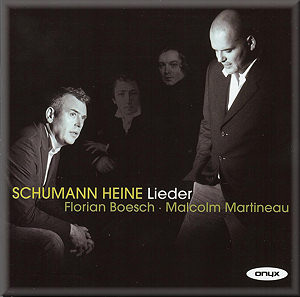
 Florian Boesch (baritone);
Malcolm Martineau (piano)
Florian Boesch (baritone);
Malcolm Martineau (piano) 
