Every time I listen
to a new issue in this Schubert-Lied-Edition
it strikes me what a wealth of mainly
unsung gems there are hidden in
Schubert’s oeuvre. We tend to hear
roughly fifty, maybe one hundred,
songs relatively frequently performed,
live or on records. The rest pop
up, if at all, only in complete
surveys like the pioneering Hyperion
series in the 1990s and the present
series, which now seems to be on
the final straight. This is volume
27 and it has to be ranked among
the most desirable in the series
and not only for unearthing several
fascinating songs that should by
right belong to the established
Schubert canon. We also have Naxos
to thank for introducing many listeners
to a superb new Lieder singer. I
had heard him a couple of times
in opera recordings with Harnoncourt
and reacted very positively then.
Here he grabbed me by the throat
from the first moment and never
let go. His is a rich, darkish baritone,
verging on bass-baritone, well equalized
throughout his register, powerful
and with dramatic potential, flexible
and able to express subtle nuances.
His diction is excellent. My colleague
Evan Dickerson heard him at the
Wigmore Hall in March 2007, and
he drew a parallel with Hans Hotter
"in a few key respects, being
manly and solidly founded in the
bass-baritone aspect of his voice,
but with some elements of tenderness
also present." ED in the last
resort found that his style may
be too grand for Lieder and that
his future was in opera. Live performances
and studio recordings are not necessarily
fully comparable; one misses the
visual aspect in a recording. On
the other hand the communication
with an audience, visually as well
as aurally, can sometimes induce
unwanted exaggerations whereas the
sterile and neutral microphone frees
the singer from extra-musical influences
and lets the true feelings flow
freely.
Be that as it may,
I respect ED’s opinions highly.
My impression of him is that here
is a singer in his early maturity
who masters his means of expression
to perfection. There was hardly
a phrase or inflexion that felt
artificial – there is no posturing
about his singing. Quite recently
I reviewed a 2 CD Schubert set with
Ian Bostridge, a singer I greatly
admire. There I commented on what
I regarded as an unwise decision
to include Totengräbers
Heimweh in his programme, with
its demands on power and darkness.
Boesch’s reading of that haunting
and gripping song shows what I was
missing. Here is the pithy and all-embracing
Wotanesque intensity in the opening
– Hotter-like, why not? Boesch also
brings out the soft and inward privacy
later on.
He is an expressive
narrator too, a quality that comes
to the fore in several of these
songs, not least in the two ballad-like
compositions that open the disc.
Both are the work of a still teenaged
composer – he was eighteen at the
time. They are remarkable in their
dramatic power and free compositional
structure with a piano accompaniment
that is just as important as the
song line. Both are way ahead of
their time and should be classified
as among the most important compositions
of their kind in Schubert’s oeuvre
– almost on a par with Erlkönig.
Fülle der
Liebe is another song that
should be heard more often. Der
Schiffer, which was one of the
songs he performed at the Wigmore
Hall, peaceful and restrained. This
is Schubert at his most lyrical.
The songs in this programme are
generally on the dark side, dealing
with war, pilgrimage, evening, old
age and death. Thus they are well
suited to a bass-baritone. The manuscript
of Die drei Sänger is
preserved in incomplete form; it
breaks off at the end of the last
page, as Ulrich Eisenlohr points
out in his excellent notes. This
has led scholars to assume that
Schubert actually finished it but
that the end has been lost. To make
it something more than a torso Florian
Boesch recites the remaining lines
of the poem. He does this expressively
and with the dark speaking voice
one expects from the weight of his
singing at the lower end of his
register.
At the Wigmore
Hall he was accompanied by Malcolm
Martineau, who is one of the most
sought after accompanists worldwide.
Burkhard Kehring, with whom Boesch
regularly appears shows here, as
well as on some other issues in
the same series, that he is in the
same league. The recording is expertly
balanced and contributes further
to the value of this issue. It’s
a pity the Schubert series is almost
finished. Naxos will, I’m sure,
find other worthy tasks for Florian
Boesch in the near future: a Brahms
cycle? Hans Hotter was masterly
in Brahms and Vier ernste Gesänge
could well be ideal for Boesch.
Göran
Forsling
























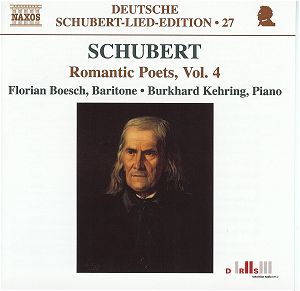

 Florian Boesch (baritone); Burkhard Kehring
(piano)
Florian Boesch (baritone); Burkhard Kehring
(piano) 
