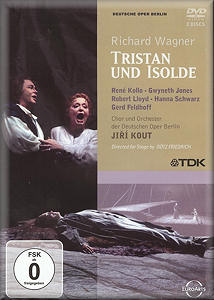
This DVD is like a nostalgic wave from the long-lost friends.
The performance was filmed during one of the Deutsche Oper’s tours
to Japan and it gets it first commercial release in wide-screen and
surround sound. It is undeniably flawed, but it is great to have
nonetheless, and I for one found it immensely moving.
Rene
Kollo and Gwyneth Jones were coming to the end of their long
careers when this performance was recorded and nobody would
argue that they sound fresh here, but then neither Tristan nor
Isolde are supposed to be in their first flush of youth. Jones
recorded the role nearly 15 years after committing her Brünnhilde to disc in Chéreau’s centenary
Ring
at Bayreuth. It is
remarkable first of all that she was still capable of singing
Isolde this late in her career and secondly how similar her
Isolde is to her Brünnhilde. This has obvious pros and cons:
her tone, never the easiest on the ear, is if anything even
more shrill and penetrating. This can be very distracting at
the start of each sequence, nowhere more so than in her address
over Tristan’s body in Act 3 which sounds heavy and unwieldy
when it should be the most tender passage in the drama. However,
I found my ear soon adjusting to it, and you cannot fault her
for sheer musicality. All the notes are there, even if she
sometimes swoops up to them, and the climactic moments of the
Love Duet and Liebestod are quite overwhelming. Kollo too has
problems with rawness of tone and some slackness of attack in
Act 2, but this, if anything, intensifies the delirium of Act
3 and, like Jones, all of his notes are secure. Furthermore,
they both look fantastic.
They act compellingly, throwing themselves into their scenes
convincingly, and they strike sparks off one another in their
scenes together, be it the malevolence of Act 1 or the uncontrolled
passion of Act 2. They are a world away from the lovers evoked
by Nina Stemme and Robert Gambill on the Glyndebourne DVD (see
review):
they evoke the passion and excitement of youth, but Jones and
Kollo portray the full-blown exhilaration of mature adult obsession
– Antony and Cleopatra rather than Romeo and Juliet.
The other characters are all
excellent. Just as she was for Barenboim at Bayreuth, Hanna Schwarz
is a near ideal Brangäne.
Her voice has lots of juice where Jones’ has heft and she makes
a convincing foil with her perky “look-on-the-bright-side” attitude
of Act 1 and her “please-be-sensible” pleading at the start
of Act 2. Gerd Feldhoff is a magnificent Kurwenal, youthful
sounding and virile, evoking real sympathy in the final scenes.
Robert Lloyd almost pulls off the impossible feat of making
King Marke’s monologue exciting: he certainly makes it beautiful
and his final words in Act 3 are very moving. The smaller roles
are all taken very well, especially Uwe Peper’s Shepherd whose
youthful voice belies his geriatric costume.
I
have praised Götz Friedrich’s Wagner in these pages before (see
review
of his Bayreuth Tannhäuser) and his production is
safe without being revelatory. He is very clearly influenced
by the New Bayreuth style. Act 1 is a vast but empty ship’s
deck with some rigging and a hint of a sail, Act 2 is set at
the base of a vast tree outside Marke’s castle, while Act 3
is dominated by a vast granite promontory which seems to be
jutting out over the very edge of existence. The huge sense
of scale suits this work very well and his direction of the
characters matches it. His central vision is of their isolation
in a world that does not understand them: thus in the Prelude
to Act 1 we see Tristan, Isolde and Brangäne standing in spotlights
amid the darkness, cut off from one another as well as the rest
of the world. Marke and Brangäne drift quietly away during
the Liebestod, leaving them to achieve their consummation in
isolation. This sense of separation reaches its climax in the
Libesnacht, where the whole stage is plunged into darkness save
for the spotlight on the two lovers, and even this fades away
for Brangäne’s warnings where we focus on an abstract lighting
effect instead. Allied to the incomparable music this produces
in the viewer a sense of sublimation that is really quite lovely,
though turn off the subtitles if you want to get the full effect!
Friedrich’s use of lighting is controlled and effective: when
the lovers are surprised at the end of their Act 2 duet it is
jarringly sudden, as if the floodlights had just been switched
onto a scene of complete darkness. Together with the music
the sense of dislocation is highly effective. The opposite
is achieved in the final scene: as Isolde sinks onto Tristan’s
body there is a beautiful slow fade to darkness which mirrors
the orchestral wind-down perfectly. Friedrich provides us with
a marvellous way to experience this endlessly fascinating drama,
one which can stand up against anything else on the market.
Jiří
Kout’s contol of this amazing score is a little stop-start,
and the orchestra seem to have trouble following his beat in
the opening bars of each act but, like Jones’ voice, they soon
tune into him and the sound they produce is marvellous, especially
in the Act 1 prelude which has a rising sense of momentum to
it. The camera work is fine though little details niggle, such
as the intrusive bits of rigging that get in the way of lots
of facial close-ups in Act 1. Furthermore there seems to have
been one camera with a lens that needed cleaning and this distracts
from a couple of moments, though it isn’t pervasive.
The
major problem with this set, however, is that Kout observes
the traditional cut in the first ecstatic section of the Act
2 love duet. This is really unforgiveable from a German company
and it is all the more puzzling in light of what great voice
Kollo and Jones were in for the duet itself. This will probably
rule it out as a definitive choice for a lot of collectors,
which is a real shame, but it’s well worth considering as an
alternative.
Tristan has been very well served on DVD. Not
only has there been the marvellous Glyndebourne production mentioned
above but there are three productions from Barenboim: Bayreuth
in 1983 (visually stunning with largely excellent vocal performances)
and 1995 (see review
- perhaps the best pairing of lovers on DVD in Meier and Jerusalem,
if a somewhat bizarre production) and at La Scala in 2007 (good
singing, fine production, appalling camera direction), and that’s
only to mention a few. On balance the Glyndebourne DVD is probably
still the best one at the moment, but don’t be put off trying
this one if you can stretch to the price. It’s a great achievement
from everyone involved and I will be coming back to it again and
again.
Simon Thompson