One of the greatest
Wagner productions of modern times
arrives for the first time on DVD
with crystal clear surround sound,
and it could not be more welcome.
Let me nail my colours to the mast
at the outset, and I don’t think
I’m exaggerating the case here:
this is the greatest Wagner experience
that DVD has to offer.
This production
of 1972 (filmed here in its 1978
revival) came at a turning point
in the history of the Bayreuth Festival
and did much to set the tone for
the decades that followed. Wieland
Wagner had been dead for six years
and his productions, lacking the
hand of their creator, were beginning
to seem tired. His successor, Wolfgang,
always an able administrator, was
nowhere near as talented a director/producer
as his brother. New blood was needed,
so Wolfgang turned to guest directors
to produce some of the festival’s
repertoire. He offered Tannhäuser
to Götz Friedrich, disciple
of Felsenstein at the East Berlin
Komische Oper. Friedrich’s style
of working stripped the work bare
of all preconceptions and sought
for meaning in the circumstances
of the work’s composition as well
as in the text itself. He produced
a masterpiece, filmed here with
great assurance by Brian Large and
sung by one of the best Bayreuth
casts of the 1970s.
Friedrich presented
Tannhäuser as an outsider in
a grim world, who can find belonging
in neither the Venusberg nor in
the Wartburg. During the prelude,
which defies Bayreuth convention
by being staged, Tannhäuser
appears alone in a barren landscape
with only his harp, which he looks
through as if it were the bars of
a prison cell. The Venusberg looks
like a spider’s web in which Tannhäuser
is trapped. The opening Bacchanal
is indeed an orgy: young, attractive
dancers, wearing next to nothing,
writhe and twist around one another,
representing sexual attraction at
its most raw. Yet the titillation
which this produces is countered
by some scenes of disturbing violence
as other members of the party take
sexual gratification to a violent
and disturbing climax. Significantly,
we see some of these "satyrs
and bacchantes" wearing Death’s
Head masks. Erotic yet repugnant,
this Venusberg objectifies its inhabitants;
its only natural conclusion is enslavement,
and this is the state in which we
find Tannhäuser, sitting indolently
at Venus’ feet.
Friedrich’s masterstroke
was to show Venus and Elisabeth
not as antitheses but as two sides
of the same coin, neither of which
producing the fulfilment or freedom
that Tannhäuser desires. Both
roles are sung by Gwyneth Jones
(a remarkable achievement) who acts
her roles magnificently as well
as singing them brilliantly. When
we first see her she too wears an
anonymous mask, and it seems that
she herself has become enslaved
by her passion for Tannhäuser.
Once the Venusberg disappears Tannhäuser
is plunged into a bare landscape
with nothing save the young shepherd
to relieve the gloom: this return
to the "real" world brings
no comfort.
The Wartburg of
Act 2 is a closed club; a faceless,
unforgiving environment. Hermann’s
retinue all dress in identical uniforms,
black with a suspiciously familiar
medal hanging round their necks.
They even have identical hairstyles,
though it is a testament to Friedrich’s
attention to detail that the women
and lower orders in the Hall of
Song wear full medieval costume:
a reference to authoritarianism
in his own country? The banners
that are raised at the entrance
of the guests: medieval standards
or another Nuremburg Rally? This
restricted, authoritarian society
can brook no individuality, and
this is one of the reasons why they
turn on Tannhäuser with such
alarming force. When he sings his
hymn to Venus he is cast out with
disturbing violence, the whole company
rounding on him with their swords,
and almost cutting down Elizabeth
in the process.
Friedrich’s often
shocking direction of the actors
reaches its climax at the start
of Act Three where we see Elisabeth,
emaciated and starving, driven to
what genuinely seems the point of
death by her intercessions for Tannhäuser.
Jones’ acting is superlative here,
vehemently rejecting Wolfram’s offers
of help lest they diminish the value
of her penance. Her disappointment
when she realises that Tannhäuser
is not among the returning pilgrims
is gutting for us too. She literally
crawls off-stage to her death, inspiring
Wolfram to cast away his harp during
the Abendstern solo: in the
face of what he has seen, its usefulness,
together with all it symbolised,
is over for ever.
When Tannhäuser
reappears he has failed to find
fulfilment in either the Venusberg
or the Christian world, so he embraces
the Venusberg as the lesser of the
two horrors. This time when she
appears, however, Venus herself
is masked behind a Death’s Head:
all illusion about her world is
gone and Tannhäuser loses all
hope of finding satisfaction. Even
when he receives the news that Heaven
is open to him he dies despairing
and alone among a sea of anonymous
clones who show him no compassion
whatever.
Friedrich’s vision
of the work is undoubtedly a grim
one, but it fits the work surprisingly
well. It is one of those all too
rare productions that made me see
new things in a work that I thought
I knew well. It is a testament to
the success of the production that
it is quite feasible, if you so
choose, to take it as a purely literal
interpretation of Wagner’s directions.
Peel back they layers, though, and
you find layers of richness which
enhance your understanding of the
work rather than get in the way.
Brian Large’s direction, always
dependable, here is superlative.
When necessary he zooms in on faces
and he monitors every reaction,
so essential to a production like
this one. The Bacchanal is filmed
sensitively but he does not shy
away from lewd close-ups when they
achieve a certain effect. It seems,
in fact, as if the sequence was
filmed in a special studio then
edited in later, though there is
nothing to that effect in the booklet
notes. Unusually for a Bayreuth
film, an audience is present in
the theatre during the filming,
though you would never guess from
the things the camera manages to
achieve, and there is barely a sound
from them throughout. The picture
quality is also notably superior
to other contemporary Bayreuth films,
such as the Chéreau Ring.
To match such inspired
direction we have remarkable singing
and, as important here, acting.
Spas Wenkoff is a marvellously assured
Tannhäuser. His baritonal voice
gives his character authority, but
he tempers it well to accommodate
his anguish and uncertainty too.
In particular his telling of the
Pope’s judgement in Act 3 is suitably
dark. Gwyneth Jones gives a truly
remarkable performance, equally
convincing as the erotic siren in
Act 1 and the holy innocent of Acts
2 and 3. Furthermore she tempers
her voice astoundingly so as to
provide entirely different colours
for the two characters. Sotin is
a dark and sinister Hermann who
looks as grim as he sounds. His
authoritative projection in Act
2 is marvellous. Perhaps the most
purely beautiful singing of the
set, however, comes from an incredible
Bernd Weikl. His Wolfram is a stoical
victim who surrenders to his circumstances
selflessly. His voice, never sounding
better, captures the characters
extremes of goodness and sorrow.
The Abendstern solo alone
is heart-stoppingly beautiful.
In the pit Colin
Davis, not a name one naturally
associates with Wagner, keeps things
ticking along nicely. His Entrance
of the Guests has great momentum
and he keeps his foot on the pedal
excitingly during the Bacchanal.
He is not afraid to be expansive
during the big moments like the
Pilgrim’s Chorus, however, and he
judges the long arc of the final
act particularly well.
I repeat, then:
this set offers what, for my money,
is the best Wagner experience that
DVD has to offer. A production with
incredible attention to detail,
coupled with impeccable singing,
an orchestra on the top of its form,
with top notch picture and sound
quality. This is essential not just
for Wagnerians but for anyone interested
in the power of the theatre. Get
it now.
Simon Thompson
























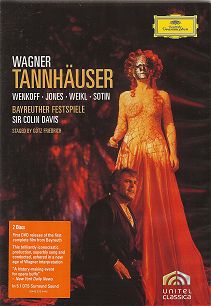

 Orchestra and Chorus of the Bayreuth Festival/Colin
Davis
Orchestra and Chorus of the Bayreuth Festival/Colin
Davis  [2
DVDs, 64:24 + 123:43]
[2
DVDs, 64:24 + 123:43] 
