Editorial Board
MusicWeb International
Founding Editor Rob Barnett Editor in Chief
John Quinn Contributing Editor Ralph Moore Webmaster
David Barker Postmaster
Jonathan Woolf MusicWeb Founder Len Mullenger
Buy
through MusicWeb for £10.50 postage
paid World-wide.
Battaglia d'amore Bellerofonte CASTALDI (1580 - 1649)
O Clorida [02:44]
Saetta pur saetta [1:51]
O crudel amor [03:25]
Quella che tanto [04:58]
Echo, prima parte [03:46]
Echo, seonda parte [03:25]
Quagliotta canzone [03:49]
Hor meno lieti [04:40]
Fuor di noia [04:48]
Occhi belli [02:45]
Lo sdegno [03:11] Girolamo FRESCOBALDI (1583 - 1643)
Canzon V detta Bellerofonte [03:06] Bellerofonte CASTALDI
Felice e contento [02:53]
Pieno di bellezze [02:03]
Proterà'l sol [02:54]
Capriccio detto hermafrodito [02:30]
Più non vi miro [04:22]
Quella altera [01:46]
Amor colei [03:12]
Capriccio di battaglia a due stromenti [14:27] Il Furioso (Eugenia
Cirrieri, Laura Fabris, Janet Youngdahl (soprano), Gian Polo Fagotto,
Claudio Zinutti (tenor), Victor Coelho (archlute, theorbo, tiorbino),
David Dolata (theorbo, tiorbino), Neil Cockburn (harpsichord))/David
Dolata
rec. 23-25 June 2006, Concert Hall of the Herbert and Nicole Wertheim
Performing Arts Center, Florida International University, Miami,
Fla., USA; 12-17 July 2006, Antica Pieve di San Martino d'Asio-Clauzetto,
Pordenone, Italy. DDD TOCCATA CLASSICS
TOCC 0081 [76:33]
There's a good chance you have never heard the name of Bellerofonte Castaldi. Once you have heard it ther's little chance you are going to forget it. Bellerofonte is not a very common Christian name. It was deliberately given to him in order to set him apart from others with the same family name. His father Francesco and two others with the same name all lived in Modena at the same time and they were regularly given the wrong mail. Francesco said to himself: "If I have ever children, I will definitely avoid such names as Pier, Polo or Gian and choose more proper ones". Bellerofonte was his seventh child and third son. His sisters were called Arpalice, Areta, Artemia and Axiotea and his brothers Oromedonte and Sesostro.
His name was as extravagant as Bellerofonte's personality. He was very outspoken and he was regularly imprisoned for insulting people. The Estense library in Modena contains a manuscript with personal notes by Castaldi. They also include some crude insults to personal enemies. Castaldi and his brothers and sisters had received an excellent education. It was based on the principles of a profound taste for knowledge, the love of antique culture and the greatest respect for high moral values and chivalrous ideals. One wonders how the latter principle is compatible with his habit of regularly insulting people he didn't like.
Castaldi started travelling Europe until shortly before his death, when he returned to Modena. It fits his character that he always remained independent as a musician and never took a job at the service of some prince. As a result he was heavily in debt at the time of his death. Despite his conflicts with authority he was held in high esteem both as a musician and as a poet. Poets like Tassoni and Testi were part of his circle as were composers such as Gastoldi and Monteverdi.
Castaldi's music is not entirely neglected. About ten years ago the French ensemble Le Poème Harmonique devoted a disc to his music (Alpha 900). This disc is an excellent addition to the previous one: only two pieces appear on both discs (Quagliotta canzone, Capriccio detto hermafrodito). Apparently David Dolata isn't aware of this disc as he claims all vocal works on this disc are recorded for the first time.
The pieces for theorbo solo and the duets for theorbo and tiorbino are from a collection which was printed in Modena in 1622. The tiorbino is twice smaller than the theorbo and its range one octave up. Castaldi claimed this instrument to be his own invention. It is the only collection with music specifically for the tiorbino which makes it an invaluable source. The most intriguing piece from this collection is the last item on this disc, the Capriccio di battaglia a due stromenti. It is part of a tradition of writing battle pieces which lasted until the 18th century. With more than 14 minutes this must be one of the longest ever written. It is stated in the booklet that as with most battaglias this ends in the minor mode. We are not told why, but one would imagine that this is an indication of the elements of a battle: some are wounded and some die. But in this recording "we have taken the liberty of ending it in the triumphant major", as David Dolata writes. Quite a strange decision, I would say, in particular if we take into account the possibility the ending in the minor mode was deliberate.
It is a remarkable piece but in my view not the most interesting. The vocal items are more captivating; Castaldi was not only the composer but also in almost every case the poet as well. Among the most notable items are the 'Echo, prima parte' and 'Echo, seconda parte'. The use of an echo was quite fashionable in Italy in the early 17th century. It was in particular used in opera when protagonists were often portrayed talking to himself or herself, and was 'answered', as it were, by an echo. Usually the echo took a part of the last word of the protagonist which formed a kind of 'answer'. In the first of the two pieces the soprano is answered by a second soprano somewhere in the background. In the second Castaldi goes even further by adding a second echo, which uses a part of the word of the first echo. The wonderful thing is that it all makes sense. The closing of the second aria is also noticeable. The first soprano sings: "What mercy is there for one who is in love, now that my death is wanted and granted by my pitiless fate?" And the first and second echoes sing; "alla morte" (to death!). And then the first soprano joins the two echoes by also singing: "to death!".
This diptych is one of the few pieces which is not strophic. Another one is 'Porterà'l sol', which is a real monody - one of many at the time. The other items are all strophic. Some of them contain six stanzas which are performed in pairs. First two stanzas are sung the second of which is then repeated, then the next two are sung etcetera. There is less need for declamation in monodic style but the interpreters should add ornamentation not only to create variety but also to express the emotional content of the text.
In this respect the singers could have gone a bit further. In my view they are a little too modest. Gian Paolo Fagotto has a very nice voice and sings with great expression. One has to get used to the fact that he is often very loud - too loud, I think. Sometimes I longed for a little more subtlety in his performances. The three sopranos are all excellent, and the two 'echo' pieces I have described are just splendidly performed. The playing of the lutenists leaves nothing to be desired, and Neil Cockburn contributes a harpsichord solo, a piece by Frescobaldi referring to Bellerofonte. Apparently Frescobaldi was another composer who knew Castaldi personally.
This disc offers a most interesting and musically captivating portrait of an intriguing early 17th century Italian figure. As much as he was his own man, he is nevertheless a model of his time: he was certainly not the only musician looking for independence, both personally and musically. It was the time of experiments of all kinds, and Castaldi is a perfect albeit uncommon example of what this could lead to.
Johan van Veen
Please support our advertisers below by clicking on the logos for further information.
























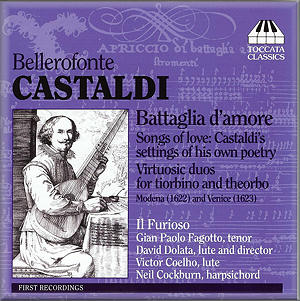
 Il Furioso (Eugenia
Cirrieri, Laura Fabris, Janet Youngdahl (soprano), Gian Polo Fagotto,
Claudio Zinutti (tenor), Victor Coelho (archlute, theorbo, tiorbino),
David Dolata (theorbo, tiorbino), Neil Cockburn (harpsichord))/David
Dolata
Il Furioso (Eugenia
Cirrieri, Laura Fabris, Janet Youngdahl (soprano), Gian Polo Fagotto,
Claudio Zinutti (tenor), Victor Coelho (archlute, theorbo, tiorbino),
David Dolata (theorbo, tiorbino), Neil Cockburn (harpsichord))/David
Dolata 
