Premiered
in January 1893
Ninetta, Strauss’s twelfth operetta,
was quite a success, running for 76 performances at the Theater
an der Wien. It was also staged by a dozen other theatres
in the Austrian Empire but after 1905 it was not given again.
To quote the liner-notes: ‘Sleeping Beauty slept a hundred
years,
Fürstin Ninetta for 102.’
This
is a fate that has fallen upon most of his sixteen operettas.
Die
Fledermaus is practically the only one that is regularly
played although
Der Zigeunerbaron and
Eine Nacht
in Venedig also pop up now and then. The reason for the
neglect is hardly musical but the choice of librettos has
often been called in question. In the case of
Ninetta Strauss
is only partly to blame since he only authorised the plot
and the lyrics, not the dialogue. When he was present at
the first dress rehearsal he was reportedly surprised by
the dialogue, which he found completely at odds with his
music. ‘This libretto does not need any music at all’, was
his comment. In consequence, the present recording, taken
from a concert performance at Berwaldhallen, the concert
hall of the Swedish Radio Symphony Orchestra, omits all the
spoken dialogue.
The
story is filled with misunderstandings and complications
but everything is sorted out in the end and the young lovers,
Adelheid and Ferdinand, are free to marry. But they are a
secondary couple anyway. It is the Russian-born princess
Ninetta, widow of an Italian prince, and the Turkish hypnotist
Cassim Pascha, who are the central characters. Ninetta’s
passion is to dress as a man and during the proceedings of
the operetta, which plays at a beach-hotel in Sorrento, Italy,
she appears in several disguises, which in its turn leads
the guests to believe, in the finale of act II, that Cassim
has murdered five different people. This is also cleared
up before the last curtain-fall and everybody lives happily
ever after, Prosper Möbius is so happy that he indulges in
some yodelling.
So
much for the story. The music is in the main out of Strauss’s
top drawer. There is a short march-like overture that at
once evokes that special Straussian tingle factor. The introduction
scene, with splendid choral writing further enhances the
feel-fine factor. There are solos for the main characters:
Ferdinand, Ninetta and Cassim. There are some duets and several
ensembles, notably the two extended finales to act I and
II. The latter is one of Strauss’s finest creations, not
only for the marvellous melodies but even more for the dramatic
tension and some contrapuntal writing for the chorus. In
addition we are treated to illustrative orchestral effects
and a dark operatic doomsday atmosphere before the murders
are sorted out one by one. Ninetta’s long solo, with its
melismatic opening, should be a fine showpiece at any solo
recital.
The
separate solos and duets are also memorable, perhaps finest
of all Cassim’s waltz
Einst träumte mir (CD 2 tr.
6). This is followed by a children’s ballet, accompanied
by
Neue Pizzicato Polka, Op. 449
, which was
composed by Strauss in the spring of 1892, long before he
finished the operetta. It is exquisitely played here, as
is the rest of the music. The Stockholm Strauss Orchestra
was founded in 1992 and its fifty players are drawn from
all the major orchestras in Stockholm. It has the original
Wiener Johann Strauss-Capelle as its model. They play all
kinds of music and have a repertoire of more than 1200 works.
Judging by this recording they are devoted to the music of
Strauss. The members of the Ninetta Chorus were handpicked
for this production by the chorus-master Bo Wannefors from
the Swedish Radio Choir and the Choir of the People’s Opera
(Folkoperan). Rarely if ever do we encounter such ravishing
choral singing in operetta.
Among
the soloists Jesper Taube’s Cassim stands out as a superb
operetta charmer: manly, warm of voice, with the right operetta
lilt and expressive with words. I have seen and heard him
a number of times, most recently his excellent Dandini in
Stockholm’s
La Cenerentola less than a year ago (see
review).
His singing here surpasses everything I have heard. Almost
on a par with him is Tua Åberg as Ninetta. She has been a
leading coloratura for quite some time now – I first heard
her while she was still a student at the University College
of Opera in Stockholm and thought then that she had something
of Toti Dal Monte about her. The agility and the pinpoint
accuracy at the top are still there as is the beauty of tone,
even though it has hardened slightly. She is however superb
in her chanson in act II (CD 2 tr. 2) – a lovely song! -
as she is in the preceding long hypnotising duet with Cassim
(CD 2 tr. 1).
Fredrik
Strid and Henriikka Gröndahl as the young couple, Ferdinand
and Adelheid, have agreeable voices, though they take some
time to warm up. Ferdinand’s mother and Adelheid’s father
Elin Rombo and Göran Eliasson are excellent. I had reason
to praise Ms Rombo quite recently when reviewing the world
premiere of Sven-David Sandström’s opera
Batseba (see
review).
Ola Eliasson and Samuel Jarrick also make good impressions.
The
recording engineer is Gert Palmcrantz, which for many years
has been a guarantee of excellent sound. Distant applause
is heard at end of acts and after some numbers. The German
libretto can be downloaded but here I have to issue a warning:
it is printed in old German type, which I suppose can pose
problems to at least younger readers. Still it heightens
the experience to be able to understand the essentials of
the plot and who is singing what. What counts most of all
is however the music. I think every lover of Strauss II or
operetta in general should hear this. It is hardly likely
that there will be an opportunity to catch any other performance
of this work nor another recording of it. This one gives
a worthy representation of this delectable score.
Göran
Forsling
























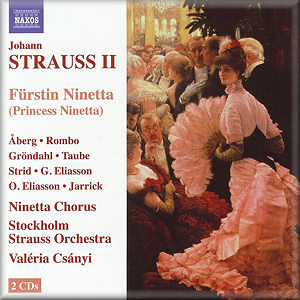

 Tua Åberg
(soprano) – Ninetta Campocasso; Elin Rombo (soprano) – Anastasia
Knapp (Ferdinand’s mother); Henriikka Gröndahl (soprano) – Adelheid
Möbius; Jesper Taube (baritone) – Cassim Pascha; Lord Plato;
Fredrik Strid (tenor) – Ferdinand Knapp; Göran Eliasson
(tenor) – Prosper Möbius (Adelheid’s father); Ola Eliasson
(baritone) – Baron Mörsburg; Samuel Jarrick (baritone) – Emilio;
Consul Rübke; Michael Axelsson (tenor) – Wirth (Landlord);
Anders Blom (tenor) – Quästor (Arbiter); Kristina Martling
(contralto) – Rustan (Cassim’s servant); Katarina Wedin-Nilsson
(soprano) – Laura
Tua Åberg
(soprano) – Ninetta Campocasso; Elin Rombo (soprano) – Anastasia
Knapp (Ferdinand’s mother); Henriikka Gröndahl (soprano) – Adelheid
Möbius; Jesper Taube (baritone) – Cassim Pascha; Lord Plato;
Fredrik Strid (tenor) – Ferdinand Knapp; Göran Eliasson
(tenor) – Prosper Möbius (Adelheid’s father); Ola Eliasson
(baritone) – Baron Mörsburg; Samuel Jarrick (baritone) – Emilio;
Consul Rübke; Michael Axelsson (tenor) – Wirth (Landlord);
Anders Blom (tenor) – Quästor (Arbiter); Kristina Martling
(contralto) – Rustan (Cassim’s servant); Katarina Wedin-Nilsson
(soprano) – Laura 
