Editorial Board
MusicWeb International
Founding Editor Rob Barnett Editor in Chief
John Quinn Contributing Editor Ralph Moore Webmaster
David Barker Postmaster
Jonathan Woolf MusicWeb Founder Len Mullenger
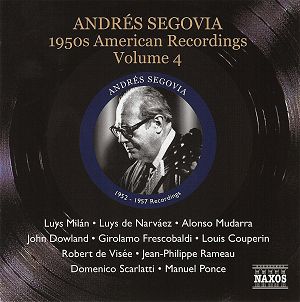
Andrés Segovia - 1950s American Recordings:
Volume 4 Luys MILAN (c. 1500–after
1560) Pavana III [1:32] Fantasia XVI [3:03] Luys de NARVÁEZ (fl. 1526–1549) Canción del Emperador [3:05] Guárdame las vacas [2:48] Alonso MUDARRA (c. 1510–1580) Romanesca [2:00] John DOWLAND (1563–1626) Captain Digorie Piper’s Galliard [2:09] Anon. Galliard [0:43] Girolamo FRESCOBALDI (1583–1643) Aria detta la Frescobalda [6:39] Louis COUPERIN (c. 1626–1661) Passacaglia [6:00]
Six 16th Century Pieces:
Anonymous: Vaghe belleze [1:34] Cesare Negri: Bianco fiore [0:37]
Anonymous: Danza [0:53] Anonymous: Gagliarda [0:58] Anonymous: Se
io m’accorgo [1:52] Vincenzo Galilei: Saltarello [0:59] Robert de VISÉE (c. 1650–c.
1732) Suite in D minor: Prélude [0:43] Allemande [2:28]
Bourrée [0:44] Sarabande [1:44] Gavotte [0:56]
Gigue [1:13] Manuel PONCE (1882–1948) from Suite II: Preámbulo [4:21] Tempo di Gavotta [3:09] Jean-Philippe RAMEAU (1683–1764) Minuet [3:37] Domenico SCARLATTI (1685–1757) Sonata K. 11 / L. 352 [3:19] Manuel PONCE from Suite I: Prélude [2:07] Ballet [2:44] Prélude [1:50] Allemande
[2:35] Gigue [4:45] Andrés Segovia (guitar)
rec. 1952–1957 NAXOS HISTORICAL 8.111092 [71:06]
Perhaps
I am not the best qualified person to review this CD and
this for at least two reasons. Firstly, I belong to a generation
who believe that the greatest guitarists in the world-ever
are Jimi Hendrix, Eric Clapton, Carlos Santana and Jimmy
Page. Perhaps I even have a sneaking admiration for Slash?
But do not get me wrong, I have heard of the classical
guitar – in my day it was John Williams and Julian Bream
that came onto my horizon as I began to explore works by
Michael Tippett, Lennox Berkeley and Malcolm Arnold. Segovia,
I guess was a name that I had heard of – but along with Django
Reinhardt, he belonged to another era, another generation.
The
second reason is that I do not ‘dig’ the point of view that
says that Andrés Segovia’s interpretation is somehow lacking
in light of subsequent scholarship. For example Göran Forsling
writes in these pages that “performing styles have changed
considerably since the 1940s and 1950s. With authentic performance
practice in mind both Landowska and Segovia can appear too
romantic with their rubato playing as opposed to a more strict
adherence to basic tempo.” However he does insist that this
should not be problem. I agree. I will not be bullied by
the ‘Back to Someone or Other who does it Perfect’ school
of playing! He or she never existed. The bottom line is – does
it move me? The answer here is: Yes, it does!
It is often stated that
Segovia was the father of ‘classical guitar’ scholarship.
It is not a field that I can really comment definitively
on – yet it is worth quoting Segovia’s own view of his programme.
He developed "five purposes" as goals for his legacy.
They were outlined by the performer in the Guitar Review
No. 32, Autumn 1969:
1) To
extract the guitar from the noisy and disreputable folkloric
amusements ...
2) I requested the living composers
not in the field of guitar to write
for me. This was the second of my
purposes: to create a wonderful repertoire
for my instrument.
3) My third purpose was to make the
guitar known by the philharmonic public
of the world.
4) To
provide a unifying medium for those interested in the development
of the guitar. This I did through my support of the now well
known international musicological journal, the Guitar Review
5) I
am still working on my fifth and maybe the last purpose,
which is to place the guitar in the most important conservatories
of the world for teaching the young lovers of it, and thus
securing its future.
To
decide if he has fully achieved these goals is beyond my
ken – yet even the briefest look at the world of the classical
guitar would suggest that by and large he has.
It
has been argued that Segovia had a ‘full-blooded’ approach
to the early music. He did not think to play his realisations
on ‘contemporary’ instruments, for example. Further he was
often accused of being cavalier with his editing of historic
manuscripts - he tended to recreate the music in his own
image rather than trying to recover the original context.
Whatever
pupils and followers of Segovia were to say - and not all
of it was complimentary by any manner of speaking, he was
a great innovator. I guess that he laid the ground rules
that others were to follow. Furthermore, however much the
integrity and historical accuracy of his interpretations
fall short of present standards, he was acclaimed in his
day and was regarded as a genius. Sometimes in this world
the great individual is the one who begins the job: sometimes
it is the person who finishes the task. Often it can be both.
The
programme on this CD is, to my ear at least, well balanced.
The music is not played in any kind of chronological order
nor does it attempt to present composers from various countries
in ‘local’ groups. Most of the pieces are 16th and 17th century
including works such as the John Dowland’s Captain Digorie
Piper’s Galliard written for lute and Louis Couperin’s Passacaglia – originally
for organ. Later composers are represented by the great Mexican
Manuel Ponce although his work does seem to nod towards Bach – so
it is in some ways appropriate for them to be included on
this CD even if the Suites are given as excerpted
movements!
Segovia
plays music that was originally written for keyboard, lute
and guitar. Frescobaldi’s Aria was a set of variations
composed for the harpsichord. The six 16th Century pieces
are from a collection of 16th Century Italian
guitar music. Baroque guitar works by Robert de Visée are
contrasted with music by Luis Milan, Luys de Narvaez and
Alonso Mudarra. These are all names that are new to me! I
am on better understood territory with the Minuet by
Rameau and the Sonataby Scarlatti!
The
sound quality of this CD is utterly remarkable. Bearing in
mind that these transfers derive from the mid nineteen-fifties
they sound well nigh perfect. Of course, the perfectionist
will complain about hiss here and resonance there – but to
my innocent ear it sounds as if Segovia has returned from
heaven and is present in the room with me. I listened to
this CD drinking a glass of sherry – it was only the Spanish
sunshine that was missing.
However,
one word of warning: the nature of this CD is of a single
instrument playing some 15 works in 30 tracks. Do not listen
to all this at a sitting. Play it in order by all means – but
please take a break. Go top up the ‘fino’ - possibly after
the Couperin and again after Manuel Ponce’s Second Suite.
This, like sherry, is music to be savoured - not taken at
a gulp.
























 Andrés Segovia (guitar)
