This disc covers Segovia’s recordings of music from the late renaissance
and the baroque – real or faked. In the ’fifties little of this
repertoire was known beyond a fairly narrow circle of specialists.
Segovia made an important contribution to spread this often exquisite
music – not to every Tom, Dick and Harry but at least to general
lovers of classical music. The period performance movement was
in its infancy and to Segovia it felt natural to adapt the music
for the modern six-stringed guitar instead of taking up the baroque
guitar or the lute. The consequence was that he distanced himself
from the originals. He also performed the works in a romanticized
manner with heavy accents, wide dynamics and freedom of tempo.
For today’s listener who have grown accustomed to more authentic
playing he can appear dated, heavy and rather unsubtle. Take Luys
Milan’s Pavana III as an enlightening example. It is energetic
and played with great conviction but rather four-square. I only
had to take down Michael Tillman’s disc A
Renaissance, which I reviewed a couple of years ago, to
find something different. He too plays this music on a modern
guitar and in his own transcriptions, so the comparison is apt.
This music is softer, more gracious and intimate but also at the
lower volume and less outgoing approach he finds lots of nuances
and he invites us to listen, not by shouting but by whispering:
“a well-needed counterpoint to the terror, the catastrophes and
the turmoil in the world around us” as I wrote at the time.
The
difference between the two players is at least as big as when
comparing a full symphony orchestra and a small period group
in Bach. Segovia finds his own subtleties and I can well think
of people who prefer his earthbound approach. He plays Mudarra
(tr. 5) with more light and shade and Dowland is OK but the
anonymous Gaillard, formerly attributed to Dowland, is
robust almost to a fault.
The
Aria by Frescobaldi is originally for harpsichord and
a set of variations on a theme that probably is Frescobaldi’s
own. Transcribing music from one instrument to another, further
distances it from its own time and the flexible tempos that
Segovia adopts are actually advised by the composer. Also Louis
Couperin’s Passacaglia is for a keyboard instrument.
It is sensitively played but with heavy accents in places.
The
six 16th century pieces are from an anthology by
the Italian 19th century musicologist Oscar Chilesotti
and Segovia was very fond of these miniatures as concert-openers.
They are melodious and attractive, the last one – a lively dance
over an ostinato bass – was composed by Vincenzo Galilei, father
of physicist and astronomer Galileo Galilei.
Robert
de Visée was a court musician in Paris between 1680 and 1732
– a long time indeed. This was the era of Louis XIV and eventually
he also became the guitar tutor of Louis XV. This is also music
that sounds best on a baroque instrument but the Sarabande
is a fine piece also on a modern instrument and so is the lively
Gavotte.
Readers
may wonder what 20th century composer Manuel Ponce
is doing in this company but both the suites represented here
were written by request from Segovia in a somewhat Bach-like
style. Since Bach was well-known even in the early 1930s he
instead ascribed them to Alessandro Scarlatti and Sylvius Leopold
Weiss. According to Miguel Alcázar, the editor of Ponce’s complete
music for guitar, attributed them to other composers ‘in order
to avoid playing only works by Ponce in his recitals. The ‘Scarlatti’
pieces (tr. 22, 23) are marred by an over-resonant recording
that diffuses the sound almost to distortion. This is also the
case with Domenico Scarlatti’s charming Sonata (tr. 25).
In the Minuet by Rameau one can clearly hear that the
piece was conceived for harpsichord – or so I believed when
hearing it but it is actually a transcription of a dance interlude
from the opera Platée. I don’t think anyone could believe
the concluding ‘Weiss’ pastiches to be early 17th
century but they are attractive pieces – Weiss was a great composer
of lute music! – and the Allemande and Gigue are
riveting.
Those
who have been collecting this Segovia series can safely invest
in this volume too but those who feel uncertain whether they
will appreciate his dated performance style should listen before
buying. From an historical point of view it might be argued
that this music wouldn’t have been performed at all fifty years
ago if it hadn’t been for Segovia championing it. Thus they
are valuable documents and add something significant to his
discography.
Göran
Forsling
























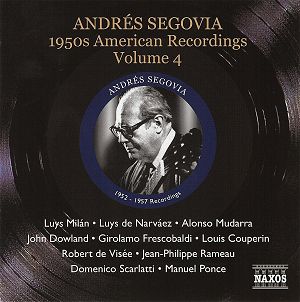
 Andrés Segovia (guitar)
