Editorial Board
MusicWeb International
Founding Editor Rob Barnett Editor in Chief
John Quinn Contributing Editor Ralph Moore Webmaster
David Barker Postmaster
Jonathan Woolf MusicWeb Founder Len Mullenger
Karol
SZYMANOWSKI (1882-1937)
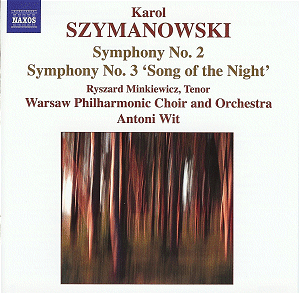
Symphony No. 2 in B flat major, Op. 19 (1910) [34:38]
Symphony No. 3, Op. 27, ‘Pieśń o nocy’ (Song of the Night)
(1916) [26:10] Ewa Marczyk (violin solo) (2)
Ryszard Minkiewicz (tenor) (3)
Warsaw National Philharmonic Choir/Henryk Wojnarowski (3)
Warsaw National Philharmonic Orchestra/Antoni Wit
rec. 16-19 April 2007, Philharmonic Hall, Warsaw.
Polish texts and English translation provided NAXOS 8.570721 [60:48]
Antoni
Wit must be a very busy man indeed if his steady stream of
recordings is anything to go by. His Penderecki Te Deum (see review) and
Mahler 8 (Naxos 8.550533-34 - see review)
are among his most memorable outings so far, but how does
he fare with these
Szymanowski
symphonies?
The
Second Symphonywas not well received at its Warsaw
premiere in 1911 but audiences in Berlin, Leipzig and Vienna
took to it straightaway. According to the composer it consists
of an Allegro moderato ‘in a grand manner’, a theme
and nine variations and an ‘adagio and finale with a fugue’.
First impressions are that this music is heavily influenced
by Richard Strauss. Indeed the opening movement has all the
creaminess of Rosenkavalier and the sweep of Ein
Alpensinfonie,the spell only broken by the first
entry of the boxy timps at 1:59. Those surging string tunes
are pure Strauss, the Warsaw players giving them plenty of
body and brilliance.
On
the whole the band is well recorded in sound of boldness
and breadth. Wit keeps the musicians on course, although
even he can’t redeem the less inspired patches. In particular
those Scriabinesque passages are not so much creamy as clotted.
That said the final half minute of the first movement has
an inner glow that is most appealing.
The
start of the Lento, lovingly phrased, is infused with
that same Straussian warmth. The Scherzo is much more
playful and the Warsaw band give it plenty of scoot and scurry.
A hint of Don Juan, perhaps, before we slip seamlessly
into the strange little gavotte and minuet. The latter has
some lovely, limpid writing; at times Szymanowski achieves
a real sense of ebb and flow, that extraordinary ‘breathing’ quality
one associates with Strauss.
The
various elements of the symphony are expertly dovetailed
but the Vivace marks a distinct change of mood and
direction. This time the timps make a much more powerful
impact, the string players digging in for all they’re worth.
And surely this has its rhythmic roots a long way east of
Vienna?
The
fugal finale veers towards Scriabin again, although it sounds
somewhat opaque at times. That said Wit conveys the rising
tension very well indeed. It’s an imposing, muscular finale
that expands without any sign of strain. All credit to the
engineers for keeping it all in focus and sustaining that
huge orchestral weight.
And huge is the operative word in the Third Symphony, scored
for tenor soloist, chorus and large orchestra – including
organ, bells, tam-tam, piano, celesta and two harps. The
sung text, ‘The Song of the Night’, is from a poem
by Mawlana Jalal ad-din Rumi, a 13th-century Persian
poet and founder of the Mevlevi order of Dervishes. The first
movement is wonderfully evocative, the pulsing organ pedal
and muted timps a prelude to the tenor’s entry with the words, ‘Do
not sleep, O friend, through the night!’ Even though Szymanowski’s
sound-world is still reminiscent of Scriabin there is a hint
of Debussian languor as well. The music certainly shimmers
and oscillates most seductively.
The chorus sings with passion and unanimity, cutting through the music’s
more diffuse textures. They are a fine collection of singers,
having played a key part in the success of the Naxos Mahler
8. Wit held that great structure together admirably and he
does the same here, building up to that blazing peroration
that begins at 6:35. This is incredibly sensuous music, played
with panache.
The orientalism of the second movement is unmistakable from the outset,
the chorus’s wordless melisma adding to the perfumed orchestral
textures. It’s heady stuff, a work that cries out for an
SACD recording, if only to uncover all those exotic orchestral
details this CD doesn’t always reveal.
The tenor Ryszard Minkiewicz sounds suitably transported in ‘So quiet, others sleep... / I and
God alone in the night’ and is even audible above the outburst
at 1:30. What follows is altogether more diaphanous, a sense
of barely suppressed ecstasy that grows to a light-drenched
climax before fading to a serene close. There is plenty of
sinew and muscle in this symphony and no excess fat, which
translates into a much more robust, individual and engaging
work.
Szymanowski fans need not hesitate, if only to savour this captivating ‘Song
of the Night’. Yes, the Second has its moments but it’s too
derivative and uneven to be completely satisfying. That said,
it’s a plus having both symphonies on one disc. As for alternatives
there is a Sinaisky 2 and 4 on Chandos (only available as
a high-def lossless or MP3 download) and a Third and Stabat
Mater under Polyansky on Chandos CHAN9937.
Whatever the competition this new Naxos disc is very welcome indeed.
Another triumph for Maestro Wit and his busy Warsaw band.
Dan Morgan
Please support our advertisers below by clicking on the logos for further information.

























 Ewa Marczyk (violin solo) (2)
