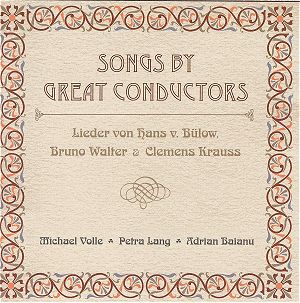
Today we tend to divide the world of classical music into two
halves: the composers on the one side and the interpreters on
the other. Two hundred years ago there were no such borderlines:
the composer was also the interpreter and sometime during the
19th century, interpreters also wanted to create. Richard
Strauss was a noted conductor, today best known as a composer;
Gustav Mahler was definitely best known in his lifetime as the
great conductor, who only had time to compose during the summer
vacation and his music was largely unknown or misunderstood. We
do indeed have great conductors today as well who are also important
composers. Pierre Boulez is arguably the best known, Lorin Maazel
and in the not so distant past Leonard Bernstein.
On
the present disc we meet three important conductors from three
generations who also had ambitions to compose. I knew some of
Bruno Walter’s songs from a Bluebell record with Swedish soprano
MariAnn Häggander – none of the present ones incidentally –
but both von Bülow and Krauss were new to me in this capacity.
They were all three, so to speak, children of their time, influenced
by leading masters from their respective previous generations.
In von Bülow’s music one can trace Schumann – also Brahms who
was an exact contemporary. In addition one can hear Wagner,
whom he first met in 1850, the year when he composed his Fünf
Lieder Op. 5. By 1884, when von Bülow wrote the Op. 30 songs,
Wagner was already dead but in the intervening years he had
revolutionized music and von Bülow had adopted the chromatics
of Tristan and the Ring operas.
In
his youth Bruno Walter had heard von Bülow conducting and was
so impressed that he decided to become a conductor himself.
Early in his career he was Gustav Mahler’s assistant in Hamburg
and there the two developed a deep friendship. It was also Walter
who conducted the premieres of the Ninth Symphony and Das
Lied von der Erde and it’s no wonder that he was influenced
by the older composer. This can clearly be heard in both groups
recorded here.
The
third conductor-composer represented on this disc, Clemens Krauss,
was in his turn closely tied to Richard Strauss. It was he who
wrote the libretto for Capriccio, which was also dedicated
to him. His Rilke songs were written long before this – they
were published in 1920 – but Strauss’s spirit unmistakably hovers
over them. There are also references to Alban Berg and his Sieben
frühen Lieder from 1907.
And
what about the songs? Let me say at once that they are permeated
by genuine craftsmanship, sensitivity to the poetry and expressive
piano parts. There is no doubt that these are inspired and personal
utterances. I was impressed by the youthful freshness of the
early Bülow songs, where especially Wunsch (tr. 3) is
highly attractive, and of the late songs Op. 30 the stormy Wenn
an den Weltmeer’s Klippen (tr. 8) is almost breathlessly
intense. Walter’s Der junge Ehemann (tr. 10)
with its Wunderhorn echoes might be mistaken for a ‘real’
Mahler song – and one can have worse models. The high spots
in his oeuvre are however the three Heine-settings, where Auf
ihrem Grab (tr. 14) is possibly the best and most personal.
Clemens Krauss’s Gehst du aussen die Mauern entlang (tr.
17) is another song I will return to with pleasure.
It
helps a lot that these are sung with such commitment and vocal
and verbal acuity by Michael Volle – Bayreuth’s present Beckmesser
– and the expressive Petra Lang. It is difficult to imagine
better advocates for this music. They are expertly accompanied
by Adrian Baianu and the recordings, made almost three years
apart, cannot be faulted. There is a good essay and full texts
and English translations. Full marks for the presentation.
So
why have these songs been collecting dust in archives for 100–150
years? It is certainly not for lack of professionalism from
the composers, it’s not because of bad poems, quite the opposite.
It isn’t easy to put a finger on it but however skilled these
three composers are they are epigones and lack something of
the individuality and personality of the real masters. Still
I must repeat my verdict: this is good music and good music
is always a pleasure to hear. Pâté de foie gras is always
nice – as long as I can afford it – but I’m also happy every
time I’m being served well cooked steak and kidney pie. I would
be happy indeed to hear some of these songs in a recital, but
in the meantime this disc is a splendid substitute.
Göran
Forsling
see
also Review
by Jim Pritchard