When Dufay died he left provision in his will for masses to be
said in perpetuity for the repose of his soul. This included thirteeen
low masses and three annual polyphonic masses, one being specified
as his own Mass for St. Antony of Padua. This had been performed
annually on the saint’s day for many years before Dufay’s death.
The composer left his manuscript of the mass and several antiphons
to the Chapel where it was to be performed. We do not know how
long this annual performance persisted, but we do know that the
chapel was demolished in 1796.
Dufay’s mass did
not seem to have survived, but there is quite a quantity of
music which has come down to us from his period and might
be by Dufay but cannot confidently be ascribed. Thanks to
some detective work by David Fallows, the ordinary of the
mass was recovered from anonymity in a manuscript in Trent,
Italy. But Dufay’s mass, being for a particular saint, would
almost certainly have had settings of the propers for that
saint’s day. Again more detective work meant that a set of
propers in another Trent manuscript have been identified.
We now have ten
movements (Introit, Kyrie, Gloria, Gradual, Alleluia, Credo,
Offertory, Sanctus, Agnus Dei and Communion) which are confidently
ascribed to Dufay’s Missa de S Anthonii de Padua. But don’t
expect a common musical thread to run through them; that was
not the way in Dufay’s time. Each of the propers is related
to the plainchant setting of the proper and naturally enough
there is no musical relationship between the plainchant propers
of the saint’s day. But when this mass was written, the idea
of a full polyphonic mass was still rather new - the first
one probably appeared in the 1440s - so the disparity between
the movements of the ordinary would not have been so obvious.
All this musicology
is completely fascinating and is explained in great detail
in the CD booklet of the Binchois Consort’s recording of the
mass, now reissued by Hyperion. I am a great believer in getting
as much background as possible to a recording, but Andrew
Kirkman and his group deliver such a vigorous, gripping performance
that any question of reading the background disappears, you
just want to listen to their performance.
Perhaps part of
the impression of their performance comes from the fact that
here is an English group giving a very un-English performance.
No objectivity or coolness here, instead they sing Dufay’s
music with a liveliness, incisiveness and attention to rhythm
that makes the music positively toe-tapping. The group employs
just six singers (two counter-tenors, and four tenors) and
for most of the time the mass is in just three parts, but
such is the brilliance and complexity of Dufay’s writing that
you would not know it.
The mass is built
on a leisurely scale, which would rather preclude its complete
liturgical performance in a modern day setting. There is around
50 minutes of the mass, the Gradual and the Alleluia each
last over six minutes. But the sheer scale is part of the
work’s charm; we can simply wonder at Dufay’s sheer inventiveness
at creating so much infectious polyphony.
This is an engrossing
and highly characterful performance. Perhaps there are one
or two rough edges, but given the singers’ lively articulation
of Dufay’s rhythms this is easily forgivable. Perhaps Kirkman
misses just one or two moments of reflection and devotion,
but his interpretation is of a piece - and wonderfully attention-grabbing.
This is a wonderful
disc and a candidate for one of my discs of the year. Kirkman
and his group deliver a confident and vivid interpretation
of Dufay’s fine mass which makes the disc a candidate not
only for convinced lovers of music of this period but also
for the unconvinced as well. I defy anyone to listen to this
music and not want to tap their toes!
Robert Hugill
see also Review
by Brian Wilson January BARGAIN
OF THE MONTH
























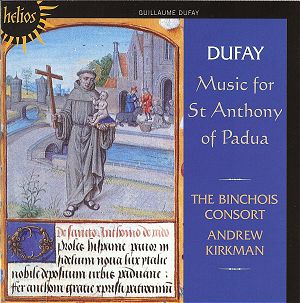

 The Binchois
Consort/Andrew Kirkman
The Binchois
Consort/Andrew Kirkman 
