Editorial Board
MusicWeb International
Founding Editor Rob Barnett Editor in Chief
John Quinn Contributing Editor Ralph Moore Webmaster
David Barker Postmaster
Jonathan Woolf MusicWeb Founder Len Mullenger
Guillaume DUFAY (c.1397-1474) Music for Saint Anthony of Padua Missa de S Anthonii de Padua (c.1450, ed. David Fallows)
[54:27]
Introit In media ecclesiae [5:49] Kyrie [2:28] Gloria [8:06]
Gradual Os iusti meditabitur sapientiam [6:41]
Alleluia Anthoni compar inclite [6:23] Credo [8:53]
Offertory Veritas mea [3:35] Sanctus [6:13] Agnus Dei [3:28]
Communion Domine, quinque talenta [2 :41] O proles Hispaniæ / O sidus Hispaniæ [4 :28] The Binchois
Consort (Mark Chambers, Fergus McLusky (discantus); Edwin
Simpson, Matthew Vine (tenor I); Andrew Carwood, Chris
Watson (tenor II))/Andrew Kirkman
rec. with assistance from the Plainsong and Medieval Music
Society, 17-19, 29 January 1996, venue not stated. DDD.
Booklet with notes in English, French and German.
Texts in Latin with English translation. HYPERION
HELIOS CDH55271 [59:02]
By one of those unfortunate
coincidences, this recording first appeared almost simultaneously
with the Archiv recording of the Mass and Veni creator spiritus (Pomerium/Alexander
Blachly, 447 772-2). Reviewers then found it hard to choose
between the two but at its new bargain price this Hyperion
recording now enjoys a clear advantage and, in any case, the
Archiv CD appears to have been deleted from the general catalogue,
though it is available as a high-quality CD-R from ArkivMusic.
Saint Anthony of Padua,
not to be confused with Saint Anthony the first hermit, for
whose feast Dufay also wrote a Mass (see below), seems to have
ranked high in Dufay’s devotions; one of his treasured possessions
was a piece of the saint’s belt, so it is hardly surprising
that the Missa de S Anthonii de Padua should be one
of his best pieces – assuming that the work we have here is
indeed that Mass. Thanks to detective work by David Fallows,
whose edition is used for this recording, the attribution to
Dufay of a set of anonymous propria in a manuscript
from Trent is almost certain.
The normal practice was
to set the common, the fixed portions of the Mass: Kyrie, Gloria, Credo, Sanctus and Benedictus and Agnus
Dei, as Dufay does in his best-known setting, the Mass Se
la face ay pale. The propria or propers, those
sections special to the day, are then chanted. Dufay, however,
here sets both the common and the propers for a complete Mass.
The Franciscan St Anthony
of Padua (d. 1331) was known as the ‘Hammer of Heretics’ for
his missionary work in France, Italy, Sicily and Mauretania. As
a Confessor and Doctor of the Church, the Mass for his day
(June 13th) follows with variations the pattern
for a Confessor. Before the Tridentine reforms a number of
local variants prevailed. In most of England, the so-called
Sarum Rite was most common, but there were variations in the
York, Hereford and other usages. In other countries, too,
local variants existed, mostly swept away after the Council
of Trent, except for the Ambrosian Rite at Milan and the Mozarabitic
Rite in one chapel of Toledo Cathedral. Dufay’s setting, therefore,
presumably intended for Cambrai, does not correspond exactly
with either the Sarum or Tridentine usages. (For the Tridentine
propers for his day, go to the catholic.org website.)
The Introit, In media
ecclesiæ – In the midst of the assembly he opened his
mouth – and Gradual, Os justi – The mouth of the righteous
shall rehearse wisdom – are as per the Tridentine Rite, with
a short sequence in praise of Anthony, Anthoni compar
inclite, following the Alleluia – Anthony our illustrious
companion on the way. (Compar almost = ‘mate’ or ‘buddy’.) The
Offertory is Veritas mea, as in the Sarum Rite – My
truth and my mercy are upon him – and the Communion, Domine,
quinque talenta compares the saint to the faithful servant
in the parable who increased his talents, instead of the
related text Fidelis servus used in the Tridentine
and Sarum usages.
What we have here is,
thus, the complete Mass for the day, except for the Collect,
Epistle, Gospel, Preface and Canon, which would have been chanted. I
suppose it is too much to hope that some day we can be given
the complete works, setting the polyphonic sections within
the chant, as in Paul McCreesh’s various liturgical reconstructions. (A
Venetian Christmas, 471
333-2, Prætorius’s Christmas Mass, 439
250-2, or Venetian Vespers, 476 1868.) With twenty
minutes of potential playing time left, this could have been
achieved, but it is churlish of me to complain when the performances
are so superb – and we are given a bonus in the form of the
motet O proles Hispaniæ/O sidus Hispaniæ – O scion of
Spain/O star of Spain – intended for Compline on the eve of
the feast.
If you sometimes find
it difficult to come to terms with earlier medieval music,
you’ll probably find yourself on more familiar territory here. Polyphonic
music developed in different ways well after the time of Dufay
but if you have already found your way around its later exponents,
such as Tallis, Byrd or Palestrina, you shouldn’t have too
much trouble relating to Dufay, especially as performed here.
I have already run out
of superlatives for the various Gothic Voices reissues on the
Hyperion Helios label which I have reviewed recently. These
performances by the Binchois Consort are equally likely to
exhaust my vocabulary, especially if their Music for St
James comes my way when it is reissued shortly, as I hope
it does. (If not, I shall certainly buy it.) The Consort
is a small group, six in all, two each of discantus,
tenor I and tenor II. One of their number, Andrew Carwood,
is the director of another eminent group, the Cardinalls Musicke.
After an initial session
in which I listen to the CD once through without making notes,
I usually then take up pen and paper and make detailed notes. In
listening to this recording I never went to the second stage,
since it was evident from the start that any comments would
be repetitious in their praise. I cannot imagine anyone performing
this music better. The Binchois Consort are consistently more
sprightly than their Archiv rivals Pomerium, to the benefit
of the music. I shall probably retain the Archiv version for
the sake of its filler, Veni creator spiritus, but it
is to the Helios that I shall turn for the Mass.
The recording is equally
excellent – as usual with Hyperion, it never intrudes on one’s
enjoyment of the music. I was, however, a little surprised
not to find details of the recording venue, since Hyperion
are usually scrupulous in this matter.
The booklet is the usual
Hyperion model of information, with notes by Andrew Kirkman
and full texts with English translations. Apart from the Helios
logo on the front, it is a straight reprint of the original – would
that other record companies were as generous with their bargain-price
reissues. The Latin texts are presented without misprint and
the translations are accurate – two things which cannot always
be taken for granted.
I know that I have only
recently nominated the Helios reissue of Music for the Lion-hearted
King (CDH55292)
as Bargain of the Month but this Dufay reissue is just as deserving.
The booklet advertises the Binchois Consort’s
version of Dufay’s undoubtedly authentic Mass for St James
the Greater as available on the Helios label, CDH55272,
an announcement which seems to be a little premature; I understand
from Hyperion that its reappearance is imminent (March 2008). Further
Binchois Consort recordings of the Mass Puisque je vis (CDA67368)
and the Mass for St Anthony Abbot (CDA67474) remain
at full price. (See Em
Marshall’s favourable review of the latter: “gorgeous works
... outstandingly performed.”) There is also music by Dufay
on two excellent Helios reissues of the Gothic Voices which
I have reviewed recently: The Castle of Fair Welcome (CDH55274)
and The Garden of Zephirus (CDH55289). If
that still does not exhaust your appetite, try another Hyperion
full-price Binchois Consort CD, Josquin and his Contemporaries (CDA67183).
I haven’t heard any of the current versions of
Dufay’s Mass Se la face ay pale but I note that Alpha
are about to reissue in February 2008 their highly-rated version
at bargain price (Alpha908). It’s time that I replaced
my elderly and unidiomatic Vox/Bach Guild recording of this
work (Hans Gillesberger) and it is to the Alpha version that
I shall turn. There is a good recording of Dufay’s Mass L’homme
armé on Naxos 8.553087 (Oxford Camerata under Jeremy Summerly).
The Wikipedia article on Dufay was reliable when
last I looked, but be aware, as always, that it is subject
at any time to inaccurate additions – and the section on his
Masses omits any reference to the present work. There are
scores of various pieces by Dufay available online but, unfortunately,
none which relate to the present works.
Brian
Wilson
Please support our advertisers below by clicking on the logos for further information.
























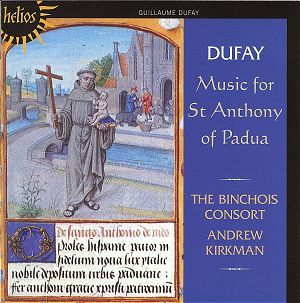

 The Binchois
Consort (Mark Chambers, Fergus McLusky (discantus); Edwin
Simpson, Matthew Vine (tenor I); Andrew Carwood, Chris
Watson (tenor II))/Andrew Kirkman
The Binchois
Consort (Mark Chambers, Fergus McLusky (discantus); Edwin
Simpson, Matthew Vine (tenor I); Andrew Carwood, Chris
Watson (tenor II))/Andrew Kirkman