‘Uncompromising in its modernity’ is the phrase I used in my recent
review of works by Gloria Coates. That is certainly true of this
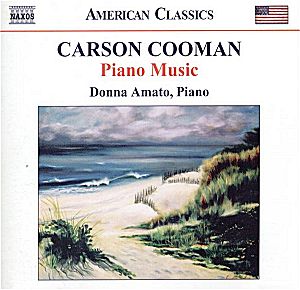
disc of Carson Cooman’s piano music, nearly all of it written
this century. But while Coates seems to take her cue from the
avant-garde composers of the 1960s and 1970s Cooman’s influences
are harder to discern. That said his sound-world – which includes
the use of serial techniques – isn’t what you’d call instantly
accessible; which is probably why this isn’t as ‘unashamedly pleasant’
as the disc of symphonies and other works reviewed by my colleague
Jens F. Laurson (review).
I must confess to
some surprise at the 26-year-old composer’s vast output – more
than 600 works – but this also made me curious as to whether this
was a case of quantity before quality. In particular I was intrigued
to hear how Cooman would transfer the distinctive Orkney landscape
of poet George Mackay Brown to Nantucket Island, Massachusetts,
where Op. 466 was written. In this case the background detail
adds little or nothing to the music itself. Maxwell Davies it
isn’t, but there is an arresting spikiness to the writing that
is hard to ignore. That said the turbulence is shot through with
rays of lyricism – listen to that tolling melody that begins at
4:06 – and at times it’s strongly reminiscent of Debussy in marine
mode, albeit refracted through the prism of Cooman’s own,
21st-century, sensibilities.
A surprisingly enjoyable
appetiser, not quite as uncompromising as I’d expected. And I
wasn’t prepared for the wry humour of the Kayser Variations
either. Written for a retiring chemistry professor, one Margaret
Kayser, this piece is a set of variations on God Save the Queen.
Apparently part of Cooman’s method includes Periodic Table in-jokes,
but as before this information is not essential to our enjoyment
of the piece. It is perhaps a tribute to his training as an organist
that Cooman handles these variations with such ease and fluency.
But make no mistake he can make this grand old tune boogie and
stomp when required. And surely there is a passing reference to
Saint-Saëns’ Carnival of the Animals in the section that
begins at 4:20?
Which brings me to
the US-born pianist Donna Amato, who also teaches piano at the
University of Pittsburgh. She has a formidable technique and certainly
has no trouble with the more powerful, percussive elements of
this music. The Naxos engineers have opted for a relatively close
balance but the piano has plenty of weight and detail.
According to Cooman
his Dream-Tombeau: Crucifixus ‘imagines the time that Jesus
was in the tomb – between his death and his impending resurrection’.
Reading the composer’s notes – not always as illuminating as I
would have liked – there seems to be a musical-spiritual element
to some of his writing, perhaps reminiscent of that other great
organist-composer Olivier Messiaen. In this work of transformation
Cooman makes use of a 12-note set, a chordal sequence and a quote
from a Lassus motet. No doubt these elements are present and audible
but the abiding impression of this piece is that it evokes a sense
of timelessness with its long, sustained notes and sense of stasis.
Be warned, the close miking picks up every sympathetic vibration
from the piano. Still, it’s a strangely compelling piece.
Cooman’s kaleidoscope
of colours and irregular rhythms also contribute to the Messiaen-like
flavour of Crucifixus. But welcome shafts of lyricism pierce
the dense clouds of dissonance, as at 5:20. And anyone familiar
with the music of John Tavener might recognise the single notes
struck like bells or Tibetan bowls, which bring a degree of spiritual
intensity to the proceedings.
At 21 minutes Crucifixus
is the longest piece on this disc and it does come close to outstaying
its welcome. But whatever my reservations Cooman is clearly a
composer with many faces. He can be whimsical in the Kayser
Variations, rigorously academic in Crucifixus and genial
in To Gwyneth and Postcard Partita, the latter a
collection of vignettes for his friends. The former, a tribute
to American composer Gwyneth Walker, is warmly expansive, quite
at odds with Dream Etudes, which has more in common with
the soundscape of Crucifixus.
Certainly ‘Reflections’
and ‘Ringing’ have strongly percussive qualities – lots of note
clusters and manic trills – but sandwiched in between them are
the marvellous, bell-like sonorities of ‘Singing’. And what a
contrast with Partita, which has a generally relaxed demeanour.
That said, Postcard to the North Country is brief but exhilarating,
the most memorable piece in this delightful set of miniatures.
A Summer Sunrise, with its carillons and dance rhythms,
has a strong, improvisatory feel, as if the composer were sitting
at the piano making music in good-humoured company.
Not so congenial is
the Piano Sonata No. 4 which, despite its descriptive titles,
finds Cooman in powerfully dissonant mode. Commissioned by and
dedicated to Amato, this piece is the one that listeners may find
hard to comprehend. There is none of that compensating lyricism,
just a dark and impenetrable forest of note clusters and occasional
bell-like sonorities. Cooman explains his method in the liner-notes
but I imagine the average, reasonably enlightened, listener will
probably find its ‘interlocking canonic structures’ and Chopinesque
references hard to spot.
A mixed selection
and a mixed bag, too. There is some spontaneous and memorable
music-making here, and whatever my reservations about the
more abstract – even cryptic – pieces Cooman is remarkably
confident for a composer only in his third decade. This disc
has certainly piqued my interest in his other works and that,
surely, is what adventurous programming is all about.
Dan Morgan
see also Review
by Jonathan Woolf
























 Donna Amato
(piano)
Donna Amato
(piano) 
