Site
Map
More
Reviews
How
to find a review
Classical CD Review Archive
Book
Reviews
Film
Music Reviews
Jazz
CD Reviews
Nostalgia
Comment
Norman
Lebrecht Weekly
Arthur
Butterworth Writes
Phil
Scowcroft's Garlands
Classical
blogs
Reviewers
Logs
Announcements
Don't
Go Here!
Community
Bulletin
Board
Web
Ring
Reviewers
Helpers
invited!
Resources
How
Did I Miss That?
British
Composers
British
Light Music Composers
Other
composers
Indexes
Label
Masterwork
Discographies
On-line
Music
[Download sites]
Themed
Review pages
Our
Classic Classics
Online
books
MWI
Classical
Encyclopaedia
Gilder
Dictionary of
Composers
MWI
Pop
Encyclopedia
Other
Complete
Books
Programme
Notes
British
Music Society
Performers
The
BBC Proms
Musical
WWW pages
Classical
Music Online
Recording
Companies and Retailers
Agents
and Marketing
Publishers
Non-Classical
Web pages
Orchestra
Web Sites
Newsgroups
Web
News sites etc
Editorial
Board
Classical Editor
Rob Barnett
Seen & Heard
Editor and Webmaster
Bill Kenny
MusicWeb Webmaster
Len Mullenger
Assistant Webmasters
Patrick Waller
David Barker
PotPourri
A
pot-pourri of articles
MW
Listening Room
MW
Office
Helping
MusicWeb
Advice
to Windows Vista users
Questionnaire
Site
History
What
they say about us
What
we say about us!
Where
to get help on the Internet
CD
orders By Special Request
Graphics
archive
Currency
Converter
Dictionary
Magazines
Newsfeed
Web Ring
Translation Service
Rules
for potential reviewers :-)
Do
Not Go Here!
April Fools
|

 |
 |
|

alternatively
Crotchet
AmazonUK
AmazonUS |
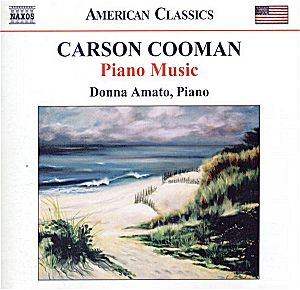
Carson COOMAN (b.1982)
Seascape Passion; Midday Brightness (Third Piano Sonata)
Op.466 (2002) [12:23]
Kayser Variations (1997) Op.63 [5:59]
Dream-Tombeau; Crucifixus (2003) Op.516 [21:30]
For Gwyneth (1999) Op.168 [2:49]
Dream Etudes Book II (2001) Op.253 [10:09]
Postcard Partita (2002) Op.420 [9:01]
Fourth Piano Sonata (2005) Op.620 [15:02]
Donna Amato
(piano)
rec. Kresge Recital Hall, Carnegie Mellon University, Pittsburgh,
July 2006
NAXOS 8.559350 [77:12]
|
|
Carson
Cooman is a prolific composer as those who have cause to write
about him invariably take care to note. For a composer who
has not yet progressed beyond his mid-twenties his opus tally
is astounding. I note that Naxos doesn’t print these details
in its outer case track-listing but does do so in the composer’s
own liner notes. Thus the most recent work here, the Fourth
Piano Sonata, bears the opus number 620. This perhaps shouldn’t
cause critics to narrow their eyes as much as perhaps they
do, but it’s certainly the case that Cooman has made Villa
Lobos and Milhaud look positively dilatory.
Cooman
may be better known for his piano works written for orchestral
forces but the solo piano works have their own strong character.
It’s fortunate that they’re played by that champion of music
new and obscured, Donna Amato. She’s a splendid exponent, architecturally
and tonally sensitive, and capable of considerable interpretative
nuance.
Seascape
Passion; Midday Brightness (the
Third Piano Sonata) was written in 2002. It opens in jagged
and unlikeable fashion before calming in the clement breeze
of its second section, chordal and strong; brittle raindrops
fall abruptly. We end in contrasting twilight. Cooman claims
here a fusion of technical astuteness and nature painting
to produce a twelve-minute work of strong contrasts and complex
sound world.
The
Kayser Variations is a set of variations on God Save the
Queen. It’s heard in mutilated form in the broken down
left hand voicings or heard in substituted chords – or indeed
stated in full. Rather amusingly Cooman doesn’t stint some
wry, verbose and slangy voicings, nor indeed does he shy away
from a modicum of good old school barrelhouse.
Dream-Tombeau;
Crucifixus is the longest work here. It was written for the
Canadian pianist, composer and researcher Gordon Rumson in
2003. Cooman notes that it was inspired by Rumson’s piano playing
and musicianship. It includes a twelve-tone row, a tonal, chordal
section and a quotation from Lassus. It’s a long work and despite
repeated hearings I can’t bring myself to like it. Silences
are extended and there are some terse flurries not unreminiscent
of some of the more bracing and argumentative moments of Seascape
Passion. The whole thing sounds endless.
Much
more enlivening is Dream Etudes Book II, which cribs from Debussy
and employs some brusque carillon gestures amidst a driving
toccata and more Cooman glowering. The Postcard Partita is
a compact five-movement work that seems to quote Frčre Jacques
and embraces the languid and romantic in A Postcard to Galesburg – the
most immediately attractive of the five if one discounts the
rather joyous and ebullient final movement, A Summer Sunrise.
It’s
the more unbuttoned romantic side of Cooman that I prefer.
The more divisive aspects of his writing are outweighed by
the limpid in the Fourth sonata, which is topped by a Chopinesque
salute in the final movement.
This
is a difficult compilation to assess. Cooman ranges over moods
and styles with some avidity. His more mottled, tense writing
has a rather implacable bleakness, the monastic stasis he sometimes
seeks – as in Dream-Tombeau; Crucifixus - can sound merely
arid; but the more extrovert and pluralistic writing has real
verve.
Jonathan
Woolf
Naxos
American Classics page
|
|
Advertising
Rates
Visitor
stats
MusicWeb
International
has over 21,000 Classical CD reviews on offer
Gerard
Hoffnung Concerts &
The
Bricklayer Story
Purchase
Brilliant Classics
New
Releases

New
Releases


MusicWeb
sells the Polish
catalogue CDAccord
£10.50 post free W-W

MusicWeb sells the
Arcodiva catalogue
£12.00 post free W-W

Price
Reduction: £11.00
post-free world-wide
Try
it and see - Sale or Return
MusicWeb
can now offer you discs from the following catalogues:
Prices include postage
MusicWeb
Recommended Recordings 2008
DISCS
OF THE YEAR 2007
|