These performances were first released singly on Dacapo 8.224169
and then as part of a complete
set, the latter much praised by Rob
Barnett. For comparison I hauled out Jukka-Pekka Saraste’s
Finnish Radio recordings; Nos. 1 and 2 on Warner Elatus 2564
60431 2, Nos. 5 and 6 on 0927
49424 2.
In his 2002 review
Rob remarked that Michael Schønwandt is little known outside
Denmark; indeed I could only recall his Chandos Salome,
although I see he has also recorded works by fellow Dane Vagn
Holmboe. Quite why these Nielsen symphonies are reappearing
on Naxos is not clear but at least there is a price advantage
over the original releases. That said, the Saraste discs are
still pretty competitive at mid-price, as are Blomstedt’s
two Double Decca sets, so Naxos don’t have the field all
to themselves.
Nielsen’s First
begins and ends with a juxtaposition of C major and G
minor, creating a tension that pervades the entire symphony.
In the opening Allegro orgoglioso the Naxos recording
may be more diffuse but in mitigation the Danes sound much
more refined. There is an air of patience and restraint to
Schønwandt’s reading that may not appeal to everyone but it
certainly grew on me.
The lyrical G
major Andante has some lovely phrasing and plenty of
inner detail. Schønwandt pitches the gentler music against
the darker interludes with great care, creating a genuine
sense of symphonic development. Saraste’s recording is more
transparent, the rocking theme on the lower strings marginally
less telling than for Schønwandt. Still, Saraste achieves
a certain cragginess in the climaxes and there is a wonderful
sense of repose at the end; Schønwandt is generally more implacable
and, in the final bars, more stoical.
The perky little
tune that opens the Allegro comodo – in E major – is
winningly phrased on both recordings, though Saraste emphasises
the music’s more daring sonorities. Schønwandt’s style is
altogether plainer but not to the detriment of detail and
contrast. He is certainly less excitable than Saraste, a quality
I appreciated more on repeated hearing.
In the fiery Finale
– C major and G minor again – Schønwandt’s emphatic style
seems more appropriate than ever. At this point I felt Saraste’s
reading was beginning to lose some of its appeal. Make no
mistake the Finns are more than capable of raw excitement,
especially in the tuttis, but Schønwandt has a much surer
grasp of the larger symphonic structure. The Danish brass
are thrilling, the timp-led crescendos superbly judged. As
always Schønwandt is unflappable, and that creates a musical
tension all of its own.
I set out thinking
that Saraste was unassailable in this symphony but I have
to admit Schønwandt’s reading is very impressive indeed. Perhaps
it’s a loftier, far-sighted reading, whereas Saraste’s is
more immediate and impulsive. Both are compelling and I’d
not want to be without either.
Nielsen’s last
symphony, No. 6, is not as simple as its subtitle might suggest.
Yes, there is a sunny, idyllic mood in the Tempo giusto
but there are storm clouds too. Once again there is that tonal
ambiguity, this time G major and B flat, and the movement
ends enigmatically, without any sense of resolution.
Saraste is somewhat
faster in this movement – 12:32 as opposed to 14:24 – yet
he never misses the subtleties of Nielsen’s chamber-like scoring.
His recording is more transparent and this time he has the
surer grasp of musical structure. Saraste also points up the
mix of Mahlerian innocence and Sibelian grandeur, bringing
greater poignancy to the movement’s melancholic close.
One thing that
did puzzle me about Schønwandt’s Sixth is that it was
recorded over months rather than days. That isn’t ideal and
perhaps explains why Schønwandt’s reading lacks the sheer
concentration and focus of the First. Certainly Saraste
has the better, more revealing acoustic and that’s a real
plus in Nielsen’s delicate scoring.
The Humoresque
recalls Shostakovich at his most sardonic, with martial side
drums and grotesque instrumental touches. Musically Schønwandt’s
steady approach works surprisingly well here, although sonically
Saraste has the benefit of a broader, more detailed soundstage.
Whatever their minor differences both conductors are alive
to the movement’s strange, spectral mood.
The outwardly
passionate string theme that opens the Proposta seria –
Adagio is as uncertain as anything in this symphony. Again
there are echoes of Shostakovich; is it the hollowness of
these tunes that brings the latter to mind? Any sense of tranquillity
is short-lived, and while the Finns play with commendable
eloquence it’s the Danes who shine a light into the music’s
dark corners.
The solo bassoon
ushers in the final Theme and variations, Saraste deft
in the ensuing waltz and bass drum intrusions. This time it’s
the Finnish brass and agitated strings that make the most
impact, the roar of percussion much enhanced by the wide-ranging
recording. That said the Naxos disc is weighty but unspectacular,
an apt description of Schønwandt’s approach to the score as
a whole.
Despite my initial
reservations about the recording of Schønwandt’s Sixth
it remains a powerful performance. And while there are moments
where I night prefer Saraste’s reading Schønwandt brings an
air of authority to this music that’s impossible to ignore.
Of course there are other recordings to consider – notably
the Blomstedt sets – but in their different ways Saraste and
Schønwandt are both deeply satisfying.
Dan Morgan
























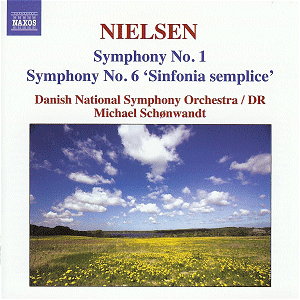

 Danish National Radio Symphony Orchestra/Michael
Schønwandt
Danish National Radio Symphony Orchestra/Michael
Schønwandt
