Goehr’s so-called "Little"
Symphony of 1963 was written in memory
of his father, the German-born conductor
and composer Walter
Goehr. The title refers to the instrumental
forces used, not to the length or emotional
scope of the work, which is otherwise
on a large scale. First performed in
York Minster, it was recorded the following
year by the same forces when it was
originally coupled with Tippett’s Concerto
for Orchestra. This pairing was
singularly appropriate in one aspect;
both composers make use of contrasting
instrumental groupings as a means of
articulating the structure. Unlike his
older colleague, however Alexander Goehr
uses a modified form of serial technique
in the work - perhaps as a tribute to
his father’s interest in the music of
Schoenberg and his contemporaries. Walter
Goehr had made an extensive study of
Mussorgsky’s Catacombs movement
(in Pictures at an Exhibition)
and his son uses a modified version
of the chord sequence of that movement
as a means of launching the work. Thus,
having stated the sequence in the tiny
opening movement, the second movement
comprises a set of variations on it.
The third movement is a brief, delicate
scherzo and the finale an elegiac summing-up
of what has gone before, including a
brief quotation from Schoenberg’s First
Chamber Symphony. A finely crafted work,
although perhaps lacking the last degree
of individuality to make it truly memorable.
Both the Second Quartet
and the Piano Trio display the composer’s
assurance in articulating his musical
material within the overall structure.
The Allegri Quartet gave the first performance
of the Quartet, while that of the Trio
was the result of a commission from
Yehudi Menuhin; here it is played by
the Orion Trio. In the Quartet Goehr
casts his opening movement as an extended
set of variations, contrasting serene
and agitated passages. Originally this
constituted the whole of the work, but
feeling this would benefit from two
extra movements Goehr went on to compose
a brief scherzo and a lento conclusion,
described by Goehr as "continuous
melody". The opening Con anima
of the Piano Trio also uses variation
form; this is followed by a long, slow
concluding movement.
Writing in The Musical
Times of February 1974, Stephen
Walsh speaks highly of these works,
linking them to the chamber music tradition
of Beethoven and Bartók in their
combination of originality and tradition.
He felt, however, that, while Goehr
effectively held the listener’s interest
in the opening movements of each work,
later in the piece the musical argument
lost impetus, so that the listener’s
concentration lapses; this is particularly
evident in some of the slower sections
which the composer recognised are also
challenging for the performers themselves.
Excellent analogue
sound for all works and informative
booklet notes by Paul Conway.
Ewan McCormick
see also review
by Rob Barnett
























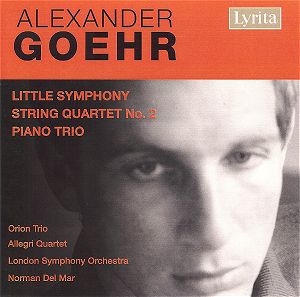
 London Symphony Orchestra/Norman Del Mar;
Allegri Quartet; Orion Trio.
London Symphony Orchestra/Norman Del Mar;
Allegri Quartet; Orion Trio. 