I am running out of ways of saying that I am running
out of superlatives for these Gothic Voices reissues on the
Hyperion Helios label. Very highly recommendable as they were
at full price, receiving a great deal of praise from several
scholarly journals, as well as in the music magazines, they
are much more so at their new bargain price. One reviewer went
so far as to say that this was probably the best record he had
ever reviewed. I have listened with pleasure to the original
version of this CD regularly.
First issued in 1989, to mark the 400th
anniversary of the coronation of Richard I, it remains just
as valuable today. If you want to cut to the chase, I strongly
recommend anyone with even the slightest interest in medieval
music to go out and buy this CD.
Whilst you’re about it, you could do a great deal
worse than to invest in the other Gothic Voices reissues which
I’ve recently recommended: The Garden of Zephirus (CDH55289),
The Marriage of Heaven and Hell (CDH55273), The Spirits
of England and France (CDH55281) and The Castle of Fair
Welcome (CDH55274). At around £5-£6 each in the UK, the
whole lot wouldn’t break the bank. For around £20 more, you
could add the 3-CD Award Winners collection: A Feather on
the Breath of God, The Service of Venus and Mars
and A Song for Francesca on CDS44251/3. One of the Gothic
Voices’ recordings, deleted and yet to be reissued, Lancaster
and Valois, is on offer on the web as I write at $215! I
understand that it will be reissued in the near future.
The present CD is more closely focused than most
of the series, in that it is largely composed of conductus
and chansons dating from the period c.1170-1200. The
Concise Grove defines conductus as a medieval
song with a serious, usually sacred text in Latin verse. The
sacred and the political are often linked, as the first two
items on the CD illustrate. The first, mundus vergens,
is on the familiar theme of change and decay: “The world is
declining into ruin ...” The note in the booklet links it tentatively
to the wars between Richard I and the French King Philip Augustus
in the 1190s and the chaos which these caused: “France perishes
before its time”. Such dynastic conflict is not an aspect of
the ‘Lion Heart’ that fits our modern image of him as the good
king whose brother tried to usurp his throne while he was on
crusade but was foiled by Robin Hood.
The notes link the second piece, Novus miles
sequitur (“A new soldier follows ...”) to the events of
April 1173 when the barons tried to replace Richard’s father,
Henry II, with the young Prince Henry. The rebels invoked the
spirit of the newly-canonised Thomas à Becket: “Thomas agni
sanguine / lavat stole gemine / purpuram rubentem” – “Thomas
washes the purple (finery) of his double stole red in the blood
of the lamb.”
Anglia, planctus itera laments the death either
of Henry II in 1189 or the earlier death of Richard’s brother
Geoffrey in 1186.
Only one piece, Etas auri reditur, specifically
celebrates the Richard’s coronation. The legend of the Golden
Age there referred to dates back at least to Ovid and Vergil
– a period when humans lived content. Its return must have been
celebrated in just about every generation since, but it was
a particularly potent theme in the high Middle Ages and the
Renaissance until Ronsard scuppered it in his Elegy to the Royal
Treasurer, in which he praises the frugality of the Golden Age,
curses whoever first thought of mining for precious metals,
then asks the treasurer to let him have some of this obnoxious
metal so that he may treat it with the contempt which it deserves:
“je le prye/De passer par tes mains, pour s’en venir loger/Chés
moi, qui le tiendra comme un oste estranger/Sans trop le caresser.”
In occasu sideris probably predates Etas
auri, in that it seems to refer to events earlier in 1189,
following the death of Richard’s father, Henry II; it looks
forward to the coronation of a new ‘heir of Hector ... promised
to you as king’. Sol sub nube latuit may well belong
to the same period, though the notes postulate an earlier date.
Pange melos lacrimosum probably refers to events of the
following year, when the Emperor Barbarossa perished on his
way to join Richard in the Holy Land.
Some of the pieces refer to the Christmas and New
Year period. Sol sub nube latuit celebrates the ‘marriage’
of God and man in Christ. Hac in anni ianua welcomes
the New Year, Vetus abit littera celebrates the replacement
of the Old Law by the New at Christmas and Purgator criminum
is a diatribe against the Jews, “a foolish people / harder than
iron” for their refusal to acknowledge the birth of the Messiah
at Christmas. Even in this ostensibly religious, though deeply
prejudiced, conductus, the political element is not far
away: Richard’s crusade unleashed a torrent of economically
motivated hatred against the Jews. Repugnant as this is to the
modern listener, we simply have to accept such anti-semitism
as a historical fact, present even in Chaucer. Latex silice
links events in the life of Moses with parallels in the life
of Christ, a kind of biblical exegesis very common in the Middle
Ages, not least in the miracle plays of York, Wakefield, Chester
and elsewhere: as the water flowed from the rock which Moses
struck, so Christ’s blood flows in torrents to redeem mankind.
Interspersed with these anonymous examples of conductus
are four examples of vernacular chansons from the same
period, two by Blondel de Nesle and one each by Gace Brulé and
Chastelain de Coucy. Blondel was, of course, the trouvère
or minstrel who is supposed to have discovered Richard as he
was being held for ransom on his return from crusade. His identity
is not known for certain, but he and the other two named trouvères
flourished in the period 1180-1200.
In A la douçour the lover rejoices that
he alone remains faithful to love, since no man is truly a lover
who ever thinks of abandoning it. L’amours dont sui espris
combines references to the classical love stories of Dido and
Æneas, Paris and Helen and Pyramus and Thisbe with the fin
amors of Tristan and Iseult. Li nouviau tanz celebrates
the month of May, but even the delights of the season cannot
console the singer for the contempt of his beloved, who is killing
him for no other fault than that of loving her. Ma joie me
semont asserts that those who love in a refined way (that
of fin amors, or courtly love), give generously and speak
in courtly fashion will never go wrong.
In these four chansons we have all the essentials
of the cult of courtly love. I make no attempt here to enter
into the vexed debate of how ‘real’ courtly love was. Odd as
it seems to have Margaret Philpot sing two of these laments
of (male) lovers, it works surprisingly well.
The performances are at least every bit as good
as those on the other CDs in the series. If anything, their
performance of the late-12th-century style seems
to demand even more superlatives: purity of tone, clarity of
diction and sheer musicality of performance. Of course, no performance
can ever overcome the fact that there is an inevitable degree
of sameness about these pieces, but the same is true of other
periods much closer to our own time. By ringing the changes
between single-voice and multi-part pieces, Christopher Page
has done his best to maintain a degree of variety. The chansons
are all for a solo singer, as is Anglia, planctus itera.
Five other pieces of conductus are for two voices, two
for three voices and three for four voices. Purgator criminum
begins for one voice but three others enter later.
The recording is in every way equal to the task,
bringing out to the full the qualities of the performance without
intruding in any way.
Hyperion make it possible to listen to extracts
from every track of this CD on their website. Track 5,
Hac in anni ianua, might be a good track to try, since
this piece sometimes features on recordings of medieval Christmas
music, but there isn’t a dud on the whole CD. Rather than waste
time listening to brief extracts, though, why not place your order
immediately? My only reservation would be that the twelfth century
may not be the best place to begin to get to know medieval music,
in which case one of Gothic Voices’ recordings of later medieval
music might make a better recommendation – The
Garden of Zephirus (early 15th-century, CDH55289)
or The
Castle of Fair Welcome (later 15th-century,
CDH55274).
The notes, by Christopher Page, are very detailed;
as usual, they perhaps assume too high a degree of knowledge
of medieval music in the reader. Even I found them hard-going
at times, and I am something of a medieval and renaissance specialist.
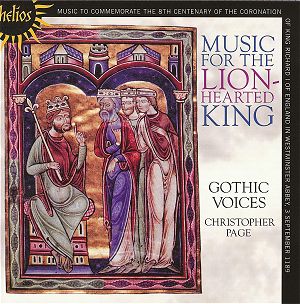
Like all the reissues in this series, the new booklet
is in no way inferior to the full-price original. The striking
front cover, a contemporary depiction of Herod and the Wise Men,
will surely help to attract the casual buyer. Perhaps Hyperion
chose it to remind us that the real Richard the Lion Heart was
as ambiguous a figure as Herod.
Brian
Wilson

























 Gothic Voices (Margaret Philpot (alto); Rogers Covey-Crump (tenor);
John Mark Ainsley (tenor); Leigh Nixon
( tenor))
Gothic Voices (Margaret Philpot (alto); Rogers Covey-Crump (tenor);
John Mark Ainsley (tenor); Leigh Nixon
( tenor))