This enterprising release
from Toccata Classics brings to the
fore the music of Julius Burger, born
Bürger, composer, conductor, arranger,
pianist, and exile. He was born in the
Monarchical stronghold, Vienna, in 1897
and studied under Schreker and Humperdinck.
In the city in the early 1920s his fellow
students included Hába, Křenek,
Rathaus, and Jascha Horenstein. Burger
began conventionally as a répétiteur
in Karlsruhe and then, on Bruno Walter’s
instigation, Burger went to the Met
in New York as assistant to the redoubtable
Bodanzky, returning to Europe as accompanist
to the perhaps even more redoubtable
Ernestine Schumann-Heink. He was Klemperer’s
assistant at the groundbreaking Kroll
before leaving for Vienna on Hitler’s
advent as Chancellor. Shortly before
the Anschluss he was on the move again
and in 1939 emigrated to America for
good.
Here he found himself
back at the Met as an assistant conductor
and accompanist; his career was relatively
low-key and his original compositions
only very occasionally aired. There
was a cello-piano reduction of the Cello
Concerto at New York Town Hall in 1952
and some other performances over the
years. Fortunately interest in Burger,
his life and music increased and he
lived long enough to hear these performances,
made in 1994 and only now released commercially
– a co-production with Deutschland Radio
and released under licence from Sony
Classical, from whose grasp they have
presumably been prised.
Burger is here revealed
as standing in the central Austro-German
mainstream; Schreker, Mahler, Zemlinsky,
Korngold and Strauss are names that
spring to mind – as does that of Debussy.
The excellent early c.1919 Stille
der Nacht for baritone and orchestra
has strong impressionist hues but also
hints at absorption of late Wagner and
a keen ear for Mahler’s song cycles.
The piano – Burger’s own instrument
of course – is used discreetly for colouristic
effect and the orchestration throughout
remains light and aerated, not heavy
or cloying. There’s occasionally some
luscious string moulding, owing something
to Strauss and Korngold, and some stirring
grandiloquent moments as well. The companion
Legende for baritone and orchestra
is more obviously over-heated than Stille
der Nacht and here we find some
Hebraic oboe/drone writing – derived
perhaps from Mahlerian example – and
some powerful bell chime music, flourishing
late romanticism writ large.
The Scherzo for strings
(1939) is a riot of cross rhythms –
energetic, vital music with moulded
romantic melodies arching through it
– wafting in perhaps one should say.
And at five minutes it hardly outstays
its welcome. The Variations on a
Theme of Karl [Carl] Philipp Emanuel
Bach is a later affair, dating from
Burger’s American sojourn. The model
is possibly Brahms’ Haydn variations
though the results are very different.
Burger can be a touch too heavy in places
but elsewhere one finds him suave, deft
and engaging. There’s panache in the
second variation, warm string contours
in the fifth, rustic sounding moments
in the sixth and maybe just a touch
of justified portent in the finale.
The 1938 Cello Concerto
is the most important work here. The
slow movement has been recorded before
- by cellist Jan Vogler with the Saarbrücken
Radio Symphony and Thomas Sanderling
on Berlin Classics New CD 0017672BC.
It was coupled with Barber’s Cello Concerto
and Adagio for strings and Korngold’s
Concerto; strange though only to present
a torso of the Burger concerto. Now
the Toccata recording shows the concerto
in a proper light. It’s a substantial
three-movement, thirty-two minute score.
It opens in intense, introspective and
lyric fashion and then breaks into the
allegro proper – not unlike classical
models, say a Haydn symphony. The slow
movement was later dedicated to Burger’s
mother who had died on the way to Auschwitz
(shot out of hand). It has the feel
of a passacaglia – with elegant cello
and wind lines sounding slightly but
not obviously Jewish. There’s a strong
sense of suffused power but the tolling
is certainly more central European than
anything bardic; certainly there’s no
kind of kinship with, say, Bloch. The
finale is lively – there are hints of
Hindemith here, unusually so for Burger
if the other works are reflective of
the influences on him – though Burger
is more overtly expressive. There are
changes of mood and moments of reflection
and over-arching reminiscences of the
mood of the opening movement.
All the performances
are outstanding. The recording is first
class as well and Toccata’s documentation
serves as a model for how an unknown
composer should be presented in biographical
and musical form. Burger’s was a keen
voice, not necessarily either original
or ground breaking, but one which presented
a strong musical blood line, finely
absorbed, excellently orchestrated,
thematically interesting, dramatically
convincing, and expressively controlled
yet eloquent. A composer well worth
getting to know, especially in performances
as expert as these.
Jonathan Woolf
























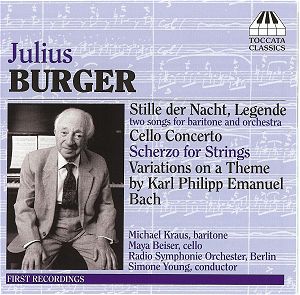
 Michael Krauss (baritone) ¹