Editorial Board
MusicWeb International
Founding Editor Rob Barnett Editor in Chief
John Quinn Contributing Editor Ralph Moore Webmaster
David Barker Postmaster
Jonathan Woolf MusicWeb Founder Len Mullenger
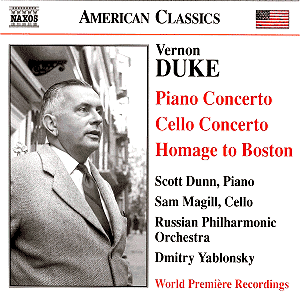
Vernon DUKE (Vladimir Dukelsky) (1903-1969)
Piano Concerto (1923) (completed by Scott Dunn) (1998) [18:20]
Cello Concerto (1945) [26:37] Homage to Boston (Suite for solo piano) [12:33] Scott Dunn (piano),
Sam Magill (cello)
Russian Philharmonic Orchestra/Dimitry Yablonsky
rec. 27 September–1 October 2006, Studio 5, Russian State TV and
Radio Company, Kultura, Moscow (Concertos); 6 January 2007, Glenn
Gould Studio, CBC Toronto (Suite). DDD NAXOS 8.559286 [57:30]
Vernon Duke makes
it very clear, in his entertaining autobiography Passport to
Paris (Little, Brown and Co, Boston 1955), that he was born
Vladimir Dukelsky. His concert works were written under that name
but when he wrote for Broadway or Hollywood his name was Vernon
Duke.
It was George Gershwin
who suggested the change of name to the Russian and it was a sensible
move; after all, could you really believe that the song April
in Paris, so American in its nostalgic resonance, was written
by a Russian? But then could you believe that the song High
Noon was written by a student of Glazunov? So Vladimir Dukelsky
wrote symphonies and chamber music and the rest, and Vernon Duke
wrote Taking a Chance on Love, I Can’t Get Started,
the score for She’s Working Her Way Through College (1952),
and the completion of Gershwin’s score for the film The Goldwyn
Follies (1937), on the composer’s death, contributing two
original ballets and a conclusion to Gershwin’s Love is Here
to Stay.
The difference is
important for Dukelsky is the composer of the music on this disk.
It does him a disservice to represent him, basically, as another
man, but perhaps people no longer know who Dukelsky is. Certainly
they used to as I have several LPs of music by the Russian and
there is no mistaking him as Dukelsky.
Perhaps I’m being
pedantic, but if the composer perceived the difference then perhaps
we should acknowledge that fact.
That
said, this is a superb disk. The Piano Concerto was conceived
for Rubinstein but Dukelsky never orchestrated the work. It was
never performed in his lifetime and it’s such an attractive work.
In one movement, playing for just over 18 minutes, it is light
and frothy , brim full of good tunes. What else would you expect
from a work written in the twenties with more than a nod towards Les
Six? At first hearing I thought that there was, perhaps, a
little too much Prokofiev in the score; Dukelsky and Prokofiev
were fellow students in the composition class of Reinhold Glière,
at the Kiev Conservatory. They remained friends until the older
man returned to Russia after which the contact between them ceased.
Dukelsky never heard from his friend again. Repeated hearings
have revealed that while there is a light powdering of the Prokofiev
sound it is fleeting. It’s quite neo-classical in feel and the
style is only broken by the interruption of a brief, but exotic,
samba!
The Cello
Concerto is a bigger and much more serious work. Written
for Piatigorsky, and commissioned by Koussevitsky, the work
took three years to write. Its composition was interrupted by
Dukelsky’s serving in the US Coast Guard. It is a bold romantic
work. There are occasional hints of Prokofiev and Shostakovich,
to be sure, but this in no way corrupts the music which is pure
Dukelsky. Two fast movements enclose an elegy of great beauty,
perhaps a lament for the dead of the war just ended. The first
movement starts with a cadenza for the soloist and the finale
is a kind of macabre march with a brisk coda.
The Suite,
Homage to Boston, which closes the disk, is dedicated “to
the members of the Boston Symphony”, the seven short movements
portraying various people and places in Boston familiar to the
composer. The movements are so brief that they fly past in an
instant. There’s the grand romantic gesture in the first movement
, a sly waltz, a gavotte (in homage to Prokofiev) and a final Mecanicamente (Midnight
Train).
It’s
fine stuff from a composer who has never really received his due,
and whose concert works are woefully unrepresented on disk these
days. The performances are totally committed, everyone playing
for all they are worth, and the recorded sound has everything
well in perspective with a good balance between soloist and orchestra.
The solo Suite is equally well done.
One
of the very best, and, for me, most interesting, releases in Naxos’s
American Classics series.

























 Scott Dunn (piano),
Sam Magill (cello)
Scott Dunn (piano),
Sam Magill (cello) 