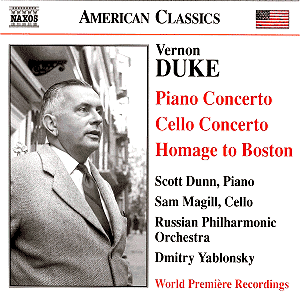
The
Russian composer Vladimir Dukelsky was born in 1903. The American
composer Vernon Duke was born in America about twenty years later
when his friend George Gershwin suggested that Dukelsky use his
Russian name for serious compositions and the Anglo-Saxon name
for the musical shows and songs he had started writing. Both composers
were successful in their respective fields, but in 1955 the two
personalities were merged under the Duke name. On this disc we
have the concert composer, including at least two world premieres.
The
earliest composed piece on this disc is the one-movement Piano
Concerto, which has an interesting history. The nineteen-year-old
composer wrote it for Artur Rubinstein after emigrating to America
because of the Russian Revolution. He never orchestrated it and
Rubinstein never played it, although a two-piano version was published.
Not until 1998 did the soloist on this disc, Scott Dunn, orchestrate
it and give the first performance. From the first thematic statements
we can tell that we are in the presence of an admirer of Prokofieff
and Stravinsky - Duke was close with both composers. Les Six
also make an appearance. In the “development” things become more
serious and Duke proves himself capable of some very imaginative
thematic development. There are a number of tempo changes in this
section before a fine return of the secondary theme. After short
cadenzas for the piano and the cello, the pianist launches into
a second cadenza which leads to some excellent final development
of the original material.
Homage
to Boston is a suite of piano evocations
of life in Boston, a town that Duke spent much time in as Koussevitzky
and the Boston Symphony gave many premieres of his concert works.
The idiom here still retains many aspects of the style evinced
in the piano concerto, but the harmony is more dissonant and the
handling of materials more integrated. This piece and the cello
concerto are the works of an imaginative, mature composer. The
Charles River is the main river of Boston and it literally
flows along smoothly. Nearby Boston Common is quieter than
the river - perhaps it’s night. Molly was a young lady
about whom Duke was quite serious and that may explain the thicker
texture and more advanced harmony in this piece. I don’t know
which poet is depicted in the Poco Pomposo, but this title
could probably apply to many New England poets, although the jazzy
part at the end is surprising. Dining at the Ritz seems
pretty generic, but the Prokofieff [recital?] in Louisburg
Sq. is an interesting contrast. Finally, the Midnight Train
takes us back, presumably to New York, and we feel that this was
a very good visit.
Like
Homage to Boston, the Cello Concerto is the work of a mature
composer and shows a depth of feeling not evident in the other
two works, as well as a rich combination of the composer’s Russian
and American stylistic elements. In the first movement a sorrowful
cadenza is followed by a serious first section and then a more
satirical part reminiscent of Stravinsky. These are combined into
an effective recapitulation before another cello cadenza. The
second movement is slightly more American in style. It is mostly
scored with a few winds accompanying the cello. The soloist himself
is frequently called upon to play in a higher register than in
the rest of the work and the part becomes progressively sadder
in tone as the movement continues. Finally we have a sort of march-like
scherzo with alternating virtuoso and gentle interludes. The gentle,
somewhat sad, parts win out in the end, although the coda is traditional.
As
the reviver or resuscitator of Duke’s Concerto, Dunn’s performance
will remain standard even if there are other recordings. He has
an excellent feel for Duke’s alternations between concert hall
and cabaret/night club and demonstrates this especially in some
of the pieces in Homage to Boston. Magill adopts a more
measured approach to his concerto, but this pays off well in the
parts requiring the middle register of the cello and he excels
at projecting the sorrowful tone of certain sections of the piece.
Yablonsky is competent as always, although one feels that he is
not totally in sympathy with Duke. The sound in the Moscow hall
leaves something to be desired in the way of richness; less brittle
music would only further emphasize this aspect. The Glenn Gould
Studio is better suited to its music.
Naxos
American Classics has performed a genuine service this time in
recording music that many must have wondered about, but probably
never thought they would hear.
William Kreindler
And a further perspective from Rob Barnett:-
Vladimir
Dukelsky took the name 'Vernon Duke' at the suggestion of George
Gershwin. He began as a pupil of Gliere alongside Prokofiev in
Kiev. Fleeing the Russian Revolution Dukelsky went to the USA
and there lived a double life. This disc concentrates on his neglected
concert works.
The
brilliant and gangling Piano Concerto was written for Rubinsten
who wanted something compact, pianistically grateful and not too
cerebral. It fits the bill completely, glinting with bright jangling
orchestration and alive with neo-classical brusqueness. Works
and composers evoked include Prokofiev (Classical Symphony
and Love of Three Oranges), the Stravinsky of Pulcinella
and Petrushka, Auric, Milhaud, the jazzy Lambert, Poulenc
and even Grainger's The Warriors. There is also a strong
sentimental-romantic thread running through this music. It is
all done with swoon and scintillation by Dunn - who completed
the work - and his colleagues.
The
Cello Concerto is a different proposition. It leaves behind the
carnival high jinks of the Piano Concerto. Instead this is music
of impassioned and nuanced romantic concentration. Determinedly
tonal it is melancholy, soulful and sentimental. A fine work,
it is unshowy, sincere and memorable. In short a wonderful addition
to the potentially active repertoire of accomplished cellists
everywhere. It melodic content is moving in much the same way
as the themes and treatment in Prokofiev's Classical Symphony.
The
seven movement solo piano suite is affectingly romantic, playful,
taut and grand in the manner of Barber's Souvenirs.
Duke
made a living in the USA in the field of musicals and popular
music. Clearly he had other facets. Exploration of his three
symphonies must now be a priority.
Rob Barnett