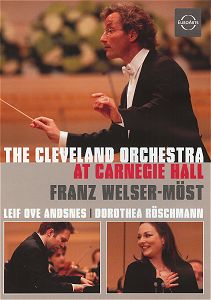
Here’s the all-Viennese
gala evening which began the 2006 Carnegie Hall season.
First the Light
Cavalry overture with plenty of spit and polish in its brightly
sonorous opening, taut and exciting strings’ ostinato
against brass fanfares. Franz Welser-Möst achieves a perky allegro
(tr. 2 2:41), racy enough to make the allegretto brillante
of the following famous trumpet tune seem even jollier in its
relative relaxation. By contrast again it grins from ear to
ear on its return after the andantino con moto (4:59)
is expressed as a commanding aria for rich strings. There’s
just a spicing, unmarked but effective, of acceleration in the
coda. You witness the crispness and clarity of Welser-Möst’s
beat and his concern in the aria to keep the phrasing flowing.
Mozart comes next
with a refined and exquisite approach to Piano Concerto 17 by
Welser-Most, fully mirrored by the soloist Leif Ove Andsnes.
The opening is light, sweet and quite intimate with the second
theme (tr. 3 9:49 in continuous timing) having a simple grace.
The piano entry adds a touch of playfulness to the mix but is
always sensitively balanced with the orchestra, never dominating.
The third theme (12:01), which the piano introduces, has an
open, carefree gracefulness. The development (14:15) provides
a suave element of mystery but in the recapitulation it’s back
to a mellifluous parade of themes and enviable ease of pianism.
Mozart’s cadenza shimmers delicately in Andsnes’ hands, the
dynamic contrasts stylishly unforced.
I compared the 1981
recording by Leonard Bernstein, piano-conductor with the Vienna
Philharmonic (Euroarts 2072098, review).
Here are the actual music timings:
Timings
|
I
|
II
|
III
|
Total
|
Andsnes/Welser-Möst
|
11:44
|
9:43
|
7:15
|
28:42
|
Bernstein
|
12:33
|
12:35
|
7:55
|
33:03
|
There’s more sense
of fun in Bernstein’s account and also more vigour in the tuttis.
Yet there’s also more relaxation and emphasis on lyricism. The
piano presentation of the third theme is especially pointed
and characterful. Bernstein takes the cadenza more slowly, 1:51
against Andsnes 1:18, giving it more of a spontaneous thinking
aloud quality, but Andsnes deftly deploys more marked tempo
fluctuations to the same end. Welser-Möst is faster and lighter,
the sound leaner, relatively unconcerned with vigour, something
I miss. Andsnes’ Steinway piano has a more crystalline sound
than Bernstein’s mellower Bösendorfer yet Andsnes tempers this
with his smooth touch. His blending with the orchestra is a
joy as is his presentation of the third theme, less extrovert
than Bernstein’s but wonderfully balanced and self-contained.
With Andsnes/Welser-Möst
the ambivalence of the slow movement comes across more strongly.
The woodwind offer a serene meditation but the strings’ later
backing is darker, partly because he has 5 double basses to
Bernstein’s 4. Andsnes’ opening solo is eloquent and quite elegiac,
leading readily to the following more dramatic material. His
conversation with bassoon, oboe and flute is a happy phase,
after which his demisemiquavers ripple down like flotsam. But
more memorable is the still solemnity of his solo interlude
in D minor (tr. 4 25:03), suddenly starkly probing more fearful
territory and he maintains his gaze while presenting fluently.
In Mozart’s cadenza Andsnes contrasts outward display and inner
meditation in playing of great sensibility. His tempo fluctuations
here suggest that to be effective Mozart’s Andante marking
for the movement has to be treated flexibly. Bernstein makes
a case for a considerably more expansive, Adagietto like
approach because the argument thereby emerges more lucidly.
For instance, when the woodwind brighten the piano’s darker
mood of the latter part of his opening solo, Bernstein agrees
gently with them.
To the finale’s
theme Welser-Möst brings an easy, genial lightness, more graceful
than Bernstein’s skipping. The first variation (tr. 4 31:34)
Andsnes gives a free-flowing buoyancy. He’s trippingly mercurial
in the second variation (32:18) alongside neatly bright woodwind
and urbane strings where Bernstein is more buoyant. The Andsnes/Welser-Möst
third variation (33:00) is delightfully florid in a genteel
way, where Bernstein is more chirpy. The fourth variation (33:47)
in G minor from Andsnes/Welser-Möst has a suave mystique, more
exotic than Bernstein’s sad phase to be faced. Welser-Möst begins
the fifth variation (34:41) purposefully, a mood Andsnes gradually
wipes away. Bernstein’s orchestra begins it perkily but his
piano closes it gently. The closing scamper of the coda (35:51)
is airily articulated by Andsnes/Welser-Möst. Bernstein provides
more bite.
In Welser-Möst’s
DVD here enters Dorothea Roschmann as a passionate Countess
in The Marriage of Figaro. Her cavatina opening Act 2,
Porgi amor, is sorrowful yet resilient, matching the
strength of resolve and tender, however fragile hope of the
orchestral introduction. It’s heartfelt and affectingly sung
but, perhaps inevitably in a concert setting, not as intimate
nor with the soft, pure tone of Renée Fleming in the DVD of
the 1994 Glyndebourne stage version with the London Philharmonic/Bernard
Haitink (NVC Arts 0630-14013-2). At 4:23 this has more contemplative
breadth than Roschmann’s actual music time of 3:34. The dramatic
recitative E Susanna non vien in Act 3 gets volatile,
fiery treatment from Roschmann, 1:45 against Fleming’s 2:12
and Welser-Möst provides vivid orchestral support. The aria
Dove sono begins with more melting tone from Roschmann
and flowing line but it’s rather thrust forward for Andantino,
former pleasures more fully projected and experienced than Fleming’s
steadier tempo, taking 5:20 against Roschmann’s 4:28. Fleming’s
rapt consideration of the happy past is almost like a lullaby
and her Allegro more hopeful section from ‘Ah! Se almen’
is more contrasted than Roschmann’s (tr. 7 48:29) though that
is lighter in tone.
This DVD concert
ends with three Strauss items. First the waltz sequence Kunstler-Leben.
The introduction offers smooth caresses from oboe, clarinets
and horns with cellos in turn and then a gentle build up to
a sprightlier version of that opening oboe theme which proves
to be that of Waltz 1 (tr. 7 53:28). This is lightly and shiningly
articulated, the repeat of the second part taken a little faster.
Waltz 2 (54:31) is more dreamy but still lustrous and presented
with deft variations of tempo: slightly slower when quieter,
faster when louder, these contrasting characteristics developed
a degree further on repeat. Throughout Welser-Möst makes the
repeats subtly different.
Waltz 3 (55:47)
has a richer, more wistful dreaminess, then a buoyant section.
Waltz 4 (56:47) is more deferential, more delicately engaged,
yet with the contrast of sunny glints of brass enjoyed. Waltz
5 (57:59) has a more confident delicacy with a touch of swagger
but the second part is deliciously lightly articulated which
makes it particularly endearing, especially the piccolo and
flute embellishments which seem to look forward to Malcolm Arnold
cocking a snook. The coda (59:05) brings an entertaining final
parade of the waltzes of considerable charm. There’s an engaging
lightness of articulation, sunny tone and overall demeanour
which makes this performance a sheer delight. Welser-Möst’s
gestures vary between graceful lilt and crisp twirl, with particular
affection shown for Waltz 3.
Annen-Polka
is structurally like a microcosm of the waltz sequence with
a gentler charm within its comfortable saunter, but again with
contrasted sections and Welser-Möst achieving skilful fluctuations
of tempo in repeated passages. So while the notes are the same
the perspective you get is slightly changed.
Finally Die Fledermaus
overture is delivered with delectable finesse. The oboe offers
a melting slow version of the opening theme. The second theme
(tr. 10 67:24) luxuriates warmly on the first violins while
the third (67:57) finds their graceful strutting gently easing
at the phrase endings, just a momentary halt of Welser-Möst’s
hand. This moulding by the conductor gives the theme individuality
and style and paves the way for what then appears to be its
natural musing expansion. The Tempo di Valse section
(68:52) is lightly crisp while the Andante (70:04) finds
the oboe, then clarinet and cello gazing more expressively while
the violins’ sighs cut across whimsically. Time here expanded
is brought lightly back to order.
Here then is a satisfying
variety of Viennese pieces. It makes you ponder how Mozart can
be just as charming as the others yet also probe more deeply.
Michael Greenhalgh























 *Dorothea Roschmann
(soprano)
*Dorothea Roschmann
(soprano)  [76:13]