Several DVDs feature
Leonard Bernstein, but if you want to see and hear him playing
the piano, there’s only this one. While not as well known as
the last six concertos, No. 17 is in my view as fine as any
of them. A good choice, too, for a soloist who isn’t a concert
pianist; after all Mozart wrote it for a pupil, Barbara Ployer.
This means it isn’t as technically demanding as the concertos
Mozart wrote for himself yet still shows off the pianist’s talents.
And this is an accomplished
performance. Bernstein, here at the age of 63, plays and conducts
without score and you can appreciate his smiling enthusiasm
for the lightness of overall approach yet also verve of accent
where required. The wind players are unusually placed just for
this concerto on the far right of the stage, where they and
piano conductor can easily see one another. From the first movement
orchestral introduction the strings are sweet and stylish, with
an intimate feel even though the articulation in the passages
for full orchestra is suitably lively. The second theme (tr.
2 1:58) leans slightly to give its singing nature a soulful
touch. The piano’s entry is relaxed, smooth yet flowing. There’s
fastidious differentiation, as you might expect, between those
passages where the piano is accompanying the orchestra, e.g.
from 4:45 and where they are equal partners, as from 5:08.
Bernstein fully
realizes and always observes that the piano never dominates
the orchestra in this work. If its material or expression needs
special emphasis or clarity it has a solo. This doesn’t mean
he isn’t capable, where warranted, of firm chords and left-hand
work, as from 6:50. Yet by contrast he brings a lovely gentleness
to his statement of the third theme at 8:50. The sheer grace
of his playing at times is quite disarming. This is aided by
the cool tone of the Bösendorfer piano. His playing of Mozart’s
cadenza has by turns wistful reflection and melodic resilience.
In the slow movement
you notice the warmth of the strings, the freshness of the wind,
the affectionate approach and the easy, broad flow, albeit rather
more Adagietto than the marked Andante. One element
of the firm string bass is down to the rank of four double basses.
The aria style of the piano solo has both poise and contemplation,
though the showy ornament to the top E flat at tr. 3, 16:42
(continuous timing) is a distraction.
The joy of being
a piano conductor is wonderfully caught. Bernstein is able in
this role both to encourage expressiveness from the solo orchestral
wind players - in this instance a rising figure stated in turn
by bassoon, oboe and flute - and is then able to match it at
17:07 with the same emphasis and point on the piano. Immediately
after this his pianism achieves a lovely sotto voce against
whispering strings and in general the progress of this aria
is a blend of delicacy and tension. Accept that there is a tendency
lovingly to survey the trees and forget the wood and just enjoy.
The cadenza here is fully introspective.
The finale is light,
smiling and a demonstration of fine interplay between piano
and orchestra. Mozart’s starling, who could whistle its theme,
would have to do so very aristocratically in this company! In
the first variation (27:03) the piano solo is gentle and playful,
bolder in the second (27:46), in the third (28:28) of a more
frolicking nature, inspired and noticeably nifty in echoing
the woodwind. The fourth variation (29:22) is of a more clouded,
musing nature, vividly contrasted by a slowing up of tempo.
The fifth variation (30:27) is resolute. The coda (31:56), which
at least starts very fast as marked, makes even more of a contrast
because of the preceding slowing up.
Humphrey Burton’s
direction makes for a well balanced mix of pianist, conductor
and orchestral involvement. There are some particularly fine
shots of Bernstein’s hands, in the slow movement cadenza with
one rear angle shot almost from underneath them as they play.
I compared the only
other recording of this concerto currently available in the
UK, that by Dezso Ranki with the English Chamber Orchestra/Jeffrey
Tate (Brilliant Classics 92819). This is also from a concert
in Vienna, in this case the Austrian Imperial Palace at Schönbrunn,
a reminder that the work was written for that city. Here are
the comparative timings:-
|
Timings
|
I
|
II
|
III
|
tt
|
|
Bernstein
|
12:38
|
12:47
|
10:07
|
35:32
|
|
Ranki
|
12:07
|
11:12
|
7:51
|
31:35
|
Tate, aged 48, and
Ranki, who was 40 years of age in 1991, the copyright date of
the DVD, give us crisper, more streamlined Mozart. In the first
movement the singing lines are clear. The second theme is sufficiently
smooth but the momentum is kept up. There’s more edge to the
performance, partly because a smaller orchestra – only two double
basses on view here – can play with more attack without being
strident. The Hungarian pianist Ranki plays a Steinway piano
so his tone is more crystalline than Bernstein’s. He’s admirably
fluent but not as poetic as Bernstein. This is partly because
he seems less able to relax until, paradoxically and to very
pleasing effect, he gets to the cadenza.
He achieves a moving
inwardness in his solos in the slow movement and displays a
plainer, purer singing line than Bernstein’s. The clarity and
expressiveness of the ECO wind playing is also appreciable.
But generally Bernstein finds greater subtlety and nuance, partly
through a visibly and aurally closer relationship with the orchestra.
Ranki’s cadenza is, however, very successful though quite different
from Bernstein’s. Ranki’s is glistening and extrovert.
The finale finds
Ranki and Tate at their most engaging. The orchestral introduction
is witty in its pert pointing. Ranki shows stylish line in variation
1. The second variation is vivacious with a whiff of abandon
about it. In the fourth, not slower, Tate uses the minor key
to give a tinge of exotic colouring, not to change the tone
like Bernstein does. There’s the same mix of camera shots but
the camera work is less stylish than for Bernstein, perhaps
partly owing to the location. Sound quality is similar, both
DVDs being available in surround sound, but the Vienna Philharmonic’s
tone is richer and blend smoother. So all in all I find Bernstein’s
more leisurely performance more attractive.
The second item
on this DVD, Symphony 39, is essentially the same interpretation
as Bernstein’s CD live recording made at the same time and now
available in a Deutsche Grammophon Trio set (474 3492). But
a different team produced this DVD, with different editing criteria,
so it’s not absolutely the same. The CD timing at 32:46 is nearly
two minutes shorter and, while this may be accounted for partly
by the shortening of natural pauses in the concert, including
violins quickly retuning for the finale, the DVD performance
is itself slower. I timed just the music of the first movement
introduction which is 3:01 against the CD’s 2:53. While the
CD has more body, there’s more brightness and resilience in
the DVD sound, though that might partly be an effect of the
surround sound available with the DVD. In any event I prefer
its greater vibrancy.
It also tells you
much about the role of the conductor. I was reminded of Andre
Previn’s story about Pierre Monteux. Previn was rehearsing the
London Symphony Orchestra and Monteux asked him “Are they playing
all right?”. When Previn said yes, Monteux responded “Then try
not to get in the way.” Often, as in the finale here, Bernstein’s
role is surprisingly often ‘hands off’, just a matter of encouragement
and telepathic enjoyment, or if you prefer, bouncing back in
your enjoyment as conductor the enjoyment you wish the players
to have and convey.
In the Minuet it’s
about bounce and firmness of accent. In the slow movement it’s
regularity of overall flow then shaping of phrases and especially
the cadences, the ends of phrases. In the first movement, and
often later, it’s about revelling in the sheer panache of the
Vienna Philharmonic – the double bass tally now at six, by the
way – and just letting them play. The result is splendid attack
which is also stylish.
There are some characterful
Bernstein moments. An imploring kiss (tr. 5 46:08) at the first
violins at a quiet passage at the end of the recapitulation
of the first movement first theme. Looking like a sculpture
of a weeping saint (tr. 6 54:29) during the flute solo in the
slow movement. But this is all within the framework of a response
to the music that’s so heartfelt and affectionate; how could
the players, like us viewers, not respond? But, let me emphasise,
Bernstein very much trusts the players most of the time to present
the firm and full sound that they do.
It’s a fine performance
with all repeats observed. In the first movement introduction
the breadth and sleek grace of the first violin line is quite
arresting in response to the ceremonial fanfares of pomp and
weight. The insistent quaver/semiquaver rest/semiquaver rhythm
is shown to be a very effective device in securing the tension
with its alternating soft and loud delivery well realized. The
first theme of the main body of the movement enters smoothly
(tr. 5, 39:33) but is soon supported by the beaming strength
of trumpets and horns which have splendour without glare. The
strings are as vigorous as you could wish in these louder passages
yet can show a winsome, smiling sheen in the second theme at
41:07. The development is brief and here rugged before an intimate,
affectionate return to the first theme. However, the later violins’
descents are more racily, even precipitously, delivered.
The slow movement,
not that slow as it’s marked Andante con moto, has some
momentum as well as fastidiousness in its silky first violins,
becoming more wistful and a touch slower towards the end of
the first theme’s second strain. The second theme (tr. 6 51:07)
is at first stormier but come the idyllic second part featuring
clarinets (52:19) the storm seems something of an aberration.
The woodwind writing in the development is perhaps savoured
a little over-indulgently.
The Minuet, on the
other hand, goes with a fair zip and the clarity of texture
is appreciable. The trio glories in a glowing, singing clarinet
which is presented in a pleasingly contrasted softer focus in
its second part. The finale is bouncily festive, its second
theme (tr. 8 63:22) providing a little relief in its courtly
playfulness. The development is mettlesome and the perky bassoon
in the recapitulation a particular joy.
I compared the Vienna
Philharmonic 12 years earlier, conducted by Karl Böhm in 1969
(DG 004400734133). Here are the comparative timings
|
Timings
|
I
|
II
|
III
|
IV
|
tt
|
|
Bernstein
|
12:03
|
9:51
|
4:13
|
8:26
|
34:42
|
|
Böhm
|
8:44 (11:14)
|
7:49 (8:44)
|
4:20
|
4:23 (8:24)
|
25:16
|
Böhm, then aged
75, looks much faster than Bernstein but in fact it is because
he omits the first movement exposition repeat, the slow movement
repeat of the second strain of the first theme and both exposition
and second half repeats in the finale. I’ve put in brackets
in the heading the timing effect of including these repeats.
Böhm is still faster, except in the Minuet, markedly so in the
slow movement.
Böhm’s approach,
admirable in its way, is much more rigorously classical than
Bernstein’s. Structurally it’s very explicit with great thematic
clarity yet fewer smooth contours. The sound, also available
in surround, is well rounded and full-bodied but rather dominated
by the strings’ sheen. Filmed in studio conditions with orchestra
and conductor marooned on a specially constructed attempt at
architectural modernism, there’s a feel of the laboratory about
it. There may be a glimmer of a smile on Böhm’s countenance
once or twice, but I might just have wished for it.
The first movement
introduction lacks the tension of Bernstein’s. The slow movement
second theme is more alert but by no means stormy. Böhm’s Minuet
is a little more solid. When Bernstein bounces, Böhm chugs along.
His trio, however, is consistently mellifluous. And his finale
is scintillating with a kind of military precision. For Böhm,
classical means neat and a touch severe.
Bernstein is altogether
more yielding and, in any case, isn’t upholding a classical
ideal. As this Euroarts DVD booklet note appositely quotes him:
“Classical music by a great Romantic, eternally modern music
by a great Classicist.” It’s as good a way as any of trying
to describe Bernstein’s vividly coloured and dramatic manner
which is nevertheless underpinned by a fundamental classicism.
I wouldn’t term it a challenge to historically informed performance.
Rather Bernstein applies the Vienna Philharmonic’s luxury veneer
to his highly responsive approach to Mozart and does so to distinctive
effect.
Michael Greenhalgh























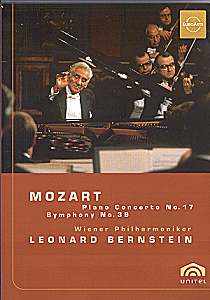

 Wiener Philharmoniker/Leonard
Bernstein *(piano conductor)
Wiener Philharmoniker/Leonard
Bernstein *(piano conductor)  [72:13]