 |
|
|

alternatively
CD: AmazonUK
AmazonUS
|
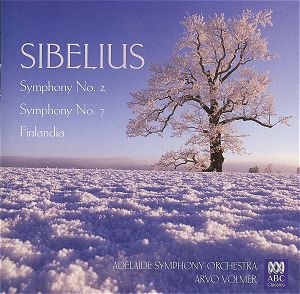
Jean SIBELIUS
(1865-1957)
Symphony No. 2 in D, Op. 43 (1901-2) [42:50]
Symphony No. 7 in C, Op. 105 (1924) [19:42]
Finlandia, Op. 26 (1899-1900) [8:16]
 Adelaide
Symphony Orchestra/Arvo Volmer Adelaide
Symphony Orchestra/Arvo Volmer
rec. Adelaide Town Hall, April 2007
ABC CLASSICS 476 6167 [71:09]  |
|
|
The Australian Broadcasting Company recording series serves the valuable function of documenting national musical life, much as CBC Records in Canada and a number of small European companies do. Whether these releases necessarily are of sufficient interest to justify an international release, particularly in a piece as familiar as Sibelius 2, is questionable. It's unlikely, after all, that the capable Adelaide Symphony could offer us any insights missed by the august orchestras of Philadelphia, London and Amsterdam. But there's a surprise or two in store.
The conductor, Arvo Volmer, plays the first movement at a slightly faster tempo than most. The rhythm is rather rigid - the individual phrases usually have more time to "breathe" - but Volmer's tighter manner brings out connections that we've previously had to take on faith and intuition. The repeated incursions of the strings' original pulsing motif into the texture, for example, here seem logical rather than arbitrary, and the various thematic fragments coalesce into broad, arching lines. Students of the piece, particularly, can learn a lot here.
The downside to the conductor's inflexibility becomes apparent at the start of the development: the woodwinds, naturally, want to taper their phrases, but this gets them slightly unstuck from the violas, who can hardly ease up on the tempo amid a stream rushing eighth-notes. The hardest part of the development, beginning at 5:30, is clean and cogent - the horns' rock-steady syncopations firmly anchoring the surging strings - but then the recapitulation sounds a bit casual and patched-together.
The rest of the symphony would be enjoyable in concert played this way, but doesn't justify eternal preservation. I'd not call the orchestra objectively "too small" for the music, but the string sections are probably short-staffed by a desk or two compared to the top-rank ensembles; the resulting smaller-scaled sonority lacks tonal weight and variety of color. Thus, the slow movement gestures towards the correct atmosphere without really conveying it. The second time around, the flute isn't strong or clear enough in its low range for the back-and-forth "calling" motifs with the trumpet - you end up noticing how busy the surrounding textures are, as you don't in more purposeful renderings. The strings are skittish in the Vivacissimo scherzo; they play the figurations well but tend to keep pulling ahead. The Finale, while it does all the right sorts of things, sounds inhibited; even the final plagal cadence is uncommitted, neither triumphant nor stoically affirmative.
The tricky one-movement Seventh Symphony is a matter of swings and roundabouts. Volmer clearly has a good feel for this music and style, but he's not quite got the more complex textures sorted out, and the piece is a stretch for the players. The opening, with sclerotic basses weighing down the upward scale, is unpromising, but it breaks through to nice, airy textures. The strings sound tentative when they begin the second theme at 2:10, but the playing becomes gradually more confident, and the arrival of the pizzicatos at 4:02 brings the right impulse. The dancing "lift" of the woodwind lines at 7:46 is underlined, and the faster phrases at 8:54 are edgy and anxious. The passage at 12:47 - based on what I think of as the symphony's principal theme - is buoyant, but the bit with the brass calls at 17:34 churns heavily. The relaxation into the coda at 18:22 is spot-on, and the final cadence is nicely felt.
I doubt you'd seek out this disc specifically for Finlandia, but the performance is good enough. Volmer "milks" the opening chorale a bit - the brass make a good showing here and elsewhere - but has the woodwinds, and then the strings, intone the big hymn tune straightforwardly and unsentimentally.
Unless you're curious about this orchestra, I'd bypass this in favor of Ormandy (RCA) or Szell (Philips) in the D major, or Colin Davis (Philips) in the C major - though the CD of the latter rather exposes the multi-miking as the vivid LP didn't.
Stephen Francis Vasta
|
|























