MW EXCLUSIVE 4CD sets £18 each or £28 for both postage paid
Search
What's New
Classical CD Reviews
Live Reviews
Jazz CD Reviews
Composers
Resources
Contact Us

Classical CD and DVD reviews. MusicWeb is not a subscription site and it is our advertisers that pay for it. Please visit their sites regularly to see if anything might interest you. Purchasing from them keeps MusicWeb free.
  Classical Editor: Rob Barnett  
Founder Len Mullenger   


Making a Donation to MusicWeb

About MWI

Site Map

More Reviews
How to find a review

Books

Film Music

Nostalgia

Records Of The Year

Recommendations

Comment
Arthur Butterworth Writes

Phil Scowcroft's Garlands

Classical blogs

Reviewers Logs

Announcements

Don't Go Here!

Community
Bulletin Board

Web Ring

Reviewers

Helpers invited!

Resources
How Did I Miss That?

British Composers

British Light Music Composers

Other composers

Indexes
   Label
   Masterwork

Discographies
   Composer
   National

Themed Review pages

Complete Books

Programme Notes

External sites
British Music Society
The BBC Proms
Performers
Orchestra Sites
Recording Companies & Retailers
Online Music
Agents & Marketing
Publishers
Other links
Newsgroups
Web News sites etc

Editorial Board
Classical Editor
   
Rob Barnett
Seen & Heard
Editor and Webmaster
   Bill Kenny
MusicWeb Webmaster
   Len Mullenger
Assistant Webmaster
   David Barker

PotPourri
A pot-pourri of articles

MW Listening Room
MW Office
Helping MusicWeb
Advice to Windows Vista users  
Questionnaire    
Site History  
What they say about us
What we say about us!
Where to get help on the Internet
CD orders By Special Request
Graphics archive
Currency Converter
Dictionary
Magazines
Newsfeed  
Web Ring
Translation Service

Rules for potential reviewers :-)
Do Not Go Here!
April Fools

Would you like a hyperlinked weekly summary of the CDs we have reviewed?
Click for further details

Sample: See what you will get


REVIEW
RECORDING OF THE MONTH

Advertising Rates
Visitor stats
MusicWeb International
has over 25,000 Classical CD reviews on offer


Gerard Hoffnung Concerts &
The Bricklayer Story

Naxos Classical


Australian Eloquence CDs on Buywell.com


New Releases

Hyperion
New Releases


Guild Music


MusicWeb sells the Polish
catalogue CDAccord
£10.50 post free W-W


MusicWeb sells the
Arcodiva catalogue
£12.00 post free W-W


£11.50
post-free
world-wide
Try it and see - Sale or Return

MusicWeb can now offer you discs from the following catalogues:
Prices include postage

[Acte Préalable £13.50]
[Arcodiva £12.00]
[Avie from £6.25]
Brilliant Classics
[British Music Society £13.49]
[CDACCORD from £10.50 ]
[ClassicO £12.50]
[Hallé from £11]
[Hortus £14.99 ]

[Lyrita ONLY £11.50 ]
LYRITA Sale or Return
[Onyx £12.00
]
ONYX Sale or Return
[REDCLIFFE £11 ]
[Sheva £11]
[Tactus £11.50 ]
[Talent from £12.00 ]
[Toccata Classics £12.50 ]

Musicweb
Special Offers

Google Ads - for information about privacy matters, click here


alternatively
CD: Crotchet
Download: Classicsonline


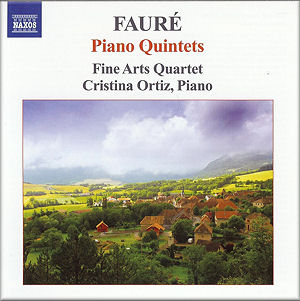
Gabriel FAURÉ (1845-1924)  
Piano Quintet No. 1 in D minor (1887-1905/6) [30:59]
Piano Quintet No. 2 in C minor (1919-21) [32:17]
Cristina Ortiz (piano); Fine Arts Quartet
rec. Performing Arts Center, Purchase College, Theatre ‘C’, Purchase, New York, USA 20-22 December 2007
NAXOS 8.570938 [63:24] 
Experience Classicsonline


What entrancing music this is: elusive and enigmatic. It demonstrates how unjust is the relative neglect of Fauré’s chamber works.
 

For this attractive new Naxos recording the Fine Arts Quartet comprises: Ralph Evans and Efim Boico (violins), Yuri Gandelsman (viola) and Wolfgang Laufer (cello) with the pianistic talents of Cristina Ortiz. Evans, Boico and Laufer have been performing together for over 25 years. This team’s readings compare very well with that on the acclaimed Hyperion equivalent recorded back in 1995 with Domus (Susan Tomes (piano), Krysia Osostowicz (violin), Timothy Boulton (viola) and Richard Lester (cello)) with the additional talent of Anthony Marwood (violin). 

Fauré’s Piano Quintet No. 1 in D minor, Op. 89 occupied him intermittently over approaching twenty years as ideas occurred and as problems were solved. The opening movement begins with a beautiful, plaintive, long-breathed melody for the strings, developing over limpid, rippling piano figurations. The music moves on through more austere, wistful and passionate moods: Domus are quicker paced and intense at 10:25 while the Fine Arts’ reading is dreamier, more other-worldly and heartfelt. This movement includes a particularly beguiling melody at about 3:23 - on the Naxos recording. The gentle central Adagio movement is sweetly melancholic and introspective. Both the Naxos and Hyperion recordings clock in at 10:56. Both have beautiful little felicities of nuance, dynamics and shading.  The concluding Allegretto moderato is a lighter-veined divertissement – again, the two ensembles sharing the same timing of 7:22; the Domus team displaying a lighter-hearted attitude, the opening piano figures being more emphatically bell-like. 

Fauré’s devoted pupil, Charles Koechlin, commenting on the Second Piano Quintet, observed that it ‘was with pleasant surprise that people found such vigorous and youthful music in a veteran composer … Perhaps we see in this … the finest first movement of Gabriel Fauré.’ This opening movement certainly opens more vigorously yet there is that same elusive ambiguity, too, added to subtle rhythmic shifting between triple and quadruple time. The Fine Arts reading is nearly a minute slower than Domus who are more forceful yet quite charming. The Fine Arts’ reading is that much more intense. The second Allegro vivo movement is a light-hearted, quicksilver scherzo with rapid scale figures for the piano and a lilting waltz introduced by the strings. The Domus reading is technically dazzling and their waltz lilts beautifully but overall their reading does not quite appeal as much as that of the Fine Arts. The long Andante third movement has something of the melancholy of Fauré’s First Piano Quintet. It finds Domus lingering unusually longer at 10:57, as opposed to Fine Arts’ 10:16. Domus show a more deeply felt air of gentle resignation whereas the Fine Arts team opt for a more romantic, more upbeat, more optimistic view. The Allegro molto finale has a high-spirited outlook and it appears from Fauré’s letters that he enjoyed working on it. Here Domus regain their faster-paced spirit; their exuberance is countered by the Fine Arts artists who find a more autumnal quality. 

Two magical, enchanting chamber works in alluring performances by the Fine Arts Quartet and Cristina Ortiz. I would not want to be without the Hyperion Domus ensemble recording either, both are magical.

Ian Lace



Return to Review Index


Reviews from previous months
Join the mailing list and receive a hyperlinked weekly update on the discs reviewed. details
We welcome feedback on our reviews. Please use the Bulletin Board
Please paste in the first line of your comments the URL of the review to which you refer.


You can purchase CDs and Save around 22% with these retailers: