Making
a Donation to MusicWeb
About MWI
Site
Map
More
Reviews
How to find a review
Books
Film
Music
Nostalgia
Records Of The Year
Recommendations
Comment
Arthur Butterworth Writes
Phil
Scowcroft's Garlands
Classical
blogs
Reviewers
Logs
Announcements
Don't
Go Here!
Community
Bulletin Board
Web
Ring
Reviewers
Helpers
invited!
Resources
How
Did I Miss That?
British
Composers
British
Light Music Composers
Other
composers
Indexes
Label
Masterwork
Discographies
Composer
National
Themed
Review pages
Complete Books
Programme
Notes
External sites
British Music Society
The BBC Proms
Performers
Orchestra Sites
Recording Companies & Retailers
Online Music
Agents & Marketing
Publishers
Other links
Newsgroups
Web News sites etc
Editorial
Board
Classical Editor
Rob Barnett
Seen & Heard
Editor and Webmaster
Bill Kenny
MusicWeb Webmaster
Len Mullenger
Assistant Webmaster
David Barker
PotPourri
A
pot-pourri of articles
MW
Listening Room
MW
Office
Helping
MusicWeb
Advice
to Windows Vista users
Questionnaire
Site
History
What
they say about us
What
we say about us!
Where
to get help on the Internet
CD
orders By Special Request
Graphics
archive
Currency
Converter
Dictionary
Magazines
Newsfeed
Web Ring
Translation Service
Rules
for potential reviewers :-)
Do
Not Go Here!
April Fools
|

REVIEW
|
Advertising
Rates
Visitor
stats
MusicWeb
International
has over 25,000 Classical CD reviews on offer
Gerard
Hoffnung Concerts &
The
Bricklayer Story

New
Releases

New
Releases


MusicWeb
sells the Polish
catalogue CDAccord
£10.50 post free W-W

MusicWeb sells the
Arcodiva catalogue
£12.00 post free W-W

£11.50
post-free world-wide
Try
it and see - Sale or Return
MusicWeb
can now offer you discs from the following catalogues:
Prices include postage
Musicweb
Special
Offers
Google Ads - for information about privacy matters, click here.
|
 |
 |
|
alternatively
CD: AmazonUK
|
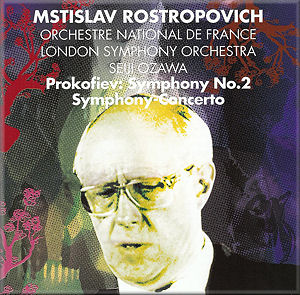
Sergei PROKOFIEV
(1891-1953)
Symphony No. 2 in D minor Op. 40 (1924) [37:43]
Symphony-Concerto in E minor Op. 125 (1951) [37:00]
French
National Orchestra/Mstislav Rostropovich (symphony); Mstislav Rostropovich
(cello), London Symphony Orchestra/Seiji Ozawa
rec. Grand Auditorium, Radio France, Paris, December 1986 and April
1987 (Symphony); Henry Wood Hall, London, November 1987 (Symphony-Concerto).
DDD
WARNER CLASSICS MAESTRO 2564 691742 [74:47]  |
|
|
The name of this Warner reissues label is Maestro. In a way that only applies to half of this disc. Rostropovich is certainly the maestro on the recording of Prokofiev's Second Symphony. But he is the soloist in the same composer’s Symphony-Concerto. However, in both pieces he demonstrates both his consummate ability, whether as cellist or conductor and his claim to be one of the foremost musicians of the second half of the century.
Prokofiev’s Symphony No. 2 was written in 1924 as an attempt at the style méchanique or as the composer put it “a work made of iron and steel”. It is in two movements, patterned after Beethoven’s last piano sonata. Most of the “iron and steel” is in the first movement and Rostropovich ably brings this out without getting bogged down in the layers of counterpoint for which the symphony is notorious. Unfortunately he cannot save the movement from certain elements of repetition. This causes the end section to go a little astray.
The much-larger second movement sets a diatonic melody against varying textures. These vary widely in mood. Rostropovich ably contrasts them without losing sight of the overall structure. His rendering of several of the sections is as close to perfection as you are likely to hear. An excellent example occurs in the central section of the movement with its combination of motor energy and mysterious strings. As the movement continues Rostropovich imperceptibly brings the first movement material forward so that we are almost subliminally jolted when it arrives in full.
This recording is taken from the complete set of Prokofiev symphonies Rostropovich did with the French National Orchestra about twenty years ago. While the hall could be more resonant, the orchestra is in fine form, especially the strings. Rostropovich also gets some wonderful combinations of those strings with members of the brass section.
In the Symphony-Concerto we have Rostropovich not only as cellist, but as a collaborator in the composition of the work. In the late thirties Prokofiev had written a cello concerto, but it had not been overly successful. About ten years later the composer met Rostropovich and wrote the Cello Sonata Op. 119 for him. The composer then offered to write a new concerto for Rostropovich, but ended up reworking the original concerto, with much help from Rostropovich, who gave its premiere in 1952. He recorded it multiple times, with the first recording in 1957 with Malcolm Sargent being the standard for many years. In this version from over thirty years later, the cellist’s sound is mellower and his phrasing is wonderful. Ozawa is also unexpectedly good in maintaining the contrast between soloist and orchestra.
The second movement starts off as a tour-de-force of motoric energy, but there are many moments of lyricism. Again Rostropovich and Ozawa are able to bring these forward in a way that justifies the title Symphony-Concerto. The highlight of the movement is a semi-cadenza of great beauty for Rostropovich and a few orchestral instruments. This is succeeded by a true cadenza leading to moments of volcanic energy which proceed to more threatening music and a final burst of excitement. All these changes are excellently negotiated. The last movement starts out very well with Rostropovich and Ozawa not neglecting the humorous element. They also make a good transition to the slower middle section, but after this things get somewhat ragged. This cannot be blamed on the LSO, as they play very dynamically throughout. The movement finishes off in a brassy manner. It is a disappointing end to an otherwise dynamic performance.
William Kreindler
|
|
|