This CD made an immediate appeal to me. I listened to the entire
album twice, although even on the first hearing I felt comfortable
with most of the works presented. The reason, I guess is
that the music passes the two fundamental tests: is the music
original and is there an obvious trajectory of tradition
that enables the listener to relate the pieces to something
that is already familiar? The answers to both these questions
is ‘yes’.
The first thing to be said on the originality aspect is that
this music is both demanding and interesting. The stylistic
parameters lead to a sense of variety that is well under control.
Lynch’s music is not like, say, Einaudi, whose every piece seems to sound the same. Before I had a chat with the composer, I had decided that there were certain influences (conscious or apparent) at work in Lynch’s music - these included Debussy, Messiaen and for my money Kaikhosru Shapurji Sorabji. Perhaps there were even hints of Fred Delius. However the composer told me that the Japanese composer Takemitusu and the Latin-American Astor Piazzolla also had an important contribution to his music. But as I have often said, listening to music is not about ‘hunt the composer’,
unless the composer we are considering has been unable to develop
and synthesise their own style.
I hope that readers will not think me unsophisticated if I suggest that they begin their exploration of this CD with the Three Tangos. These were written over a four year period and certainly nod to Piazzolla. The first, The Stolen Branch is sultry and suggests a hot day in Malaga. Milonga Azure is also lugubrious: it has been arranged for a wide variety of instruments and ensembles. The final Tango, Pajaros del Mar or Seabirds, is a little livelier at first, but concludes in a reflective mood. All three dances are attractively scored for flute and piano.
After these Tangos, have a break. Then I suggest listening to Mediterranean which
is also written for flute and piano. This piece “alludes to the composer’s increasing interest in Mediterranean music ... including flamenco, fado and the many animated, vivacious sounds of North Africa.” However this piece is not a compendium of folk dances, nor is it an impressionistic work. It is greater than the sum of its influences. At any rate it is more impressive and certainly more musical than the bit of ‘fado’ singing
I heard in Lisbon the other day!
I enjoyed Moon Cycle which is designed to convey “various aspects of the phases of the moon”. The piece is constructed in five short sections. It is a reflective piece that carries the listener’s imagination. In a short note Gillian Poznansky points out that the work uses various technical devices, including harmonics and portamento. However she concludes by emphasising that the work’s basis is a form of dialogue, describing the moon’s “cyclical
and fantastical journey.”
Petenera is one of three major cycles of piano music presented on this disc. The programme notes point out that the Petenera is
a flamenco ‘palo’ or form. Furthermore it is also a legend concerning a femme-fatale. The present piece is built around thoughts suggested by Federico Garcia Lorca’s
poems entitled Graphic of Petenera. Although I have
not read these poems they are declared to be “dark, erotic, strange and make frequent references to the guitar”.
There are four movements: Bell, Dance, The Six Strings and finally De Profundis.
Although there is the suggested Spanish background to this
work, it is not Spanish in the sense of Albeniz’s exploration
into the folk music of Andalusia. It is more a mood than a
style, yet the Iberian peninsula is never too far away.
The main event on this CD is the two volumes entitled White Book 1 and White Book 2.
Both are composed for the piano and represent both the earliest
and the latest works on this CD. Lynch has written that “these works depict the contrasting facets of life, evoking cultures and places that are both real and imaginary. The pace and personality varies significantly here, from the shadowed, sombre and evocative, to the charismatic and vivid.” The
titles of these pieces seem to cover a wide range of imagery
and mood. For example the first book has pieces called Night Garden, The
Emperor’s Field and Midsummer Reds. The second book considers Undiscovered Islands, a Night Journey to Cordoba and the Sadness of the King.
The programme notes give a lot of detailed discussion on these
pieces, some of which is a little esoteric for my taste for
example, “in a musical way to defy gravity”. However, the important points to recall are that the composer has written two cycles of pieces that are well balanced, enjoyable, effective and owing much to the Mediterranean sound-scape. Finally he has created a work that is akin to Debussy’s Preludes in their use of pictorial and literary imagery and general cohesion of thought and in a considerable diversity of style. In that sense they are a major achievement.
The presentation of the CD is excellent - with the exception of all lower case proper nouns on the cover, which grates. I was particularly impressed with the programme notes - but see note above. A good essay introduces the composer and his music. There follows a more detailed analysis of each piece along with further comments from the performers. The middle pages of the booklet have a collection of photographs that reflect the mood and subject matter of a number of the pieces.
The playing by both the pianist and the flautist sounds excellent and appears to be sympathetic to the mind of the composer, although I have nothing to compare it to, nor have I perused the scores. My only niggle is that there seems to be a little bit of a hard edge to some of the piano tone.
However, this is an impressive CD that is well within the tradition of British (or Western) music. All the works are approachable, but like all good music continues to reveal their secrets with repeated hearings. I look forward to hearing other works from Graham Lynch: he is currently writing a Concerto for bandoneón (accordion) and Strings and a commission for the percussionist Evelyn Glennie. Both works will be well worth the wait.
John France























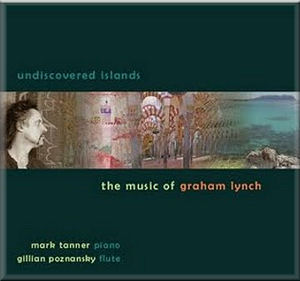
 Mark
Tanner (piano); Gillian Poznansky (flute)
Mark
Tanner (piano); Gillian Poznansky (flute)
