 |
|
|

alternatively
CD: Crotchet
|
Wolfgang Amadeus
MOZART (1756-1791)
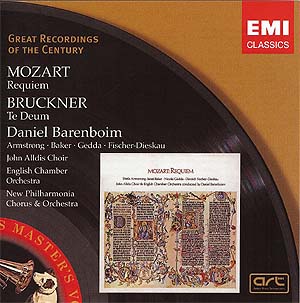
Requiem in D minor K626 (1791) [56:13]
Anton BRUCKNER (1824-1896)
Te Deum (1881-83) [22:53]
 Sheila Armstrong (soprano); Janet
Baker (mezzo); Nicolai Gedda (tenor); Dietrich Fischer-Dieskau (baritone); John
Alldis Choir; English Chamber Orchestra/Daniel
Barenboim Sheila Armstrong (soprano); Janet
Baker (mezzo); Nicolai Gedda (tenor); Dietrich Fischer-Dieskau (baritone); John
Alldis Choir; English Chamber Orchestra/Daniel
Barenboim
Anne Pashley (soprano); Birgit Finnilä (alto); Robert Tear (tenor); Don
Garrard (bass)
New Philharmonia Chorus
New Philharmonia Orchestra/Daniel Barenboim
rec. 9, 12 July 1971, 4 January 1969, All Saints Church, Tooting, London. ADD
EMI CLASSICS 2127182 [79:09]  |
|
|
This disc contains two EMI re-releases in the Great Recordings
of the Century series.
Mozart’s Requiem has been one of my favourite
works since I first heard it as a child, and this recording
by Barenboim is difficult to beat. From the opening bars of
the Introit, there is a sense of deep contemplation, with the
clarinet and bassoon suspensions accompanied by a heaviness
in the strings. The choir entry is dark and ominous, continuing
the sense of building tension and sorrow. Mozart’s genius
in this work comes from its emotional strength conveyed through
control of harmony and especially tension. The composer’s
vocal writing is spectacular, and the orchestra balances particularly
well in this recording. The fugue of the Kyrie maintains the
weightiness of the opening, and the rising entries give a sense
of splendor and magnificence.
The Dies Irae in this recording is ferocious and full
of dark energy, with brass coming to the fore in the orchestral
colour. This disc also boasts a star-studded cast of soloists,
who provide a stunning Tuba Mirum, opening with Dietrich
Fischer-Dieskau and Robert Tear, and later joined by Janet
Baker and Sheila Armstrong. These voices are impeccably well
matched and make an impressive quartet. The Rex tremendae is
rousing and full of passion, while the contemplative recordare is
wonderfully phrased with the overlapping solo lines building
well-paced dissonances. By contrast, the attacca entry
of the Confutatis Maledictis quickly breaks the reverie,
providing a great sense of drama and returning the dark energy
to the music. The contrasting sections in this movement are
extremely well handled, with wonderful juxtapositions of mood
and character.
Mozart died after completing just the first two movements,
with sketches of the vocal lines with figured bass for the
other movements, and only eight bars of the lacrimosa.
This recording uses Süssmayr’s reconstruction, which
is the most heard despite other composer’s attempts at
completing the movement. This is a glorious rendition, with
the John Alldis Choir providing a rich and sombre sound. The
remaining movements are similarly well presented; the Quam
olim Abrahae sections are triumphant, while the Hostias is
beautifully calm and tranquil. The joyful Sanctus with
its closing Hosanna provides a sense of lightness, while
the Benedictus is delightfully presented with some impressive
solo singing. The Agnus Dei is poised and elegant, with
Mozart’s harmony creating some magical moments. The reprise
of the opening in the final movement gives the piece a sense
of having come full circle, although the music is seen in a
different light as a result of the experience of having heard
the whole work.
There are numerous recordings of this Requiem on the market.
If I could only buy one, it would be this one, for its combination
of rich sound quality, excellent pacing and emotional impact.
Barenboim gets to what I feel is the essence of Mozart’s
work, supported by an impressive choir, fantastic orchestra
and some stunning soloists.
Bruckner’s Te Deum is heard here in its 1969 recording,
which was Barenboim’s first recording conducting Bruckner.
The C major tonality seems bright against Mozart’s D
minor, and Bruckner’s music is conceived on an enormous
scale, with large orchestra, organ, chorus and soloists. The
harmony in the opening movement shifts in blocks, with large-scale
unisons accompanied by moving lines in the strings. This is
powerful writing which has an impressive impact. The solo quartet
in Te ergo quaesumus is once again impressive, with
Barenboim this time working with Anne Pashley, Birgit Finnilä,
Robert Tear and Don Garrard. The stunning Aeterna fac emerges
with a burst of strength and energy. The last two movements
combine more classical-style orchestration and harmony before
the reprise of the opening material, the vocal lines holding
long sustained notes and unisons in a dramatic final cadence.
This is a bold work, heard in a magnificent performance.
Carla Rees
EMI Great Recordings of the Century review pages
|
|
|























