 |
|
|
|
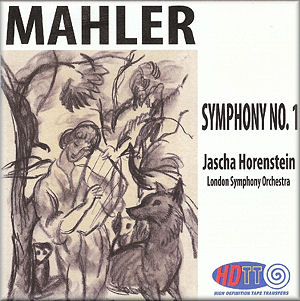
Gustav MAHLER (1860-1911)
Symphony No.1 in D (1888) [56:51]
 London Symphony Orchestra/Jascha Horenstein
rec. Barking Assembly Hall, London, 29-30 September 1969. ADD
Transferred from a Unicorn four-track tape.
HDTT HDCD128 [56:51] 
available on CD, DVD or FLAC download
PLEASE
NOTE we have received a communication from Unicorn-Kanchana
alleging that this disc is being copied without their permission.
This is a serious matter and AS A RESULT THIS DISC HAS BEEN WITHDRAWN
|
|
|
Jascha Horenstein recorded Mahler's First Symphony twice. As one of the greatest of all Mahler pioneers he recorded it first in the 1950s for Vox in Vienna in what was one of the work's first LP recordings. He recorded it again in London in 1969 for Unicorn with the LSO. It is this second recording that is reissued here.
The introduction is clear and expectant and there is a great sense of space, both in the pacing of the music and the playing of the orchestra. Horenstein shares Rafael Kubelik's simplicity in the main theme, as heard in his DG recording, but I like the way Horenstein builds in more mystery to the arrival of the soft horn announcement of what will become the clinching motif at the climax of the exposition. This is real concert hall "theatre", worthy of Furtwängler - making me always wonder if this is how it sounded when Furtwängler performed it. At the rip-roaring climax note too Horenstein's acute ear for the particular sound of the Mahler orchestra, for contrasts and for the special instrumentation. A slight slowing for dramatic effect is a surprise but such is Horenstein's long-term planning that it doesn't obtrude. The Scherzo has a lovely bucolic swing to the dance and a nice trenchancy too which contrasts beautifully with some perky clarinet contributions in the Trio. In the third movement funeral march Horenstein keeps up a slightly faster tempo than usual but, as so often with this conductor, his tempo choice is unerringly the right one for what he wants to say. He crucially recognises that this is a parody and should have the mood of fantasy too. His band interjections seem to touch a nerve and in the quotation from the Gesellen song that forms the emotional core of this movement note the bassoon contribution, the kind of detail highlighting for which Horenstein was renowned. It undermines the texture like a worm in the flower bed - very Mahlerian! When the march returns Horenstein doesn't force the "oom-pah" rhythms of the band but they make their effect which, it is surprising to report, is not as usual as you might think. The benefits of the virtuoso LSO are apparent in the opening onslaught of the fourth movement. Nothing seems beyond this orchestra and their contribution lifts the passage to an almost cosmic level, accentuating the bravado of the young Mahler. Horenstein refuses to wear his heart on his sleeve in the lovely transition into the lyrical second subject. So the great theme emerges from out of exhaustion as a consolation, heart-easing rather than heart-wrenching. In the central section where the battle is resumed and the end is signalled Horenstein, ever master of structure, holds something back for the coda and then with what nostalgia he paints the final look back to the start of the symphony. Horns calling from immense distances and also note the picking out of a violin harmonic. The end does not disappoint. In fact, Horenstein has a surprise in store. At the point in the score marked "Pesante-triumphal", where the horns should be standing up, Horenstein slows the tempo down in the kind of rhetorical gesture he was not usually known for. The effect is to lift the music again to another level and make no apologies for what always teeters on the edge of banality. In so doing he wins us over with his sheer audacity.
In its Unicorn own-label releases, LP and CD, this was always a very special recording of the First Symphony that ought to have been in every collection. So what about this new reissue? The sound produced by the Harold Davidson and Bob Auger team was always fine with good stereo spread and a richness of detail. Until now it has only ever been heard in Unicorn-Kanchana's own releases, first on LP and later on CD. I have always thought that the sound that I have been used to on the Unicorn CD was the best I would ever hear of this recording. Until now. On this new issue the HDTT engineers have used considerable skill and a whole battery of equipment (all listed on the liner) to take a Unicorn four track tape and transform it into something that is truly remarkable. As a friend recently described it to me, this is how LPs ought to have sounded. First of all it has been transferred at a very much higher level with no sense of distortion at all. Playing the Unicorn CD immediately after the HDTT you could be forgiven for thinking that there is something wrong with your amplifier. But it is so much more than just volume level that is improved. The stereo spread is much much wider, the detailing of sections and parts so good I believe that you can hear pretty well everything. In so doing you appreciate how marvellous the LSO was at that time and Horenstein's balancing of it. There is an impact and a solidity to the sound image that is absolutely breathtaking. It has the effect of making you hear a performance that you thought you knew in a completely new way. I am not exaggerating. I really can say that I have never experienced such an improvement in sound in a remastering as this. So often claims for improved sound on reissues of back catalogue can either not be heard at all or, if they can, be dismissed as marginal and perhaps only heard in high end equipment. Not this time. Take it from me, this is a transformation that really has to be heard to be believed. The basses and cellos at the start of the second movement, hard on the right, bows digging into strings, the percussion battery at the start of the fourth movement, sharp and clear, the beguiling soft strings in the third movement, all heard as though they were in the room with you. This must be close to what Jascha Horenstein actually heard in front of him at Barking Town Hall all those years ago. This is the ideal that Bob Auger was aiming for people to hear in their own homes but which he probably knew would never happen. Well it's happened now and HDTT have done it. I congratulate them warmly. Can they now please give the Unicorn Horenstein Mahler Third the same treatment? Mahlerians would be even more in their debt than they are now. It would surely sell as well as this First certainly deserves to.
If you love Mahler, admire Horenstein or already own and value this recording, or all three, do not delay in buying this new release. If you have never heard this recording before, then now is the time to get it. You will not be disappointed. You will be as thrilled as I was.
Tony Duggan
|
|
|























