 |
|
|

alternatively
CD: AmazonUK
AmazonUS
Download: Classicsonline
|
Klaus Ib JØRGENSEN
(b.1967)
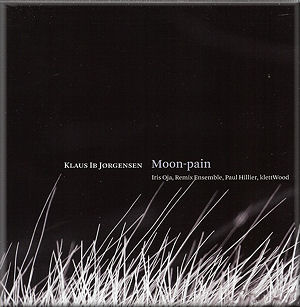
Moon-Pain (2003-8) [47:06]
Goblin Dance (2005) [17:30]
Lisbon Revisited (2008) [8:00]
 Iris
Oja (mezzo); Remix, KlettWood (Goblin Dance)/Paul Hillier Iris
Oja (mezzo); Remix, KlettWood (Goblin Dance)/Paul Hillier
rec. 1-5 April 2008, Casa da Musica, Porto (Moon-Pain), 19
and 21 September 2008, Københavns Musikskole (Goblin Dance),
field recordings at various locations (Lisbon revisited).
DACAPO 8.226505 [72:33]  |
|
|
Klaus Ib Jørgensen’s work has been represented
by a few works already released on the Dacapo label, but his
is a name unlikely to be familiar to many. Seen as his most
important work to date, the substantial song cycle Moon-pain for mezzo-soprano and chamber ensemble sets the moon-themed poems of Portuguese poet Fernando Pessoa (1888-1935) to music which responds to the texts in a highly personal and multi-layered language. The treatments range from the Sprechstimme elements
in ‘In Silence and Moon’ and elsewhere, through
colourful fragmentation of the words or their employment almost
as pure sound, and a consistently restless atmosphere of complex
melodic shapes and an uncompromising atonality. The cycle concludes
with a short instrumental full-stop of stunningly serene beauty.
This kind of music is hard to tie down to a single genre. I
hear moments of Berio and Schoenberg here and there, but in
the end it has to be said that Jørgensen is his own
man. His settings of Moon-Pain are infinitely subtle
and delicate, while at the same time robust and with a sense
of firm inevitability. They are composed with a fine ear for
detail and the sense of drama in Pessoa’s words, but have an airy freedom which occupies a place in today’s response to the romantic traditions founded by Mahler and Zemlinsky: though once again, without the Teutonic weight of any kind of Germano-Austrian historical legacy. Jørgensen’s is a sound-world which requires a certain kind of key - not so much in terms of comprehension, but in allowing oneself become aligned with his magnetic pole. My old flute teacher Gareth Morris firmly believed players only came to like avant-garde modern music because they became used to it through endless repetition, and audiences only through a kind of perverse sense of intellectual duty. I don’t have that feeling through the performances on this recording, which have a sense of vibrancy and communicate a compulsive conviction with the quality in these pieces. The composer’s
response to the constantly shifting moods of the poetry is
something to which the listener becomes increasingly attuned
through the duration of the piece, and on repeated listening.
Singer Iris Oja certainly makes the best case for this work,
with an accuracy and range of expression which draws one in
immediately. She can sing conventionally with the best of them,
but sample also her instrumental equality with the rest of
the players at the beginning of the second in the cycle, Moonlit.
The six movements of Moon-Pain are interwoven here with two other, related compositions: Goblin Dance (2005) for clarinet and piano, and Lisbon Revisited (2008).
The former, recorded at a different location, inhabits a similar
kind of musical world, with the clarinet taking on the solo
voice of the ‘singer’. The three movements of this
piece provide a change in colour and a respite from the interactions
of string instruments, though even while the textures thin
the intensity remains essentially in place, with the vast potential
of the clarinet explored to the full in sudden changes of direction,
fluttering and breathy transformations of notes, extreme squeaks
and plops. Hard to describe as this is, the music has more
substance than words can suggest, with momentary glimpses and
snatched fragments of potent invention, and a final movement
of sublime Moon-Silence. Lisbon Revisited is
a combination of recorded sounds from the streets of Pessoa’s
home town of Lisbon, a poem by Pessoa in a variety of languages,
and fragments of the Moon-pain music. This works very well to my mind, casting an atmosphere of Portugal and the origin of the poems, combining elements of language in surreal contexts but without over-complexity or pretension. One of the voices is that of Konrad Boehmer who I know quite well from my time at the Royal Conservatoire in The Hague, so I had the added dimension of Dutch familiarity popping out of the unknown and the abstract. The little fragments of distant fado singing
and the jaunty ballet piano combined with Jørgensen’s
own music coming from the same distant perspective are touches
of brilliance. Just a slightly longer pause between this and
launching into Lunar Land might have made more sense, but this is a very minor quibble.
This has the potential to be a ‘difficult’ programme, and if you musical world goes no further than 1913 then this will be outside your comfort zone. If you are attracted to this by Paul Hillier’s name then you will need to expect something entirely different to the early music or Arvo Pärt recordings for which he is better known. This is however one of those projects which just seems to ‘work’,
forming a musical experience which is more than the sum of
its parts. I must admit I found myself resisting to a certain
extent in the initial phases of listening, but once having
applied myself to a serious appraisal of the disc I was soon
charmed into uncommonly magical and rarefied realms.
Dominy Clements
|
|
|























