 |
|
|

alternatively
CD: Crotchet
|
Klaus HUBER (b.1924)
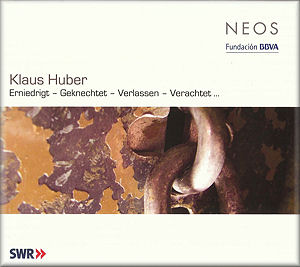
Erniedrigt - Geknechtet - Verlassen - Verachtet ... for solo
voices, chorus, orchestra and tape (texts: Ernesto Cardenal,
Florian Knobloch, Carolina María de Jesús, George Jackson)
(1975/1978-83)
 Anne Haenen
(mezzo); Theophil Maier (tenor and speaker); Paul Yoder (bass-baritone);
treble solo from the Tölzer
Knabenchor; Schola Cantorum Stuttgart/Clytus Gottwald, rehearsals;
SWR Vokalensemble Stuttgart/Helmut Franz, rehearsals; SWR Sinfonieorchester
Baden-Baden und Freiburg/Matthias Bamert; Kenneth Jean, Burkhard
Rempe, Arturo Tamayo, co-conductors Anne Haenen
(mezzo); Theophil Maier (tenor and speaker); Paul Yoder (bass-baritone);
treble solo from the Tölzer
Knabenchor; Schola Cantorum Stuttgart/Clytus Gottwald, rehearsals;
SWR Vokalensemble Stuttgart/Helmut Franz, rehearsals; SWR Sinfonieorchester
Baden-Baden und Freiburg/Matthias Bamert; Kenneth Jean, Burkhard
Rempe, Arturo Tamayo, co-conductors
rec. 14 October 1983, Donaueschinger Musktage. Stereo. DDD
NEOS 10809 [67:58]  |
|
|
‘In memoriam Luigi Dallapiccola’ - the dedication of the fifth movement
of Klaus Huber’s oratorio speaks volumes. For, like his Italian predecessor,
Huber is an avant-gardist with a political agenda. This is a work which employs
an uncompromising serial and electro-acoustic aesthetic to deliver an equally
uncompromising Communist message. The title, which translates as ‘Abased-Fettered-Abandoned-Despised’,
is taken from one of the more poetic passages of the Communist Manifesto, and
the trajectory of the work is from various representations of human suffering
towards a call to arms and some (relatively) optimistic depictions of possible
Utopian futures.
The seven movements of the oratorio where written in stages between 1975 and
1982. Each has a different instrumentation and a different text source. The result
strikes a good balance between diversity and coherence. Indeed, the serialism
upon which much of the music is based never leads to aesthetic monotony. Huber
is from Switzerland, and this work fits squarely in the tradition of central
European post-war Modernism. Various cultural bearings are evoked, most of which
link to the history of the Austro-German tradition. This adds to the aesthetic
variety, but also inadvertently attests to the cultural insularity of the avant-garde,
the Germanness of the music contrasting the cosmopolitan texts, which include
passages in German, American English, Spanish and Brazilian Portuguese.
The opening of the work fades in from silence, with a musique concrète
tape track made up of overlaid voices gradually increasing in volume and complexity.
There are a number of other very quiet taped effects throughout the work, and
the recording levels of the disc are set very low to allow these passages definition.
(Don’t be afraid to turn the amplifier volume up though, there is nothing
monumentally loud enough to blow your cones.) Huber is apparently using electronic
manipulation of the human voice as a representation of the dehumanising effect
of industrialisation.
This leads into the first main part ‘On the will of the oppressed’,
a setting of words by Florian Knobloch, a foundry worker describing his experiences
of industrial manufacture. This is the first of three disparate movements exploring
the condition of human oppression, the second sets texts from the diary of Carolina
María de Jesús describing her experiences as a resident of a Brazilian
favela and the third takes as its source the prison letters of George Jackson.
Erratic vocal effects in the first movement are often reminiscent of Ligeti,
his Aventures or the third movement of his Requiem. The second movement
mixes spoken and sung texts, and the result recalls the operas of Berg. The solo
bass-baritone in the third movement (Paul Yoder) intones the text as recitative,
its pitch content erratic, but its rhythm faithful to the agogics of the English
language.
The fourth movement is the call to arms, with militaristic oppression graphically
depicted through brief march episodes (for which Mahler’s Third Symphony
is clearly the model) and even through the use of chains in the percussion section.
The will of the people is represented by the voices of the choir, who gradually
gain the foreground. The sixth movement gives much needed respite in the form
of a calm interlude. Here a boy treble sings over representations of birdsong
from the woodwind. Shades here of the calm before the storm in Strauss’ Alpensinfonie a
reminder that the peace will soon be shattered. The conclusion, when it comes,
offers what the composer describes as a ‘profane version of the resurrection’.
What Marx might have made of this version of his Utopian ideals is anybody’s
guess, but for Huber it is an opportunity to conclude in pseudo-religious mode
with a serial reworking of Bach’s chorale setting Christ lag in Todesbanden,
although the complexity of the result all but obscures its source.
The musical parallels highlighted in this brief précis demonstrate both
the variety and approachability of Huber’s oratorio, and anybody who enjoys
the operas of Berg, the vocal music of Ligeti or the lyrical serialism of Dallapiccola
while find much of interest here. Both the performance and the recording do the
work proud, and the brass and percussion sections of the SWR Sinfonieorchester
deserve a special mention for their handling of the music’s considerable
demands.
One question hangs over this release, however, and that is its timing. The work
was completed in 1982 and the recording made in 1983 - so why wait 25 years before
the CD release? The high production standards have stood the test of time admirably,
but the aesthetics of the work are now very much history. For those like me with
an interest in 20th century musical modernism, this is not necessarily
a problem, and the music more than holds its own, even by comparison with the
biggest names in the field. The only problem is that the aesthetics and the ideology
are so closely intertwined, and while the music retains artistic value, even
as a historical artefact, the anachronism of the underlying politics makes the
whole project seem redundant, advocating as it does an already long-lost cause.
Gavin Dixon
|
|
|























