|
EXPLORE
Musicweb - CLICK
------------------
Message Board
Announcements
Twitter @MusicWebINt
------------------

Schubert
complete symphonies
Bamberger Symphoniker
Jonathan Nott

Only complete set
on the Market
35CDs £67

RECORDING
OF THE MONTH
Momentous!
BARGAIN
OF THE MONTH

Italian Cello Concertos
and Sonatas
3CDS £10.95

Brahms Symphonies Zinman
£26.85
RECORDING
OF THE MONTH
Beethoven Symphonies
Thielmann


Magic Moments of Opera
10 Operas Arthaus £95

Brilliant Classics 40CDs

Brilliant Classics 60CDs

9 Symphonies Chailly
£31.90

9
Symphonies C Davis
£18.70
BARGAIN
OF THE MONTH
Absolutely marvellous!
£5.99 post free

Bruch VC1 Gluzman
Quite the finest performance of the Bruch concerto
I have ever heard.

The best opera DVD of the year so far [ST]

Mahler Song Cycles
Katarina Karnéus
Available
again
The Raga Guide
4CDs + 196 page book
£33 post-free world-wide
15,000 copies sold
Editorial
Board
Classical Editor
Rob Barnett
Seen & Heard
Editor Emeritus
Bill Kenny
Editor in Chief
Stan Metzger
MusicWeb Webmaster
Len Mullenger
Assistant Webmaster
David Barker
|
 |
 |
|

Buy
through MusicWeb for £13.49 postage
paid World-wide.
Musicweb
Purchase button
|
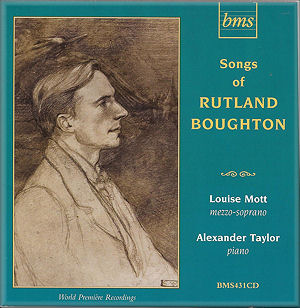
Rutland BOUGHTON (1878
- 1960)
Four Songs Op.24 [11:26]
Five Celtic Love Songs [16:38]
Songs of Womanhood Op.33 [17:28]
Three Songs Op.39 [10:22]
Symbol Songs [12:39]
Sweet Ass [1:51]
Louise Mott (mezzo); Alexander Taylor (piano)
rec. Music Hall of the Guildhall School of Music and Drama, London,
24 April and 1 May 2005
BRITISH MUSIC SOCIETY BMS431CD [70:33] 
|
|
|
Before starting this review could I direct any readers towards
Ian Boughton’s excellent article on this
website - which highlights next year (2010) as the 50th
Anniversary of the death of this fascinating, at times frustrating,
composer. The reappearance of this fine survey of his songs
from the redoubtable British Music Society I’m guessing
is by way of an early celebration.
On the strength of reading an early edition of Michael Hurd’s
definitive biography - then titled “Immortal Hour”
- while a student, a friend and I drove down to Glastonbury
one day to see the sunrise over the Tor - we didn’t: it
was foggy! This was back around 1980 and at that time the Assembly
Rooms, just off the High Street near the Abbey, were closed
up and very forlorn. This had been the focal point of the legendary
- an apt term in the circumstances - Glastonbury Festivals of
which Rutland Boughton was the inspiration and driving force.
I was so pleased to return a year or so ago and see that it
is now a thriving community
arts centre. I was able to go in and see the rooms in which
the great and the good of British music and performing arts
gathered for performances of Boughton’s stage works. I
found it extremely moving and powerful to be in the place which
had been the centre of so much creativity at such a pivotal
moment in our recent past. It is a very simple and modest venue
- probably exactly why it appealed to the socialist Boughton.
To consider Boughton as a composer it is impossible to separate
the man and his moral/social conscience from his body of work.
As Michael Hurd wrote in his 2005 liner-note for this release
- “What mattered to Boughton was the message [of the songs]
… neither in his life, nor in his art, was Rutland Boughton
willing to conform”. It is precisely this non-conformist
attitude that makes him so fascinating as a composer yet also
by turns frustrating.
Over recent years there has been a slow but sure recording of
his key works so that now we can hear the three Symphonies,
the two most famous stage works (The Immortal Hour and
Bethlehem), a good sample of the chamber music and other
orchestral works. This well-filled disc fills another gap by
providing a survey of 23 songs representing just under a quarter
of his song output. The only area where we still lack significantly
is his choral output. From memory - I do not have my copy of
the Hurd biography to hand - I recall the author being very
enthused about the quality of Boughton choral arrangements of
folksongs as well as singling out the choral passages in the
stage works as being some of the most effective. I have to admit
to having an equivocal attitude towards the music. There are
moments when I think the music is quite wonderful - as Ian Boughton
points out in the above article - the BBC broadcast of the 3rd
Symphony in 1986 under the late-lamented Edward Downes (later
released on the BBC Classics label) was a revelation. This Downes
performance has always struck me as far superior to the studio
recording with Vernon Handley and the RPO on Hyperion having
a muscular drive and joy that is utterly compelling. Yet for
all of the radical ideas he embraced intellectually and socially
his musical language is in the main very conservative - he is
no Marc Blitzstein or Kurt Weill trying to express political
ideas in a contemporary idiom. As Hurd points out, for much
of his life he had to be a pragmatic and practical musician
earning his money where he could find it and this is reflected
in the songs recorded here. His experience as a rehearsal pianist
from 1903 and later from 1905 as singing teacher at the Birmingham
Midland Institute of Music set him in good stead to know what
“works” vocally. So there are recurring characteristics
in these songs of the melodies lying well for the voice set
over accompaniments that are effective without being domineering.
This is my first encounter with any Boughton songs so it is
very easy to fall into a trap of saying what they are not. It
is hard to discern a consistently individual voice at work here.
Some songs leap out with power and emotion - The Dead Christ
(track 2) - is one that feels like a miniature scena building
dramatically while at the same time have a sense of a slowly
moving funeral procession in the accompaniment that binds the
whole together. Next to that I find the Five Celtic Love
Songs to be too full of a kind of drawing-room easy sentiment.
It’s the brickbat of the Celtic Twilight that is all too
often levelled at Arnold Bax (who also set Fiona Macleod lyrics
taken from From the Hills of Dream as his A Celtic
Song-Cycle) but one that Bax ultimately overcomes - if not
in this cycle. In the context of Boughton though this is very
valuable to hear - Macleod (the pen name of William Sharp) provided
the source text for The Immortal Hour which will always
be Boughton’s key to fame even if not his best work. The
enigma that is Rutland Boughton will always remain the question
whether or not his fame was based on the fact that he happened
to fulfil an ideal and conviction at the time is was needed
most. So what was it about Immortal Hour (and the similar
spirit that is captured in these songs) that so moved and inspired
all strata of British society for fifteen or so years from 1914?
All of the sponsors of the Glastonbury Festivals either wrote
themselves or were regularly exposed to music and art of a far
more radical nature than that expounded by Boughton. It is almost
as though he embodied a pure social (both political and practical)
ideal that was a spiritual port in the stormy seas of World
War I and the 1920’s. His neglect since that time is probably
due to the fact that the society that served has changed and
with it their needs. What seemed a fusion of the best of a legendary
past and a idealised future (don’t forget Boughton’s
socialism was that of Ruskin, William Morris and George Bernard
Shaw) has now been revealed as naïve and simplistic.
To look at production photographs from the time, what was clearly
deemed radical in setting, design and movement now looks at
best quaint. But that is more of an indictment of our own more
self-serving and cynical age. Boughton’s sincerity shines
through every song. Take the second of the Songs of Womanhood
Op.33 - A Woman to her Lover (track11). This is one of the
most musically impressive and dramatic songs recorded here.
The text was supplied in 1911 by Christina Walsh who was to
become Boughton’s second ‘wife’ as well as
a main artistic collaborator at Glastonbury through her work
as a painter and designer. The song sweeps one along until you
start following the text which is PC before the term was coined.
You would have to be sincere (and in love) to see a line to
set that goes “And our co-equal love will make the stars
to laugh with joy” and not be daunted - the sentiment
is wholly admirable the expression of it clumsy in the extreme.
And therein lies the heart of the Boughton dilemma - the gap
between intent/idea and execution.
The performers here - Louise Mott and Alexander Taylor prove
to be staunch and worthy advocates. Mott has a firm and focused
mezzo voice that is able to move easily across the vocal range
demanded. This is particularly effective in the dramatic songs
outlined above. Given that there is a tendency for some of these
settings to drift toward the ballad in feel Mott makes a virtue
of that by lightening her vocal style to great effect - track
12 A Song of Giving is a good example. There is a slight
lack of emotional differentiation inherent in the many of the
songs themselves which the performers do their best to overcome.
Taylor’s accompaniments are all one could wish for and
the engineering has the piano excellently balanced; behind the
voice but still an equal partner. Full texts are provided (in
English only) but Mott’s beautifully clear diction means
they are only required for reference. To enjoy Boughton today
I believe it is important to accept him for what he is in his
own right. He is not a great composer but his music is always
sincere, often beautiful and never less than interesting. Clearly
he was a man who inspired - literally - those around him. The
recording projects outlined in the article for next year sound
very exciting (again from memory I seem to recall Hurd extolling
a passage in the Queen of Cornwall where the walls of
the castle sing) but in the meantime this disc is an excellent
introduction cum appendix to them as a way of gaining an insight
into the mind of this singular British composer.
Nick Barnard
See also reviews by Rob
Barnett and Em
Marshall
|
|
Advertising
Rates
Visitor
stats
MusicWeb
International
has over 40,000 Classical CD reviews on offer
Discs
received
Having a problem
Donating?

Gerard
Hoffnung Concerts &
The
Bricklayer Story
MusicWeb
can now offer
you discs from the following catalogues:
Prices include postage
There will be NO
VAT Rises
Musicweb
Special
Offers
Monthly
Best Buys
New
Releases

New
Releases


MusicWeb
sells the Polish
catalogue CDAccord
£10.50 post free W-W

MusicWeb sells the
Arcodiva catalogue
£12.00 post free W-W

£11.75
post-free world-
wide
Google
Ads - for information about privacy matters, click here.
Amazon Musicweb International is a participant in the Amazon
EU Associates Programme, an affiliate advertising programme designed to provide
a means for sites to earn advertising fees by advertising and linking to Amazon.co.uk
and Amazon.com
|