 |
|
|

alternatively
CD: AmazonUK
AmazonUS
|
Johannn Sebastian
BACH (1685-1750)
Harpsichord Concertos
Concerto in C major, BWV 1061 for two harpsichords [17:08]
Concerto in C minor, BWV 1062 for two harpsichords [13:50]
Concerto in C minor, BWV 1060 for two harpsichords [13:35]
Concerto in A minor, BWV 1065 for four harpsichords [9:28]
 Tini
Mathot (harpsichord); Elina Mustonen (harpsichord) (BWV 1065); Patrizia
Marisaldi (harpsichord) (BWV 1065) Tini
Mathot (harpsichord); Elina Mustonen (harpsichord) (BWV 1065); Patrizia
Marisaldi (harpsichord) (BWV 1065)
Amsterdam Baroque Orchestra/Ton Koopman (harpsichord and director)
rec. Doopsgezinde Kerk, Harlem, November 1988 (BWV 1065), Maria Minor,
Utrecht, December 1988 (BWV 1061 and 1962) & June 1990 (BWV 1060).
Stereo. DDD
WARNER CLASSICS 2564 69174-6 [54:19]  |
|
|
The musical virtues of Bach’s concertos for multiple harpsichords
are hard to pin down. Most, if not all are arrangements, and
the process of moving from say a double violin concerto (in
the cases of BWV 1060 and 1062) to a double harpsichord concerto
invariably has the effect of introducing unwieldy mechanics
onto the performing stage. Bach himself had good reasons to
make his arrangements, although no doubt each was written for
a single specific occasion, but what is the virtue today of
performing and recording harpsichord arrangements of works that
are more eminently suited to the instruments for which they
were first written?
I have always thought that the answer was that the mechanical
sound of multiple harpsichords has musical value in itself.
The Concerto for four harpsichords that closes the disc (BWV
1065, an arrangement of a four violin concerto by Vivaldi) in
particular demonstrates how the sheer weight of percussive sound
from the many jacks plucking strings creates a de facto
percussion section, a pulsating momentum that gives the music
drive and even anticipates the industrial minimalism of the
late 20th century.
Ton Koopman, however, has other ideas. His interpretations stress
the hybrid nature of these works and introduce a lyricism into
the solo parts which attests to the origins of many of them
in music for bowed strings. The second concerto on the disc,
BWV 1062 in C minor, is more much more famous as Bach’s
Concerto in D minor for two violins BWV 1043. But rather than
try to erase this memory and claim the work solely for the harpsichord,
Koopman (and his collegue Tini Mathot) give the music lyrical
phrasing, lean on the ornaments as a violinist might, and play
the outer movements unusually slowly, in order, no doubt, to
allow these melodic lines to sing.
Tempos in the third concerto on the disc (BWV 1060) are curiously
mixed. The outer movements are again on the leisurely side,
the central largo quite brisk. This too is an arrangement of
a Bach double violin concerto (the original is lost), but the
slow movement of this work makes more of a virtue of the percussive
quality of the solo instruments, opening as it does with a slightly
angular harpsichord melody accompanied by pizzicato strings.
The four harpsichord concerto (BWV 1065) is characterised here
by clarity of line and texture - and is some distance from the
industrial minimalism I was expecting. The discipline of each
of the soloists and the lightness of the harpsichord sound creates
surprisingly intimate soundscapes. And despite there being four
soloists, Koopman is clearly the first among equals. His leading
the ensemble from the keyboard of harpsichord 1 creates a clear
aural hierarchy. I love his poise at the opening of this work:
the way he holds the unaccompanied open fifth for just the right
length before the rhythm kicks in at the end of the first bar.
And despite the expert co-ordination between the solo parts,
each has the freedom to dwell on trills, runs and other soloistic
devices, allowing the concerto grosso character to come though.
Cadences can sometimes be slightly congested, with each player
trying to get their ornament in on the final chord, but otherwise
the teamwork is excellent.
The Amsterdam Baroque Orchestra accompany without intruding.
For a period performance ensemble, their sound is surprisingly
homogeneous, which is probably just as well in this context,
given the sheer quantity of counterpoint coming from the solo
instruments. The disc is a re-issue - it was recorded in 1988-90,
and the sound quality is not quite what we would expect today.
This may be a reason for the homogeneity of the orchestral sound,
although the definition of the individual harpsichords is more
than adequate.
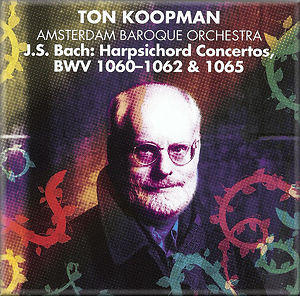
The re-issue packaging is not very exciting. It is part of the
Warner Maestro series, the covers of which emphasise their reissue
status by giving black and white images of the performers surrounded
by a frame of colourful patterns. The inside of the booklet
is a disappointment: Koopman’s original liner-notes ruthlessly
edited down to a few paragraphs are followed by some advertising
for other discs in the series. When it comes to reissue packaging,
you really do get what you pay for here. But when it comes to
the recordings themselves, you often get a bargain, and despite
a few provisos about the sound quality, I’d certainly
count this as one of them.
Gavin Dixon
|
|
|























