I have often wondered why the music of Vincent d’Indy has not
really made much impression on the repertoire, except that is
for the relatively well known ‘Symphonie sur un chant montagnard
français’. Concert-goers should not regard him as a 20th
Century, ‘modern’ composer but as firmly fixed in the late-Romantic
period. The ‘problem’ is that he outlived both Debussy and Ravel
and knew Messiaen. However, as this music testifies, although
he was not immune to the various ‘progressive’ developments of
his time, he remains firmly a Wagnerian as were Ernest Chausson
and César Franck (his teacher). D’Indy himself later became an
influential teacher.
This release is most welcome and Chandos are also
in the process of recording his orchestral works so it may be
that D’Indy’s day is upon us. You could however do no better than
to start here.
‘Wallenstein’
has been recorded several times before. In fact I have a 1975
version with Pierre Dervaux and the Orchestre Philharmonique
du Pays de Loire on EMI (CDM 7 63953 –
nla). This new version is superior both in the playing of the
Welsh Orchestra and in the recorded quality although Dervaux
takes the whole work at a brisker pace with a greater overall
architectural sense; also I prefer his couplings. Wallenstein,
despite its opus number was begun when D’Indy was still a student
but he took eleven years to bring it to fruition. It is in three
sections. Andrew Thomson in his otherwise exemplary notes calls
them, curiously, “Overtures”, surely they cannot really be played
separately!
The
first is the breezy ‘Wallenstein’s Camp’. The story is based
on Schiller’s poetic drama which is set in the 17th
Century. Wallenstein was the treacherous general of the Imperial
Hapsburg Army who is suspected of treason against Emperor Ferdinand
II. His own son is in love with Thekla who is also the daughter
of an officer who is plotting against him. Wagnerian leitmotifs
are to the fore and d’Indy ingeniously manipulates them especially
in the second movement which is a ternary form portrait of Thekla
and her lover Max. In the finale D’Indy writes of Wallenstein’s
Death in an incredibly sombre funereal opening - wonderfully
realized on this new recording. There’s a powerful middle section
and a despondent and reflective ending. The whole work shows
a maturity beyond the composer’s years but also stamps his personality,
at least at this time, as a Wagnerite. Here was a composer who
was particularly inspired by all things German, a situation
that would inevitably fall out of fashion.
The
other purely orchestral work on this CD is ‘Saugefleurie’ which
also has several Wagnerian characteristics. Based on a poem
by D’Indy’s very old friend Robert de Bonnières it has all of
ideal traits to make a symphonic poem, in which the characters
have their own motifs - very much in tune with its times. There
is a fairy, Saugefleurie (Ab major with sometimes delicate flute
and harps) who falls in love with a Prince (given a somewhat
heroic melody) but whose love can never be requited as she will
die once she has given herself to him. There is a hunting scene,
with terrific Siegfried-like horn passages and finally there
is the death of our heroine with a radiant coda. Yet, as Andrew
Thomson remarks “the music remains characteristically French
in its sonorous refinement and clear, luminous orchestration”.
Lawrence
Power has recorded, with much praise, for Hyperion before, for
example the Rubbra and Walton Viola Concertos (CDA 67587) and
those by York Bowen and Cecil Forsyth (CDA 67546), His tone
is rich and warm and wonderfully focused and is a real advert
for this often much misunderstood instrument. D’Indy’s Choral
Varié is a dark, processional-type work with two main melodic
ideas called in the detailed analytical booklet essay by Andrew
Thomson segments 1 and 2. They almost approach Gregorian chant
except that the first uses notes best placed in the whole-tone
scale. Talking of which although modality and minor tonality
are mainly employed there is an ‘Impressionist passage’ on woodwind
in the middle of the work. This shows that d’Indy, often seen
as opposed to Debussy et al and who does not often go in for
orchestral display, could be much influenced by him. On the
whole this is a very un-Debussian, sombre but fine and moving
work.
The
other work for viola and orchestra is ‘Lied’ which is an elegant
song in something like sonata form. The opening melody is in
Bb major and the second melody in G minor. This latter gains
some almost Ravel-like development in its gentle progress which
also incorporates along its path some felicitous orchestration.
This
kind of repertoire is meat and drink to Thierry Fischer who
has made a speciality in recent times of Frank Martin, Honegger
and even the early Romantics. He brings the best out of the
music. All in all this is an honourable and fine release and
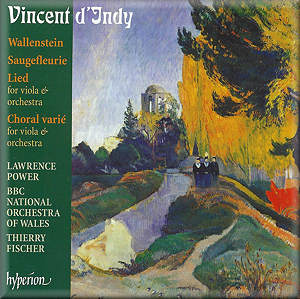
should be enjoyed by any music-lover. I’m not sure, just to
be a bit picky, if the picture on the cover by that highly original
and at times controversial artist Paul Gauguin (d.1903) is quite
suitable for d’Indy. Possibly Manet might have been a more adroit
match.
Gary Higginson

























 Lawrence Power (viola)

