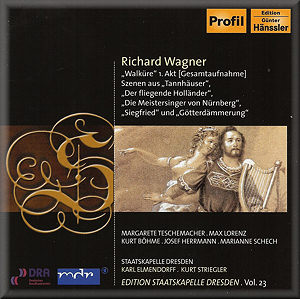
This issue is volume 23 with historic recordings by Staatskapelle
Dresden from the archives of the German Radio Reichsrundfunk.
The material from September 1944 was recorded on magnetic tape
at 77,2 cm/sec while the December session(s) obviously was/were
set down on shellac discs, maybe even on acetates. The difference
is astounding. The September sound is dynamic, catching the acoustics
of the Dresden Opera excellently. There is impressive clarity
with rasping brass, and glowing strings – and there is very little
background noise. Shortly after this session the opera house was
closed down. This was in the final phase of the war and there
had been sporadic bombings by the Allies for almost a year though
it wasn’t until February 1945 that more than 1100 British and
American bombers more or less obliterated vast areas of the city,
killing around 25,000 people. The December recording was carried
through in the Hygienemuseum and it seems that magnetic tape wasn’t
available. This means that the sound is far inferior – actually
sounding quite primitive set beside the September recording. It
is also unclear if more was recorded but hasn’t survived. The
scene with Daland and the Hollander is a substantial excerpt and
Hans Sachs’s Fliedermonolog is complete but why was only the beginning
of the Senta-Holländer duet recorded – unless of course no Senta
was available. Why was Max Lorenz, who no longer belonged to the
ensemble, brought in for a fragment lasting less than three minutes?
But we have to be
grateful for what actually was preserved and it is good
to have some of the best German singers of the period in what
were signature roles. To have Karl Elmendorff in a complete
act is another great thing. I don’t know exactly how much Wagner
he recorded. There was a Bayreuth Tristan from 1928 and
a Tannhäuser from 1930, both recorded in the empty Festspielhaus
and a live Götterdämmerung from 1942. The first two are
still available on Naxos. His handling of the stormy prelude
to Die Walküre is almost Toscaninian in its relentless
forward movement and the double basses growl ominously. But
he also catches the glow of Siegmund and Sieglinde’s love and
the final scene of the act is as ecstatic as one could wish.
Initially I was
less bowled over by the singing. Max Lorenz is strong voiced
and intense but also rather dry in tone and Margarete Teschemacher
is also lacklustre, though she sings some lovely pianissimo
phrases. Rarely, though, do we hear such superb enunciation
of the text as from these two. Especially Lorenz is so clear
that there is no need to follow a libretto – and there is none
enclosed anyway. When Hunding appears in scene 2 he is as formidable
as any singer of the part that I have heard – and I don’t forget
Frick, Greindl, Talvela, Moll or Salminen. Kurt Böhme, then
in his mid-30s, totally dominates the scene and his concluding
monologue Ich weiss ein wildes Geschlecht (CD 1 tr. 8)
is spine-chilling.
This thrill obviously
triggered the loving couple and when Hunding has gone to sleep
they are transformed. Lorenz shows his true mettle in Ein
Schwert verhiess mir der Vater (tr. 9) with steel-gleaming
Heldentenor tone and an intensity second to none – and he has
his moments of lyric restraint as well. In several respects
he reminds me of Set Svanholm, who at the time was his most
serious rival. Also Teschemacher lives up to her reputation
and finds a hitherto not heard lustre in Der Männer Sippe.
Indeed the dramatic temperature is near the boiling-point throughout
the scene. I have heard more intrinsically beautiful singing
of the roles but few so hot – and this was what Wagner aimed
at.
The recording should
be heard by anyone who believes that Wagner singing in Germany
was merely Sprechgesang, half-spoken declamation. Don’t expect
bel canto. This is in every respect a kind of singing we seldom
hear today – like it or not. Many modern singers could be taught
a lesson how to sing off the words. Pronouncing the consonants
is no hindrance to great singing.
On the second CD
we hear the fine baritone Josef Herrmann. He isn’t generously
represented on record, though he was Wanderer and Gunther on
Furtwängler’s live Ring from La Scala (1950) and there
is a disc with him on Preiser. As Wotan he is warm and rather
lyrical. It is a deeply felt inward reading of the long final
monologue. Though he may lack some of the monumental power of
Hotter this is still a considerable achievement. His Holländer
is again up against Hotter and he is in Wie aus der Ferne
even more vulnerable. He is also a marvellous Hans Sachs and
few have sung Den Vogel der heut’ sang more movingly.
The two fragments from Siegfried and Götterdämmerung
are, sonically even worse than the rest and they don’t make
much sense detached from the context. They are anyway further
evidence of Herrmann’s standing as a splendid Wagnerian. Kurt
Böhme is an authoritative Daland. Marianne Schech, relatively
early in her career, makes a good impression in the two arias
from Tannhäuser.
The richly illustrated
booklet gives a lot of valuable information on the recordings,
conductors, singers – though there is a bio on Hans Hopf who
isn’t singing anywhere – ‘Richard Wagner and Dresden’ and more.
To sum things up:
there is some truly excellent Wagner singing here, most of it
in surprisingly good sound.
Göran Forsling