Violetta Valery in La traviata was one of Callas’s greatest
roles and it is a thousand pities that she wasn’t granted a worthy
studio recording. She did record it in the early 1950s
for Italian Cetra but neither of the other leading singers was
very distinguished. Some years later EMI arranged for a recording
with their top trio Callas, Di Stefano and Gobbi and conductor
Tullio Serafin, but there was a hang-up: in Callas’s contract
with Cetra was stipulated that she wasn’t allowed to record the
work again for five years. EMI couldn’t wait and instead contracted
the young and upcoming Antonietta Stella. The resulting recording
wasn’t bad (see review)
but the missed opportunity of hearing Callas opposite singers
of the first rank was sadly missed. We are lucky, however, to
have her in some unofficial live recordings, a couple of them
later issued commercially by EMI. One was recorded at La Scala
in 1955, the year she was supposed to make the studio set. It
is conducted by Carlo Maria Giulini and Germont père and fils
are sung by Ettore Bastianini and Giuseppe Di Stefano. The other
was recorded in Lisbon in 1958, the same year that the present
Covent Garden recording was made, with veteran Franco Ghione conducting,
Alfredo Kraus and Mario Sereni in the other leading roles. Starry
casts in both cases. A review of a highlights disc from the Giulini
set is here.
The present set
suffers from unsophisticated recording, rather boomy and with
a fair amount of distortion. As with so many live recordings
the balance is variable, voices coming and going depending on
stage movements. The voices fare better, anyway, than the orchestra
which in the prelude seems to play forte from the outset. The
choruses, especially in act II scene 2, at Flora’s party, are
well sung with fine rhythmic lilt. Nicola Rescigno, who was
one of Callas’s favourite conductors, ensures a well paced performance.
At the time of recording he was in his early forties; he died
last August (2008) aged 92.
But it is neither
the orchestra nor the chorus, not even the conductor that will
tempt record buyers. It is first and foremost Callas. Even in
her earliest recordings she had her squally moments and by 1958
there was a marked deterioration in her voice. But that loosening
of vibrato, which at its worst could be a reason for the listener
to seek shelter, is noticeable only occasionally and what characterizes
her reading is the total identification with the role. From
the incipient infatuation in the first act scene with Alfredo,
crowned with a passionate Un di, felice, eterea, via
the wonder, indecisiveness and finally exultation of her great
solo in the same act, the fright, sorrow, despair and consolation
in the scene with Germont, to the last act’s weakness, temporary
hope and last blossoming before she dies, she hardly puts a
foot wrong. It is in a way a basically low-key performance,
pianissimo dominating, but such is the emotional strength and
inward intensity that in several instances, where there normally
are ovations, in this performance there is not a sound from
the audience and the performance can go on without the spell
being broken. Thus the whole long second act scene with Germont
is performed unbroken. This happens again after the meltingly
sung Parigi, o cara in the last act.
The Alfredo is a
further asset on this recording. Cesare Valletti was no doubt
the foremost tenore di grazia during the 1950s, having studied
privately with Tito Schipa. His recordings of Mozart, Rossini
and Donizetti are still models but he also recorded Traviata
for RCA with Monteux, opposite Carteri and Warren and, most
surprising, Pinkerton in Madama Butterfly opposite Anna
Moffo with Leinsdorf conducting. Alfredo is a hothead, at least
in the Flora scene when he denounces Violetta, but elsewhere
he is caring and deeply in love. In Un di, felice, eterea
he caresses every syllable with passionately trembling tone.
He is nuanced, elegant and noble – like Schipa. The lyric elegance
and sensitivity is also apparent in his act II aria. Bergonzi,
with a larger voice, and Alfredo Kraus with his lean slightly
reedy tone are both different from Valletti but they have the
elegance and stylishness in common. It goes without saying that
Valletti lacks the heroic heft for the outbreak on Ogni suo
aver tal femmina in the Flora scene, but Kraus is similarly
lacking. Both singers compensate with inner intensity. In the
remorse scene, after Germont has condemned his action, he is
perhaps too lachrymose – but it is on the other hand a scene
charged with emotion. Parigi, o cara finds Callas and
Valletti, two so different voices, blending exquisitely.
Mario Zanasi as
Germont père sings Pura siccome un angelo with admirable
legato but basically emerges as a rather foursquare character
as compared with Callas’s total commitment. It could be argued
that Germont is stiff and unremitting as a personality, at least
in the beginning of the scene. Eventually he warms to Callas’s
lovable singing of Dite alla giovine and in the following
duet almost matches her in nuance. On his own he sings a straightforward
Di Provenza il mare, where he ends both stanzas with
well judged pianissimos.
The supporting cast
is largely unexceptional, not all of them even credited in the
cast list and a couple of them having their names misspelt.
The booklet has a tracklist and an essay on the background and
coming into being of the opera. Standard cuts of the period
are observed, which doesn’t disturb me, since my first Traviata
was just as heavily cut. What is more disturbing are the frequent
drop-outs of sound. There are really no notes missing but as
soon as there is a short silence the rather boomy acoustics
are edited out and the effect is like a temporary loss of hearing
for a fraction of a second.
General opera lovers
who want a decent library recording of La traviata shouldn’t
bother. All Callas lovers, innumerable I believe, who haven’t
got one or both of the EMI sets should go for this and get a
splendid Alfredo in the bargain.
Göran Forsling
























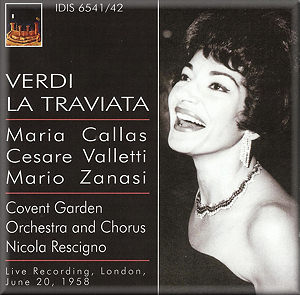

 Maria Callas
(soprano) – Violetta; Cesare Valletti (tenor) – Alfredo; Mario Zanasi
(baritone) – Germont; Maria Collier (soprano) – Flora; Lea Roberts
(soprano) – Annina; Dermot Troy (tenor) – Gastone; Forbes Robinson
(bass) – Douphol; Orchestra and Chorus of the Royal Opera House, Covent
Garden/Nicola Rescigno
Maria Callas
(soprano) – Violetta; Cesare Valletti (tenor) – Alfredo; Mario Zanasi
(baritone) – Germont; Maria Collier (soprano) – Flora; Lea Roberts
(soprano) – Annina; Dermot Troy (tenor) – Gastone; Forbes Robinson
(bass) – Douphol; Orchestra and Chorus of the Royal Opera House, Covent
Garden/Nicola Rescigno 
