Editorial Board
MusicWeb International
Founding Editor Rob Barnett Editor in Chief
John Quinn Contributing Editor Ralph Moore Webmaster
David Barker Postmaster
Jonathan Woolf MusicWeb Founder Len Mullenger
Dmitri
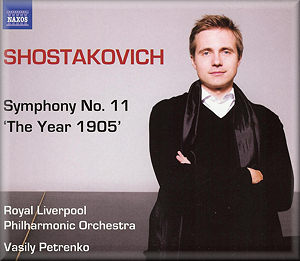
SHOSTAKOVICH (1906-1975)
Symphony No.11 in G minor, The Year 1905, op.103
(1956/1957) [57:37] Royal
Liverpool Philharmonic Orchestra/Vasily Petrenko
rec. Philharmonic Hall, Liverpool, 22-23 April 2008. DDD NAXOS 8.572082 [57:37]
Written
to commemorate the abortive 1905 revolution Shostakovich’s
11th Symphony,
like the 12th which commemorates the
1917 revolution, lacks the weight or distinction of musical
thought and logic which so characterizes the 10th and
13th Symphonies.
What we forget, I think, is that the composer is writing
in a popular idiom so as to reach as many people as he
can. There is nothing wrong in being popular – for too
long this has been seen as weak work and not a desire to
communicate. As he was writing with regard to important
events in Russian history I can well imagine that Shostakovich
wanted to reach as many members of the public as he could
with his music.
But
make no mistake – the 11th Symphony is
in no way an easy listen; you can’t sit back and bask in
the colourful orchestration and good tunes. Playing for
nearly an hour, in four big movements, which run together
and share material, some of them revolutionary songs, there
is something cinematic about the way the piece is constructed – but
this is because of the way Shostakovich cuts between ideas
and creates quite vivid visual images; indeed there is
one section in the second movement (at 10:58) which always
reminds me, for reasons I cannot explain, of the Odessa
Steps sequence from Eisenstein’s Battleship Potemkin – perhaps
Naxos could be persuaded to record Edmund Meisel’s fine
score for this film, for it warrants further hearings.
The
first movement – Palace Square – is the calm before
the storm. All is quiet, the music is restrained and delicate,
soft string chords, quite beautiful in themselves, are
interrupted by menacing fanfares from muted trumpets. There’s
a disturbed climax but the peace continues as if the insistent
brass calls didn’t exist. Fury is unleashed in The Ninth
of January, the date (old style, Julian calendar) is
significant for on that Sunday, subsequently known as Bloody
Sunday, the Orthodox Priest George Gapon led a workers’ procession
to the Winter Palace (the square of the first movement)
to deliver a petition to Tsar Nicholas II. However, the
troops guarding the Winter Palace opened fire on the crowd,
causing over 100 deaths. This is considered to be the start
of the revolution. Shostakovich depicts the slaughter with
music of vehemence, interspersed with reminiscences of
the music of the first movement but transformed into icy
sounds, long gone are the reassuring string sonorities.
Hence my feelings about the Odessa Steps sequence. This
is thrilling music and its forward momentum is irresistible.
The third movement – Eternal Memory – is an elegy
for the dead, deeply felt and with a passionate and yearning
climax. The final movement, for it doesn’t feel like a
finale in the conventional sense – The Tocsin (which
is a signal or alarm sounded on a
bell) – is a wild march, grotesque and misformed, the workers
rising, I presume. A slower section towards the end sings
of grief before the final onslaught of bells and workers
songs. It’s a very fine piece. And
this is a very fine performance. With the Liverpool Phil
on top form, responding to every one of Petrenko’s demands,
it is a resounding success. It is electrifying in the way
that a concert performance is – indeed, it’s hard to believe
that this was recorded over two days, so immediate is the
impact of the playing. The recording has an astonishingly
huge wide dynamic range, the opening chords are so quiet
that are, when played at a normal volume setting, almost
inaudible. Turn the colume control up and the recording
is as clear and bright as one could wish for. Every department
of the orchestra is exceptionally well balanced, not an
easy job in some of the fuller parts - and there are some
very full tuttis - and, best of all, at the very end where
the bells describe major and minor thirds in G the clangour
is left to reverberate after the music has ended – absolutely
thrilling. Whatever you do don’t be without Stokowski’s
quite magnificent 1958 recording with the Houston Symphony
Orchestra (EMI 6520622)
and don’t be without this new
release – I couldn’t be without either! This is an essential
disk for all collections.
Bob Briggs
Please support our advertisers below by clicking on the logos for further information.

























 Royal
Liverpool Philharmonic Orchestra/Vasily Petrenko
Royal
Liverpool Philharmonic Orchestra/Vasily Petrenko 
