The Juilliard Quartet, like the late American comedian Rodney
Dangerfield, "gets no respect." The ensemble seems
rarely to turn up on anyone's short-list of favourite quartets;
even reviews that acknowledge the quartet's top-drawer status
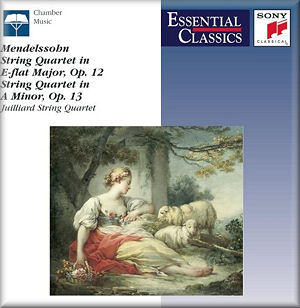
can still sound tepid. This coupling of two early Mendelssohn
quartets - their chronology apparently as muddled as that of the
composer's symphonies - set me to thinking about this curious
state of affairs.
Not only are the Juilliard's best performances marked by an essential
"rightness" - giving the impression that we're hearing
the score more or less unmediated, though that can't really
be the case - but the players execute their interpretations
with a remarkable unanimity. You may be thinking that all performers
should have such problems - this is, after all, what most musicians
strive for: as the expression goes, it's the art that conceals
art. Precisely as such, it's difficult to describe intelligently.
It's easier for the critic to pay lip service to the quality
of performance, and then to enumerate perceived shortcomings
of tone, intonation, and such - thus leaving a negative impression!
The A minor quartet's Adagio non lento illustrates the situation
nicely. The grave, lyrical chorale that starts things off suggests
a conventional slow movement, but Mendelssohn feints with a
brief fugato at 1:16,
establishing what turns out to be the movement's principal motif
before erupting into more conventional development at 2:43. The Juilliard players make sure that motif stays clear and forward;
yet there's also a strong sense of the harmonies produced by
the combined lines, so the listener also feels the weight and
direction of the chordal progressions. To prepare this effect
obviously took a great deal of care, yet the result sounds utterly
natural. And, in case you're curious, the composer does bring
back the chorale to round out the movement - he never leaves
messes.
A similar balancing of melodic and harmonic factors - or, if you like,
the horizontal and vertical - allows the composer to combine
scherzando and lyrical elements in the same movement,
and thus to get by without a full-fledged scherzo in
either quartet. The E-flat's second movement, a Canzonetta,
is at once weighted and gracious, maintaining that grace into
the scurrying Trio section. The third-movement Intermezzo
of the A minor moves a bit faster, but here the solid underpinning
of pizzicatos makes for a haunting tone à la Beethoven's
Seventh. Other expressive highlights include the full-throated
chords at the start of the A minor, which sing with tremendous
gravitas, and the quasi-operatic drama of the E-flat's finale,
where the players find scope for shade and shaping even in the
flatfooted second theme.
The Juilliard's tone quality here is rich and unified, but there is
the occasional intonation problem. A few octaves - always difficult
with solo strings - in the E-flat's Andante espressivo
aren't quite dead in tunes, but that moment passes quickly.
More conspicuously, I'd not swear that the tuning is accurate
in the turbulent figures of the A minor's first-movement development,
which seems to go every which way; fortunately, there's sufficient
dramatic impulse and forward motion to carry the listener over
the rough spots.
Were I to have heard performances of this quality and insight, at,
say, Alice Tully Hall, I'd have considered my evening well-spent.
How much better, then, to be able to enjoy them any time at
home!
Stephen
Francis Vasta


























 [55:24]
