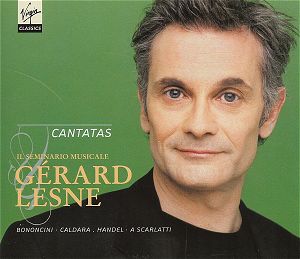
The cantata is one of the most important musical genres of the
baroque period. In particular in the early 18th century the chamber
cantata was very popular, and large numbers of such works were
composed, especially in Italy. These pieces were closely connected
to the opera. The subject-matter of many cantatas was the same
as that of the opera and both consisted of a sequence of recitatives
and (da capo) arias. But as cantatas were performed in private
homes they are more intimate in character. Gérard Lesne, who once
declared himself more or less unsuitable for opera, is one of
the strongest advocates of the chamber cantata.
This
set contains five discs, four of which have already been reissued
as a set about 10 years ago. The fact that they are reissued
once again suggests the record company thinks there is a market
for these recordings. When they were first released some of
the composers represented here were not very well known. Handel
is the exception but Caldara and Bononcini were almost unknown
quantities. Alessandro Scarlatti was a bit better known, but
not for his cantatas. Since that time much has changed, and
today Scarlatti's music is regularly performed and recorded,
including his chamber cantatas, and Caldara has also become
a household name. Bononcini is the least-known of them, and
his large output still waits rediscovery.
The
first disc is devoted to French cantatas, and that is certainly
a part of the repertoire which deserves to be better known.
It was only in the first decades of the 18th century that French
composers started to write chamber cantatas. At that time the
influence of Lully and his followers as well as Louis XIV, who
were staunch defenders of the French style, was waning. As a
result the influence of the Italian taste was growing, and with
it Italian musical forms like the trio sonata and the cantata.
Interestingly the disc begins with a 'Plainte', a typical French
genre of compositions written to commemorate a certain personality
from public life. The fact that this Plainte was written in
honour of Michel Lambert is symbolic: he was the main representative
of the old French 'air de cour', which can be seen as the predecessor
of the chamber cantata. When Lambert died in 1698 the genre
of the 'air de cour' died with him, and the chamber cantata
emerged. Clérambault was one of the main composers of cantatas,
and here he merges Italian and French influences. The other
composers on this disc did the same in various ways. Bernier
even studied in Rome with Caldara, and with Jean-Baptiste Stuck
we have a real Italian composer (of German descent) who entered
the service of Philip II, Count of Orléans and nephew of Louis
XIV.
Alessandro
Scarlatti is one of the most prolific composers of cantatas.
Around 600 of them have been preserved, mostly for solo voice
and bc. It is nice that in Il Seminario Musicale's recording
we get two solo cantatas but no less than four cantatas for
two voices, soprano and alto. It is here, with the interaction
between the two singers, that we come most close to opera. Scarlatti
played an important role in the development of the style of
the chamber cantata. The subject matter is mostly of a pastoral
character, and we meet here characters which also show up in
cantatas by contemporaries and later generations, both in France
and in Italy.
Antonio
Caldara worked first in Rome, then at the imperial court in
Vienna. Here he wrote many oratorios, which is the genre he
is mainly known for today. But while in Rome he wrote many operas
which are still largely undiscovered. His output in the genre
of the chamber cantata is limited, but of excellent quality.
We get some fine specimen of his art here, in particular 'Medea
in Corinto' and 'Vicino a un rivoletto'.
Bononcini,
on the other hand, wrote a large number of cantatas, as well
as music in most other genres of his time. He was universally
praised for the sweetness of his melodies, the originality of
his harmonies and his ability to translate texts into music.
That is certainly proved by the cantatas on this disc, of which
'Siedi, Amarilli mia' is one of the finest.
Bononcini
worked in several cities in Europe, and for some time also in
London, where he was the main rival of Handel as far as the
opera was concerned. Handel also wrote many cantatas; most of
them date from the time he stayed in Italy, although he continued
to write Italian cantatas after his arrival in London. As Handel's
operas belong to the standard repertoire it is easy to see the
similarity between them and the cantatas. That is particularly
the case with La Lucrezia which was performed in one of the
residences of Prince Ruspoli. It is a dramatization of Lucretia's
torment and suicide. It ends with a scene, which consists of
a short aria, an arioso, a recitative and a 'furioso'.
Gérard
Lesne may not feel really at home in operas, there is nothing
wrong with his sense of drama. He very well knows how to express
the emotions which composers translated into music. Handel's
La Lucrezia is a good example, and Lesne uses his chest register
to good effect here. Other examples of his theatrical approach
are Caldara's 'Vicino a un rivoletto' and Clérambault's 'Pirame
et Tisbé'. The ensemble is very responsive to his interpretations
and there are some nice instrumental intermezzo's. Lesne has
always surrounded himself with first-class musicians, and so
in these recordings we find people like the violinist Fabio
Biondi, the cellist Bruno Cocset, the lutist Pascal Monteilhet
and harpsichordists Pierre Hantaï and Blandine Rannou.
These
recordings may date from at least 12 years ago they still sound
fresh and up-to-date which is a great compliment to Gérard Lesne
and his ensemble. For everyone interested in this kind of repertoire
this is a set not to be missed.
Johan van Veen