Two years ago Decca reissued their Anna Bolena from 1987,
conducted by Richard Bonynge. It had his wife Joan Sutherland
in the title role (see
review). I had a lot of positive things to say about the performance
but the real weakness – and a serious one at that – was Ms Sutherland’s
assumption of Anne Boleyn. She recorded the role late in her career
when she was past sixty and the voice had deteriorated. The beat,
that had started to creep in as early as the mid-1970s, had developed
into something close to a wobble. She had to work hard to produce
a legato line and the reading felt bland. All of this was a sad
state of affairs since so much else was first class. At the time
I hadn’t heard the Sills recording although I was very familiar
with her capacity and had admired her since the early 1970s in
other roles. Instinctively I felt that with her in the title role
the Decca set would have been unbeatable. As things stood I recommended
readers to get the Decca anyway but keep Maria Callas’s recording
of the mad scene available for a truer reading of the role. There
is a live recording of Anna Bolena with Callas but that
studio recording, 20 minutes long, will never be redundant, however
many other versions there will be.
With the arrival
of the Brilliant Classics’ budget price issue of the Rudel/Sills
recording the situation changes radically. The sound may not
be quite in the Decca class but is fully worthy of the performance.
The LSO play with accustomed expertise. The John Alldis Choir,
who have graced so many opera sets, are in excellent form
– so important in this opera, where the chorus is almost as
essential as the soloists. Julius Rudel’s conducting is in
no way second best to Bonynge’s. Timings show that he is often
marginally slower than Bonynge but there is no sense of dragging
and the rhythmic spring adds life to the reading. Just lend
an ear to the powerful opening sinfonia.
Of the soloists
Paul Plishka as Enrico VIII is a towering presence, dramatically
convincing. He can’t quite compete with Bonynge’s Samuel Ramey,
who is an even more formidable king with a classier voice.
His reading lays claim to be his best recording. On the other
hand Robert Lloyd’s Lord Rochefort is far preferable to Bonynge’s
Giorgio Surian, good though he is at infusing life into his
character. Ernesto Gavazzi is an excellent Hervey for Bonynge
but Robert Tear is in the same class. Lord Percy is a role
that requires a bel canto tenor with some sap in the
forte. I am full of admiration for Bonynge’s Jerry Hadley
who has the necessary honeyed tone as well as the ringing
top notes. In his last act cabaletta he presses his voice
beyond its natural limits, which Stuart Burrows avoids. His
is also an agreeable voice, pliant and well equalized. He
is on a par with Hadley in most respects, though his approach
is somewhat cooler. In the reprise of the just mentioned cabaletta,
Nel veder la tua costanza, he resorts to some falsetto,
but it is tastefully done and it is quite possible that this
was still common practice in 1830.
Patricia Kern
is an excellent Smeton and her song with harp in the first
scene is executed with elegance and fine tone as is the recitative
and aria in scene 3. Bernadette Manca di Nissa
for Bonynge is just as good.
I was deeply impressed
by Susanne Mentzer’s Giovanna on the Bonynge set and wrote
that she ‘almost steals the whole show’. That is also true
of Rudel’s Shirley Verrett. From 1957 and well into the 1990s
she was one of the world’s leading mezzo-sopranos – and she
also ventured into the soprano Fach. In 1972 she was
at the height of her powers. She is at her most dramatically
expressive in Per questa fiamma (CD 3 tr. 6) and Ah!
pensate che rivolti (CD 3 tr. 8) offers glorious singing
of a kind that is very hard to surpass. In the opera house
that must have been a showstopper.
And so to the
crucial title role. Does Beverly Sills live up to the expectations?
Indeed she does. From her first entrance early in act I it’s
clear that here is an artist with a full grip on the proceedings.
Her voice is crystal clear and has considerable warmth – which
sometimes has been missing from her armoury. Her incisiveness
with words comes as no surprise, her technical accomplishment
likewise. There is often a disarming simplicity and youthfulness
in her singing. Listen to Non v’ha sguardo (CD 1 tr.
7). The scenes with Percy and Enrico are natural highlights
and the long final mad scene (CD 3 tr. 13-17) is both deeply
moving and – in the fearless reading of the concluding cabaletta
– technically spectacular.
A libretto is
available as indicated in the header but it is in Italian
without translations.
Apart from the
less than attractive reading of the title role the Decca set
is still an impressive achievement but with a similarly accomplished
supporting cast and two highly charged queens the Rudel set
becomes first choice.
Göran Forsling

























 Beverly Sills (soprano) – Anna Bolena; Paul Plishka (bass) – Enrico
VIII; Shirley Verrett (mezzo) – Giovanna Seymour; Robert Lloyd (bass)
– Lord Rochefort; Stuart Burrows (tenor) – Lord Percy; Patricia Kern
(mezzo) – Smeton; Robert Tear (tenor) – Hervey; John Alldis Choir;
London Symphony Orchestra/Julius Rudel
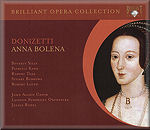
Beverly Sills (soprano) – Anna Bolena; Paul Plishka (bass) – Enrico
VIII; Shirley Verrett (mezzo) – Giovanna Seymour; Robert Lloyd (bass)
– Lord Rochefort; Stuart Burrows (tenor) – Lord Percy; Patricia Kern
(mezzo) – Smeton; Robert Tear (tenor) – Hervey; John Alldis Choir;
London Symphony Orchestra/Julius Rudel
